WHILE the federal interior minister’s comments in the National Assembly on Monday confirmed that peace talks with the TTP have been put on ice, the reason he cited — American drone strikes — for “sabotaging” the process is difficult to buy. After all, as Chaudhry Nisar Ali Khan himself pointed out in his speech, while the government is pushing for dialogue, the militants aren’t exactly bending over backwards to make peace with the state. The fact is that the TTP is simply not interested in talking to the government. If there was any chance of the militants softening their rigid stance before Hakeemullah Mehsud’s death in a drone strike earlier this month, the appointment of Fazlullah as the TTP’s new supremo has caused all such hopes to evaporate: the militants have, once again, declared war on the Pakistan government and military.
The state should know better than to pin the blame for the breakdown of talks on the American drone strikes. There is no doubt that these strikes violate Pakistan’s sovereignty and should not occur unless Islamabad is on board. But, at the same time, there is near universal consensus in the country that Mehsud’s elimination was a positive development. After all, this was a man who led a band of ruthless militants who continue to terrorise the entire nation; civilians, men in uniform and government officials were targeted with equal ferocity on his watch.
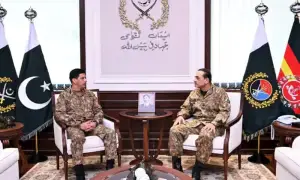
True, talks with the militants have slim chances of succeeding given the Taliban’s stance; but, in keeping with the endorsement of the major political parties, the state should still make efforts to engage the TTP. However, it must be the one to lay down the terms of engagement and draw the red lines. All stakeholders must be clear about what the contours of any peace agreement will be and what is not open for debate, ie democracy and the supremacy of the Constitution. In this regard, the prime minister discussed the security situation during his visit to GHQ on Tuesday — his first after taking office. The state must realise that if the militants do not accept its terms for dialogue, preparations should begin for a security operation. There are just two alternatives at this juncture: either the government should proceed with taking the talks forward from a position of strength, or move in to neutralise the militant threat. There can be no sitting on the fence.