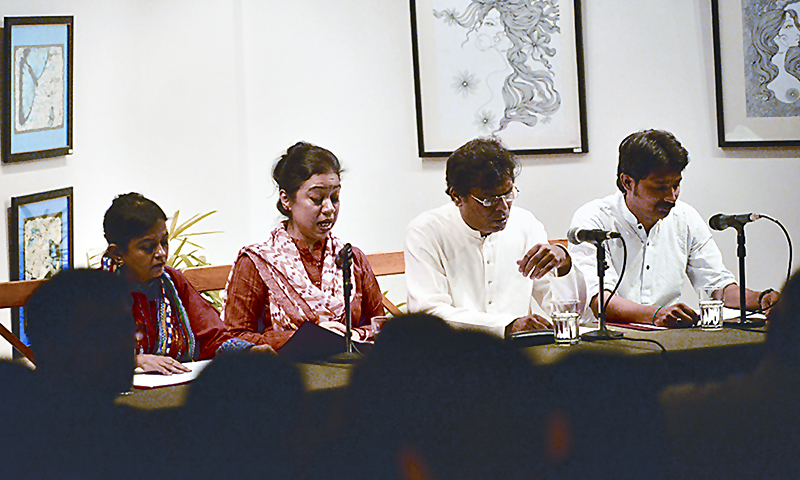
KARACHI: Celebrated writer Sadat Hasan Manto was known for his hard-hitting, no-holds-barred short stories. Not many literary critics think he was a playwright of high merit. The fact is that his plays were just as incisive and meaningful as his short pieces. Zambeel Dramatic Reading presented four of Manto’s plays that he wrote for the radio at T2F on Saturday evening.
The group had presented three out of the four earlier in a session titled Aao Manto Sunein and added one more to their repertoire.
Ostensibly, the plays were written as comedies with four principal characters, a married couple, Kishore and Lajwanti, and Kishore’s friend, Narain, and his wife. The playlets offer nuggets from their daily lives primarily based on the bantering between Kishore and Lajwanti. The first play that Zambeel’s team read out was ‘Aao Chori Karein’. It cleverly puts forward the petty issues that lead to pettier foibles, familiarizing the audience with the husband-wife pair’s eccentricities. All the characters try and hide their real selves but the dialogue between them unravels their weaknesses layer by layer.
‘Aao Kahani Likhein’ upped the tempo of the performance as it very astutely told a story by letting the characters indulge in the process of storytelling. The tit-for-tat exchange of lines between Kishore and Lajwanti, later joined in by the Narain, was a good to listen to, as during the process of collective story writing they bring up issues that directly relate to their private lives.
Perhaps the most perceptive of the plays was ‘Aao Taash Khailein’ in which Lajwanti makes an effort to get her husband play a game of cards with her. He is reluctant. Narain’s entry makes things interesting because he wants to show a card trick to Lajwanti.
The last play was ‘Aao Baat Tau Suno’ proved to be the right choice for it provided the climactic ending to the whole event. Kishore is bombarded with a list of to-get things by his wife, followed by a similar demand from his father and friend’s wife.
The four performers Ehteshamuddin (Kishore), Mahvash Faruqi (Lajwanti), Meesam Naqvi (Narain) and Narain’s wife (Asma Mundrawala) tried their best to keep true to the text. Ehtesham’s performance in the last piece was noteworthy as he jibber- jabbered his way to the end after being overburdened with the wish-lists given to him by friends and family. It needs to be mentioned here that Manto’s writings are not as linear as they come across.
There are psychological connotations that his readers often miss out on. For example, Aao Taash Khailein is not a simple tale of fun-seeking individuals. It’s the study of boredom, a subject which was famous among the 1940s writers and philosophers of Europe.
If one carefully studies the characters of Kishore and Lajwanti, one can easily understand the couple is not an ideal one.
There’s more to their lives than told through their dialogic exchange. Kishore has an unresolved issue and Lajwanti can’t talk about it.