10
10


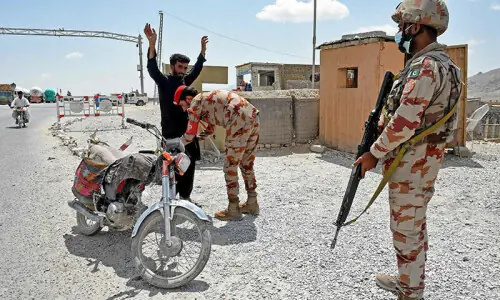
THE seemingly stop-start Karachi operation is to be expedited and its scope expanded to include the rest of Sindh as well.
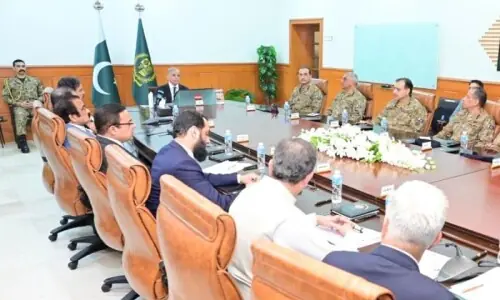
This was, broadly speaking, the outcome of the Sindh Apex Committee meeting on Wednesday which was called by the chief minister in the wake of the murder of two military police personnel the day before in Karachi. In a briefing to the media after the meeting, a number of practical measures to that end were spelled out.
These include setting up 30 more Anti Terrorism Courts, appointing 200 prosecutors and an equal number of investigators to ensure that over 7,000 cases of terrorism could be effectively processed.
Also read: Operation to be extended to interior of Sindh
The committee also decided that 8,000 police personnel would be recruited to meet the demands of an expanded operation.
Notwithstanding the fact that the operation, now in its third year, has appreciably brought down the level of violence that had become endemic to Karachi, the manner in which it has been conducted is far from transparent.
Some of the measures taken have not only raised troubling questions about its real objectives, vis-à-vis the civilian political establishment in particular, but have pushed the limits of what is legally permissible — even if one must concede that terrorism in a sprawling city like Karachi is a complex, multidimensional issue.
The recent murders of six law-enforcement personnel indicate there are criminal hideouts in this urban jungle that remain to be flushed out. The statement about expanding the operation elsewhere in Sindh therefore appears all the more incomprehensible at this point, and the public is owed a more substantial rationale for it than the vague assertion that criminals and terrorists are on the run from Karachi.
Casting the dragnet wider against out-of-favour politicians/political parties may tamp down violence for now but it is not a viable long-term strategy.
The apex committee has spoken with more clarity where proposals to strengthen the mechanism for processing terrorism cases are concerned.
Over the last two years, the operation has led to a 50pc increase in the city’s prison population, and the 11 ATCs in Karachi are clearly not sufficient to address the consequently heavier workload.
The argument constantly made in favour of the highly opaque and hence deeply problematic military courts is that the ATCs have proved unequal to the task. But it is not only a problem of overburdened courts or a prosecution service spread too thin.
Two lawyers engaged by the government to prosecute the Safoora Goth bus carnage case resigned in October because they were given neither the requisite security nor adequate compensation for fighting a case of this nature.
The provincial government, even in its presently compromised state, must demonstrate that it is an equal partner in the war against terrorism. That is the only way to take back some of the space it has ceded to non-civilian forces.
Published in Dawn, December 4th, 2015