SAADAT Hasan Manto is a unique character in Urdu fiction. The word ‘character’ should not be confused with the word ‘writer’. Yes, he is arguably the greatest short story writer as far as Urdu literature is concerned, but what has metamorphosed him into a ‘character’ from a creative individual is the almost mythical status that he has assumed in Urdu fiction. Instead of merely reading his stories as works of literature produced by an extraordinary writer, critics and analysts have also been puzzled by his alcoholism, his quirkiness despite a financially challenged status and his unwillingness to accept Partition as a tangible reality.
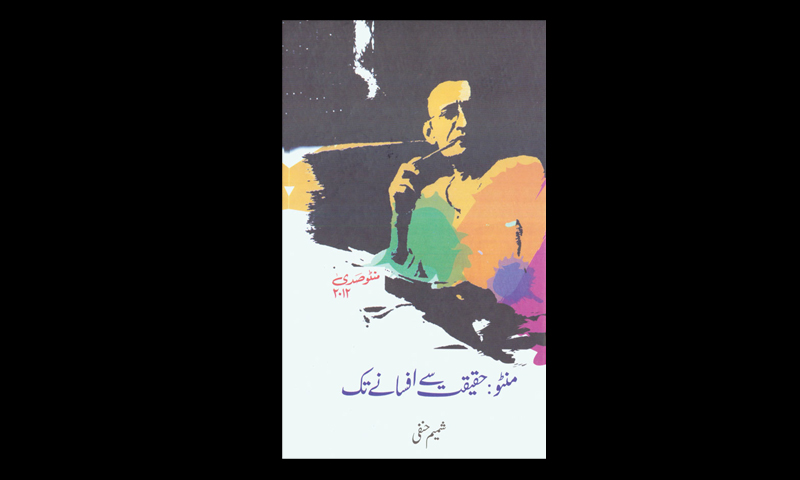
Eminent critic Shamim Hanafi’s Manto: Haqeeqat Se Afsaane Tak is not just a collection of essays and lectures that would interest Manto’s admirers, but will also attract readers of Urdu literature, and art buffs. In Manto’s defence and to elucidate some important issues, a few of Manto’s own prose pieces have been included in the book.
Hanafi grips the reader in the first chapter by dealing with the issue so inextricably associated with Manto: the problematic nature of the writer as a permanent feature of his personality (“Manto ki haisiyat aik aisey masale ki hai jo daem aur mustaqil hai”). Hanafi takes on Manto’s detractors head-on and intelligently; some have labelled him ‘a case history’, some try and unravel him by employing psychoanalytical theories and some simply seek pleasure in his writings. He believes Manto to belong to that rare breed of writers for whom life and fiction don’t have a singular literal meaning or linear direction. This is where he develops the argument further and appreciates the innate humanism that exists in Manto’s stories. Hanafi asserts that the writer presents the actions and reactions of even the ‘worst’ of his characters in order to shed light on a certain important aspect of life, and not something from which pleasure or a feeling of disgust could be elicited. This is the right approach to judge Manto. Sorry, the word judge should not be used at all and must be replaced by analyse. For who can judge Franz Kafka or Milan Kundera for what they’ve written? You can only analyse their works using literary tools. And at times all you need to do is enjoy their word wizardry.
This is the argument that Hanafi posits. He quotes a passage from James Joyce’s Ulysses where Molly Bloom indulges in a sonorous monologue. He then brings Manto into the equation and claims that at times Manto employs language in such a way that his words turn into cinders (angaarey). Even if you feel Hanafi is a bit overboard in his praise of Manto, you do understand the gist of his argument. For him Manto uses language not just to convey a story but also to justifiably enhance its effect.
Once Hanafi establishes the pedestal on which he wants Manto to be permanently placed, he takes on writers who have written on Manto. But what really impressed this reviewer while thumbing through Manto: Haqeeqat Se Afsaane Tak is the subtlety with which Hanafi writes about Manto’s influence on another genre of art — he dedicates a whole chapter to the celebrated Indian painter Ramachandran and his drawings based on Manto’s stories. In the follow-up part, the reader can view images of some of the drawings to understand Hanafi’s arguments.
The drawings, inspired by the writer’s short stories ‘Thanda Gosht’, ‘Ooper Neechey Darmayan’ and ‘Dhuan’, are brilliant illustrations of how works of literature can be interpreted in multiple ways without diluting their essence. Ramachandran’s drawings, as Hanafi argues, do not paint Manto’s stories with literality. They have, in a manner of speaking, a surrealistic, somewhat oneiric touch to them which justifies Manto’s way of looking at issues. His tales, as his characters, are not one-dimensional, which is why he surprises you every time you read him.
Like a work of fiction reaching its climax after a plausible course of argument and counter-argument, Hanafi at the end of the book, discusses the bifurcation between Manto’s Partition and pre-Partition stories and points out how pieces like ‘Khol Do’, ‘Kaali Shalwar’ and ‘Siah Hashyey’ are not merely about Partition, its traumatic effects and the bloodletting that it caused. They are also about human beings. And that is where humanism in Manto’s stories must also be looked for, if not looked at.
The one thing that the book could have done away with is the inclusion of Manto’s own writings (in his defence). There was no need for it as Hanafi’s thesis, antithesis and synthesis were sufficient to do the job.
The reviewer is a Dawn staffer
Manto: Haqeeqat Se Afsaane Tak By Shamim Hanafi Scheherzade, Karachi ISBN 9789695680889 294pp.