Voices of dissent
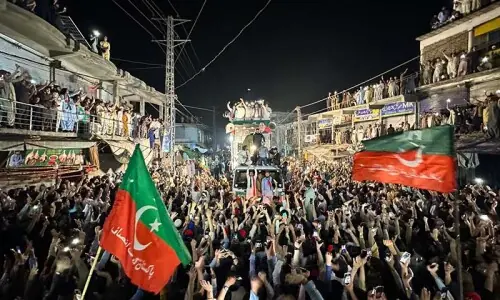
IRRESPECTIVE of the scepticism people feel towards Benazir Bhutto — more so because of the power-sharing deal she concluded with President Musharraf under the NRO — it cannot be denied that she has the power to galvanise people to come out on to the streets. How Ms Bhutto responds to the Punjab government’s ban on her Rawalpindi rally on Nov 9 will be a good indicator of her commitment to the ‘restoration of democracy’. Ms Bhutto is right when she says that for pressure to mount on the government, people have to come out on the streets in large droves. That has largely been missing since the emergency was imposed, and that is sadly due to the vacuum in leadership. Right up to the 1980s, political parties managed to mobilise mass movements. But the military’s constant meddling in politics, accompanied with concerted efforts to destroy the political parties’ infrastructure as well as other effective mechanisms of mobilisation, such as trade and student unions, only led to the depoliticisation of society. Today the common man, who provides the mass following to any party, is too focused on his survival as he struggles to make ends meet. It is a failure of the political parties that there is a disconnect between them and their voters. Mobilising people to come out on the streets to protest is thus a much bigger challenge.
In the light of this, those pockets of resistance, notably the lawyers, must be commended for their courageous stand during these difficult times when they are the target of the government’s anger. But it must also be admitted that there is strength in numbers, which is still lacking. However, a beginning has to be made somewhere. We have seen this with the mass anti-war movements in the West where tens of thousands of people have responded to calls by different groups working for one purpose. The realms of possibilities are endless. They require hope and concerted effort, which despite appearances, are still around. It can be found in a new generation of conscientious members of civil society who are converging and discussing non-traditional forms of peaceful protest and creating awareness. Theirs is a collective voice that can start a much needed movement for change recognising humanitarian values. What, however, needs to be understood is that this process is a long drawn out one and no change occurs overnight.
The response of these sections of society should stress on the government that quashing peaceful forms of dissent serves no purpose. It only adds to the frustration of protestors and encourages them to become violent. It is for this reason that we believe that the emergency is counter-productive and must be lifted right away. The Constitution must be revived, the superior courts restored and an election date announced so that the country is put back on the road to democracy. By the same token, the ban on public meetings must be lifted immediately.
No trace of progress
A REPORT by the Asian Development Bank on Pakistan’s socio-economic status belies the claims of progress that the government often makes in connection with health, education and other human development indicators. What is equally depressing is that the country appears to be doing worse than many others in the region, including Bangladesh, India and Sri Lanka where statistics for school enrolment, adult literacy and infant and child mortality show that they are better off than Pakistan in these areas. Progress on the UN’s Millennium Development Goals has also been unsatisfactory, and hopes of achieving even one remains a distant dream. Take, for instance, the goal of ensuring universal primary education by 2015. With one of the worst primary school dropout rates in the world, by some estimates almost 50 per cent, any progress on enrolling more children is offset by the departure of a number of them midway through primary schooling. In other areas such as maternal, infant and child mortality, improvement in conditions has been marginal over the years and witnessed mainly in the urban areas which have disproportionately greater access to public services than the rural population that makes up the majority.
Unfortunately, the government has not shown the needed political will to bring about a positive change — not even with the implementation of the devolution scheme that was supposed to bring the government closer to the people. Governance, as pointed out by the ADB, is riddled with corruption and inefficiency. Inaugurated in style, projects — whether in health, water or education — are often delayed in their execution, fail to meet their target or prove unsustainable because of bad planning. Instead of bringing relief to the people, they end up being half-baked attempts at improving social services. But the indifferent attitude of the government is not the only drawback. A largely silent public is reluctant to take a joint stand on a whole host of common grievances. Both India and Bangladesh are lucky to have vibrant civil societies that do not shy away from pressing their case for better services or protesting against injustices. The consequent pressure on their governments has forced the latter to be more responsive to their needs. It is this kind of public mobilisation that is needed across Pakistan if the country is to see progress in crucial sectors. Without it, there will be no change in the system and no end to corruption and poor governance.
A matter of ‘routine’
THOUGH no patch on the breakdown of the political power structure in the country, the power breakdowns that are once again affecting Karachi are not far behind in terms of their negative impact. If the public reaction is not as violent as it was last summer, it is to be attributed to the weather that is milder these days than it was some months ago. Adding insult to injury are the official explanations that emanate from the offices of the KESC from time to time. Only the other day, a KESC spokesman, while reacting to a wave of outages that lasted for about 10 hours across the metropolis, remarked that there was nothing but ‘routine faults’ behind them all. If a 10-hour, widespread breakdown is a ‘routine’ matter for the power utility, there can be little hope for what lies next.
The fragile power generation network has for long been vulnerable to the slightest external tremor or internal abuse. Be it service to domestic consumers, transmission to industry, maintenance of transformers and power lines or efforts to control power losses, the low standards set by the KESC leave a lot to be desired. This is quite apart from the growing gap between demand and supply. Against this backdrop, the recent assertions by Water and Power Minister Liaquat Ali Jatoi that the country would have as much as 2,000MW of surplus electricity will be viewed with cautious interest. Other officials have been talking of 1,500MW of additional power for Karachi alone by 2011. Even if they are taken at their face value as sincere plans, and not pompous boasts to earn short-term mileage, someone has yet to talk about what the utility plans to do in the intervening years. Perhaps it is time the KESC gave some explanations.
Higher growth, higher inflation
“PAKISTAN’S economy recorded one of the fastest growth rates in Asia during fiscal year 2006-07. The real GDP growth accelerated to seven per cent that was surpassed only by China and India”. That is how the annual report of the State Bank of Pakistan begins. But thereafter the perceptions vary and the fears differ.
The State Bank itself had grave fears of higher inflation after the food inflation reached its peak last year but this time the sources of inflation are more likely to be external particularly in the oil sector where the price of oil is heading towards 100 dollars a barrel. If such a development comes to pass, the domestic POL price may rise by ten rupees per litre and the power rates will go up much higher.
Added to that will be the steady erosion of the exchange rate of the rupee which, according to experts, is very low but according to the ministry of commerce it is substantially high and a marked devaluation is essential. The suggestion has been firmly turned down by the governor of the State Bank of Pakistan Dr Shamshad Akhtar who finds the present system of adjusting to the market demand quite satisfactory and if necessary the rupee can be pushed down.
Pressure for devaluation of the rupee is being raised at a time when the IMF chief Rodrigo Rato says the dollar faces abrupt pressures and cannot be relied upon as a reserve currency.
The other problems Pakistan faces this year are the rising debts, external deficits, slow growth in exports, threats to external foreign investment from the rising violence and several other factors which the State Bank puts very mildly.
The oil import bill contributed to a rise in deficit of 5.3 per cent in the first quarter of this year against the first quarter of last year. And the Opec countries are moving towards pricing their oil through a basket of currencies which can create uncertainties and problems for consumers in Pakistan.
The movement of the Opec countries is being watched very carefully by the oil consuming countries.
Simultaneously the Gulf Cooperation Council is making efforts to have a common currency and the time schedule for drafting the framework has been put off by six months.
These are significant developments for the international oil consumers, while Dr Rato says the Opec countries are entitled to a price rise for their oil proportionate to the loss they suffered due to the shrinking of the exchange rate of the dollar. The dollar has hit its lowest against the euro and is not likely to recover lost ground soon because of the lasting credit crisis in the West.
Meanwhile, gold has hit its highest mark against the dollar and has touched Rs15,130 for 10 grams. While those with the dollar are converting part of their reserves into gold, those with expensive gold jewellery are converting it into diamonds as it poses less security hazard. Thieves are attracted more to gold than to diamonds.
Although euro has become stronger, our dispute with the European Union with regard to fish exports remains unsolved, resulting in a loss of 90 million dollars a year in fish exports.
Meanwhile, foreign direct investment declined by 10.6 per cent this quarter compared to the preceding quarter. That may not really mark a decline in foreign investors’ interest, but what is more disturbing is the rise in violence and bomb blasts in the country. On the day India’s Sensex crossed 20,000 points, the Karachi Stock Exchange index dropped by 400 points following an explosion in Rawalpindi. The massive violence discourages foreign investment particularly portfolio investment.
The State Bank says the higher economic growth has been achieved because of positive investment which has been low in Pakistan as against the GDP. Now the situation has improved remarkably, and should not be reversed. What matters is not the breezy optimism of the ministers but the honest and earnest efforts to create peace and harmony in the country.
If as a result of such violence there is less investment and less production there will be less work and less earnings and the frustration of the workers, particularly of new job seekers, will increase. So nothing should be done to reverse the current trend of the young people taking to modern industries.
While major sources of inflation can be external there are internal factors too which can aggravate the inflation. Many wheat growers associations in Punjab met to oppose the price fixing of wheat next year. The farmers said they wanted the international price for their wheat and not the local price which is now Rs80 for 40 kilograms. They argued if the foreign growers who export wheat to Pakistan could be paid high prices for their wheat, why were they being denied? But if wheat is to be sold at international prices to our people, other imported items should also be sold on the same basis and without tax. So all that will aggravate inflation infinitely and deprive the government of large chunks of revenues.
Cotton is already infected by a bug and as a result we may lose several million bales of cotton which means a heavy loss to the country. Such additional factors which aggravate inflation must be checked through administrative means and the political process.
Although the economic growth is seven per cent, the question arises: who has gained more and who lost more and whether the poor got a better deal. Surely the rich have gained more along with those who violated the laws and took to hoarding and profiteering, while poverty reduction is still a battle to be fought. Growth is the beginning not the end and the fruits of growth should be fairly shared.
OTHER VOICES - Pusto Press
Emergency proclamation
ONGOING political turmoil and deteriorating security have purportedly touched off the proclamation of emergency rule in Pakistan. Chief of the Army Staff Gen Pervez Musharraf imposed the emergency at a time when the Supreme Court was hearing petitions challenging his candidacy for a second presidential term on the one hand and pro-Taliban miscreants were locked in fierce battles with security forces in the scenic Swat district of the NWFP on the other.
The clashes have since left many soldiers and fighters dead. One former prime minister (BB) has already returned home while another (Nawaz Sharif) too has made up his mind to follow suit.
Mindful of all these explosive issues, the army chief on Saturday announced emergency measures besides issuing a Provisional Constitution Order (PCO), prompting a security boost across the country, and soldiers to ring important government buildings in Islamabad and all the four provinces.
The Constitution allows emergency imposition under three specific circumstances: (1) when national sovereignty is under threat; (2) when aggression from a foreign country is feared; and (3) when the domestic situation spins out of government control. Following the clampdown, most provincial powers shift to the centre…from the chief minister to the governor, who represents the federation.
Even before the mini-martial law was declared, religio-political groups and the legal fraternity had warned of kicking up a storm of protest against such an extreme move. However, the COAS went ahead to invoke emergency powers in the teeth of strong opposition — a clear proof of the government’s loosening grip on the situation. From the perspective of contemporary global trends, it is undoubtedly an unwholesome decision. The rulers should have adopted effective steps well in time to stem the tide of militancy, convert political fragmentation into national unity and obviate the need for the unpopular action.
— (Nov 4)
A tumultuous welcome
THE promising national cricket squad that won the Asian Cricket Council (ACC) Twenty20 Cup in Kuwait was accorded a tumultuous welcome at the Kabul airport on its return home yesterday. Afghanistan emerged champion by outwitting Oman in an action-packed final — a grandstand finish going to the very last delivery.
In evidence at the welcome ceremony were undiluted sentiments of a nation, whose quest for realising its long-cherished aspirations is impeded by the enemies of humanity. Those of our unsuspecting compatriots — who have walked conscionably or unconscionably into the trap laid by outsiders — should have witnessed the joyous and jubilant mood.
Not only did the young cricketers hold their national flag aloft by bringing home the laurels, they also demonstrated an overwhelming desire to integrate and rub shoulders with the civilised world. The triumphant players — real ambassadors of peace — have conclusively shown they are imbued with enormous pluck and guts…to earn their country even more accolades by excelling in major sporting events around the globe.
These gifted individuals, not gunmen or other merchants of death, should serve as role models to the Afghan youth who too should change to the preferred path of healthy competition with their international peers in all spheres of life including a knowledge-driven economy and games.
Had it not been for the loss of our capabilities to a war imposed on this hapless country, the Afghans could be a match for any nation in terms of sports, technical skills and education. The emphatic success of our side coming from impecunious backgrounds…is an exemplar of that huge talent repertoire. With its exultant return, the line-up has reminded the authorities of their failure to…earmark a fraction of foreign aid worth millions of dollars for cricketing facilities and promoting other games.
— (Nov 6)
| © DAWN Group of Newspapers, 2007 |