0
0

A test case for the govt
PRESIDENT Pervez Musharraf has directed the government to get the Protection of Women Bill adopted by the National Assembly in its current session. The parliamentary affairs minister has also confirmed that the bill will be introduced in the house on Nov 15. The bill is by no means a perfect solution to the problems created by the Hudood Ordinances that must be repealed if justice is to be done to women. But the draft adopted by the parliamentary select committee in Sept at least tries to rectify the most serious shortcomings in the Zina and Qazf Ordinances and improve the situation for women. Unfortunately, the bill has many detractors. The most vocal are the members of the MMA who have been quick to cite Islamic canons to prove their contention that any changes in the law will be in violation of the Sharia. By threatening to take to the streets and to resign from the National Assembly — they have 65 members in the 342-seat house — the MMA has put the government under pressure.
Its small numbers notwithstanding, the MMA has managed to stall progress on the bill which was introduced more than two months ago. The leader of the ruling PML-Q, Chaudhri Shujaat Husain, responded to the MMA’s threat by soft-pedalling the matter and seeking a “consensus”. This is strange and may well cost the ruling party the support of the PPPP and the MQM which were members of the select committee that revised the bill. The impression is that quite a few members of the ruling party are secretly averse to the bill and would not vote for it if they had their way. So where does this charade leave the 75 million women of Pakistan? One may also ask: where does this leave democracy in the country?
Both these questions are fundamentally important for the Musharraf government and actually constitute a test case for its credibility. Its success or failure in steering this bill (the parliamentary select committee version) through the house will determine its commitment to the rights of women and democracy. Whatever the government might say, the fact is that the status of women in Pakistan is still very low. Lacking empowerment, education and social esteem, women have to suffer from the double burden of poverty and discrimination. As though this was not bad enough, many of them risk being subjected to rape and then being prosecuted for adultery. The bill may not resolve all the problems Pakistani women face, but its adoption would at least be a start towards making life more livable for them. There is not much time left because the ordinance making the offences under the Hudood laws bailable lapses next week. This is another test case for the government. Giving in to the MMA at this stage would amount to sidelining the select committee which was a parliamentary body that the religious parties boycotted. Their contempt for democracy — and, of course, for women — was shown by their insistence on forming another committee of their hand-picked ‘ulema’ outside the National Assembly. The tragedy is that the PML-Q became a party to this game on the plea of seeking a consensus. Our MNAs have traditionally shown great disdain for the parliament. This is a test case: a parliamentary select committee is pitted against a body that has no standing in the Assembly. The choice for the government is obvious.
Carnage in Gaza
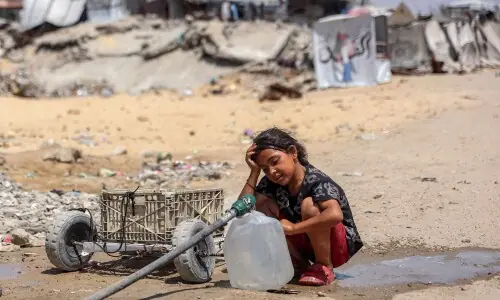
THERE seems to be no power in the world to stop Israel’s killing frenzy in Gaza. As a revenge for the death of two Israeli soldiers and the capture of one by Palestinian militants on June 25, the Israeli military had, by the last count, killed 325 Palestinians — a majority of them civilians. On Wednesday, an Israeli artillery barrage killed 18 people of an extended family, including eight children. This has been part of Israel’s policy since Jewish settlers began arriving in Palestine during the British “mandate”. The October-November days were especially suited to Israel because America was busy in its mid-term elections, though it goes without saying that whatever the time of the year, America’s support for Israel is total and unqualified. This was fully demonstrated at the UN when Qatar, the Security Council’s Arab member, demanded an urgent meeting of the world body’s executive arm to discuss the situation in Gaza. The call was supported by the Arab League and the Organisation of the Islamic Conference. A draft resolution condemning the Israeli massacre was circulated by Qatar, but Mr John Bolton, America’s ambassador to the UN, said nobody in the UN Council was in its favour. As a matter of policy, America does not think the UN Council has a role in the Middle East, because it knows that except for Britain, no other permanent member says Yes to whatever stand the US adopts on the Palestinian question.
Abandoned by the Arab-Islamic world, the Palestinians are putting up bravely against all odds. Unless the peace process is revived and the two-state solution is implemented, there is little possibility that Israel will ever end its occupation of the West Bank or stop its periodic forays into Gaza. Given the long accustomed passivity of the Muslim countries, Israel has no reason to engage in a peace dialogue with the Palestinian Authority, unless America and the European Union pressure Israel into starting talks with the democratically elected Hamas government led by Prime Minister Ismail Haniye. The basis of the talks should be the 2003 ‘roadmap’ to which the US is pledged and which calls for a two-state solution to the Palestinian question.
The festive season is here
WITH the mercury steady in the comfortable 20-degree Celsius range, cultural life in Lahore has come out of its summer-long hibernation. The gentle autumnal breeze, with a nip in the late night air, has brought Lahorites out in flocks to engage in outdoor activities once again. Cheerful families and youngsters throng the parks and open spaces, representing the fun-loving spirit their city is best known for. The public opening yesterday of the annual international performing arts festival organised by the Rafi Peer Theatre group embodied that spirit, enthralling a 4,000-plus audience at the tastefully decorated Alhamra cultural complex. Over 600 artistes and cultural troupes from around the world are participating in the 10-day-long festival featuring dance, music and theatre. Seminars and discussions on the sidelines will give the visiting performing artistes an opportunity to interact with their local counterparts and the general public.
The city is also playing host to hundreds of visiting Sikhs from around the world on their annual pilgrimage here — a dozen or so miles from the venue of the festivities have congregated over 1.2 million faithful for their annual three-day religious gathering at Raiwind. That many from diverse religious and cultural backgrounds have been rubbing shoulders in the streets these days, marvelling at their differences rather than frowning at them, is a sign of a healthy society. The cultural diversity seen in Lahore and the social tolerance it all showcases are positive reminders that not all has been lost to institutional erosion the country has been subjected to. The coming together of diverse and popular cultural and religious events is no coincidence but a planned annual occurrence; the people’s wholehearted participation in them is further proof that an overwhelming number of our citizens do believe in moderation and enlightenment for which they need no official prodding.
Mid-East: two years after Arafat’s death
WAS Yasser Arafat afraid of peace? His enemies say yes, and give many reasons, including the most bizarre one, concerning the Palestinian leader’s performance at the Camp David summit in 2000 with Bill Clinton as mediator. If he was in the way of peace, then today, two years after his death, the Middle East should have been an island of tranquillity, regional cooperation and human brotherhood.
Instead, as we can see, Arafat’s removal from the scene has not brought peace to the region. Instead, things have worsened, even if we ignore Iraq, which is a story unto itself. In Gaza and the West Bank, Fatah and Hamas are at each other’s throat, and the Israeli army has found a pretext in the Fatah-Hamas clashes to move into the Gaza strip whenever it wants and unleash death and destruction. To take revenge for the death of two Israeli soldiers and the capture of another on June 25, it has so far killed over 300 Palestinians.
Palestinian President Mahmoud Abbas — the man behind Oslo — finds himself helpless. His administration is without money because Israel has held up the Palestinian Authority’s share of revenues, and the US and the European Union have cut off all non-humanitarian assistance to his government in what can only be termed as yet another demonstration of their unqualified support for Israel irrespective of all moral considerations. The PA civil servants are in a state of agitation because they have not received their wages, and Prime Minister Ismail Haniye decided to close government offices after some officials were kidnapped and the PA headquarters at Ramallah stormed.
Worse still, Israel is not going to forget the drubbing it received at the hands of Hezbollah during the 34-day war and will mount a major offensive sooner or later to once again create what it was driven out of six years ago — a self-proclaimed security zone in south Lebanon. One can, thus, expect another war in Lebanon, and most probably it will be much bloodier than what happened last July and August.
How have the principal characters of the Middle Eastern drama behaved in the post-Arafat period? Is the Middle East closer to peace, and is the peace process anywhere close to a success? Mr Ariel Sharon, now in coma, who won a re-election as prime minister in Israel in January 2003, decided to pull Jewish settlers out of Gaza in August last year. However, the idea behind the pullout was not at all pious or in keeping with the spirit of the Oslo process, which was based on the Security Council Resolution 242 (land for peace).
The Jewish settlers were pulled out only to be accommodated in bigger settlements on the West Bank — settlements which Israel has built in violation of the laws of war and several UN resolutions and has no intention of dismantling. (UN Council Resolution 446 says: “...policy and practices of Israel in establishing settlements in the Palestinian and other Arab territories occupied since 1967 have no legal validity and constitute a serious obstruction to the achievement of a comprehensive, just and lasting peace in the Middle East”.) The settlements include those Jewish colonies which are an extension of occupied Jerusalem into the West Bank. Israel has also built up what Arafat called the Middle East’s “Berlin Wall” to gobble up more Palestinian land.
As prime minister, Mr Sharon never met Arafat, nor did President George Bush. Both raised extraneous matters, like asking Arafat to have a prime minister and carry out administrative reforms, instead of focussing on the real issue — the need for Israel to withdraw from all occupied territories as part of Resolution 242 and America’s own two-state solution to the Arab-Israeli conflict. Arafat then had a prime minister — Ahmad Korei — followed by Mr Mahmoud Abbas, but the peace process still did not go forward.
Mr Ehud Olmert, Mr Sharon’s successor as prime minister and leader of Kadima, which Mr Sharon formed after ditching Likud, has proved to be more intransigent than his predecessor. The PA, in the meantime, has had a fair and free general election in January this year, with Hamas achieving a clear majority. Yet Mr Olmert has refused to meet Prime Minister Ismail Haniye. If Arafat were in the way of peace, what is it that now stands between peace and the holy land and why has not the Bush administration, which considered Arafat the villain of the piece, helped revive the peace process?
Long before Arafat died, his principal detractors had come to accept what from their point of view was a bitter truth: in his personality Arafat and his Palestine Liberation Organisation, of which his Fatah faction was a vital component, not only epitomised the aspirations of the Palestinian people and their will to fight for their causes no matter what the odds, Abu Ammar, Arafat’s nom de guerre, would under no circumstances compromise on the two principles basic to a solution of the Arab-Israeli conflict: the right of the Palestinian people to a state of their own on their own soil and the right of the Palestinian people in exile to return.
The Israelis had carried out studies about their enemy from every imaginable angle — from psychological to dietary; from his style of leadership to his negotiating skills; from his sleeping to sartorial habits. For instance, they hated Arafat for that white patch on his kaffiye that they said resembled the map of Palestine. They knew that he never slept in the same room twice, and that his favourite drink was tea mixed with honey. They knew about his fascination with intelligence during the early stages of his career and how he began using intelligence-sharing and disinformation with friends and foes skilfully.
To break him down and make a nervous wreck of him, both Americans and Israelis used psychological tricks, but without success. At Camp David, when the Palestinian and Israeli delegations arrived, Ehud Barak had been told by his psychological advisers to keep walking straight and not to look at Arafat, much less shake hands with him. (Arafat later complained about this to Clinton).
At one stage during the marathon talking sessions, Clinton shouted at Arafat, shook him by his arm and leaned against the Palestinian leader to the extent that his nose was almost touching Arafat’s forehead. Then he and Madeleine Albright said they had had enough of Arafat and they were going to walk out. They indeed walked out, but as they came out they found it was raining heavily and going to their cars would mean getting drenched.
Both said getting wet was necessary if the walkout drama were to be enacted. Clinton also shouted at Ahmad Korei (later Palestinian prime minister), saying he had not come to Camp David to listen to speeches, and if Korei was so keen on making speeches then he better go to the Security Council.
What the US-Israeli team wanted Arafat to do was to sign a peace treaty that provided neither for Jerusalem as capital of an independent Palestinian state nor for the return of Palestinian refugees. Arafat said, “I have great respect for you, Mr President, but your proposals are not a basis for a solution”.
To Clinton’s remarks “You are leading your people and the region to a catastrophe... Barak presented proposals, but you take them and pocket them”, Arafat replied, “I came here representing Arabs, Muslims, Christians around the world. I came to make peace and won’t accept that you or anyone else put me down in history as a traitor”.
Two years later, the drama on the West Bank was much more brutal and epic, for what Clinton had tried to do diplomatically, Sharon, in keeping with the instinct of a mass murderer, attempted to achieve militarily. He reoccupied Ramallah, surrounded Arafat’s headquarters, and reduced his living and official quarters to rubble by tank fire. In fact, Israeli tanks were at times yards away from him. But Arafat — abandoned by the Arab-Islamic world — remained defiant.
He is accused of being afraid of peace exactly because he was not willing to sign on the dotted lines. Israel today consists of 78 per cent of Palestine; the rest 22 per cent has been under its occupation since 1967. The US-Israeli team wanted him to write off more areas in the remaining 22 per cent, to forgo the right of the Palestinian refugees to return and to forget all about Jerusalem. That he did not agree to all this spoke of his courage and to his ability — one, never to allow obfuscation, bribe and finer details of accords and sub-accords to blur the boarder perspective and, two, never to forget what the overall issue was in terms of the Palestinian calvary, the historic injustices done to the Muslims and Christians of Palestine, the expulsion of Palestinians from their homeland and its forcible occupation by European settlers during the British mandate.
At one stage, Clinton offered aid in “tens of billions of dollars” for the PA if Arafat would go along. Arafat replied, “Mr President, do you want to come to my funeral? I would rather die than agree to Israeli sovereignty ... (over) Haram al-Sharif”.
Arafat was an extraordinarily brave man. His enemies testify to his courage. Guerilla leaders can hide in countries thickly populated and covered with forests — Vietnam and Kashmir, for instance. The West Bank and Gaza do not fall in that category and the villages are few and far between, with small populations. Yet immediately after the 1967 war, Arafat was in the West Bank organising resistance. Once he evaded arrest by a hair’s breadth when he jumped out of a first floor window while the Israeli security men entered the house below. The Israelis found his unfinished cup of hot coffee and a transistor set that was playing Arab music.
Unlike the impression created against him by pro-American Islamists during the cold war that the “pro-Communist” Arafat was a bad Muslim, he strictly observed Islamic injunctions. In fact, George Habbash, chief of the Popular Front for the Liberation of Palestine, once remarked that if Palestine ever became independent during Arafat’s life time, he would turn Palestine into another Saudi Arabia!