0
0
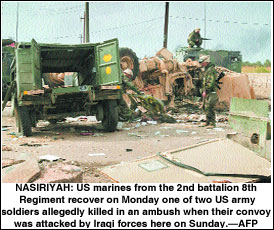 NASIRIYAH, March 24: US and British forces were bogged down in fierce battles for the strategic southern Iraqi cities of Nasiriyah and Basra on Monday, despite reassurances from their top commander that they were in fact making “rapid” progress towards Baghdad.
On the fifth day of the US-led invasion, the series of setbacks for the coalition invasion piled up with a climbing body count, tough resistance from fighters and civilians loyal to Iraqi President Saddam Hussein, and confirmation that a US Apache attack helicopter had been downed south of the Iraqi capital.
British forces assaulting Basra were forced to withdraw to regroup after coming under attack by mortars and by guerillas disguised in civilian clothes. The brigade had at one point surrounded the city.
But, with the 180,000-strong Anglo-American force pushing forward in a multi-pronged strategy that involved leapfrogging many points of opposition, there was some progress on other fronts.
Gen Tommy Franks, the head of the US Central Command, said at a press conference in Qatar that “progress toward our objectives has been rapid and in some cases dramatic”.
British Defence Secretary Geoff Hoon said in London that progress on the ground had been good despite early resistance. “It’s consistent with our plan,” he said. “The campaign is proceeding to our strategic planning.”
An infantry division of the US army was camped near Najaf, 160kms south of Baghdad, with Marines to the east and the 101st Airborne Division moving up from the southwest.
Gen Franks said US-led forces had taken about 3,000 Iraqi prisoners of war since the war started on Thursday.
Still, for most of the world, the most recent images of the conflict have been the frightened faces of five US soldiers captured on Sunday by the Iraqis during fighting around Nasiriyah in what US commanders described as “the sharpest engagement” so far.
The blow to US morale was further compounded on Monday when Iraqi television showed pictures of the downed Apache helicopter. Baghdad said it was holding its two pilots and claimed it had downed another Apache.
Gen Franks confirmed the loss of one helicopter during a sortie by around 30-40 of the attack aircraft against Republican Guard positions near Baghdad, but said that, for now, the two pilots were listed as “missing in action”.
British officials also said two of their soldiers were missing after an attack on their vehicles in southern Iraq.
The main stumbling block for the US-led offensive was Nasiriyah, a river crossing where US and British troops backed by Abrams tanks, Cobra helicopters and amphibious vehicles tried to clear the way past for a turn toward Baghdad.
Some 4,000-5,000 soldiers launched what their commanders would be an allout blitz. “We’re going straight through that city,” said a US Marine. “It will be a Hail Mary with guns ablazing.”
US commanders said less than 10 American soldiers had been killed at Nasiriyah in heavy fighting on Sunday. Others were wounded, and a dozen missing and presumed captured by the Iraqis.
But a medical corps man said the overnight toll on allied forces was heavy.
“They (US and British troops) are taking a lot more casualties than they (senior officers) are telling the press — that’s why you’re seeing all these helicopters flying back and forth all night,” he said.
He added that sniper cells remained in the city. “It is a hairy scene and the Iraqis have put up a good fight.”
In the southeast, US and British forces continued to have trouble overcoming Iraqi resistance in both the country’s second-biggest city of Basra and the small deep-water port of Umm Qasr, holding up humanitarian supplies that were meant to have been shipped in to win over local populations.
RESISTANCE UNDERESTIMATED: Military officials admitted they had vastly underestimated the strength of Iraqi resistance and the loyalty of Basra’s population to President Saddam.
“We’re currently taking stock of the situation. We were expecting a lot of hands up from Iraqi soldiers and for the humanitarian operation in Basra to begin fairly quickly behind us, with aid organizations providing food and water to the locals,” Captain Patrick Trueman said.
“But it hasn’t quite worked out that way,” he said.
“We always had the idea that everyone in this area hated Saddam. Clearly, there are a number who don’t.”
Howling sandstorms that slowed the 101st Airborne Division on Monday promised to worsen on Tuesday and would only taper off sometime on Thursday, perhaps with some thunderstorms, according to US army meteorologists.
Such weather would put restrictions on air cover for the ground forces. —AFP