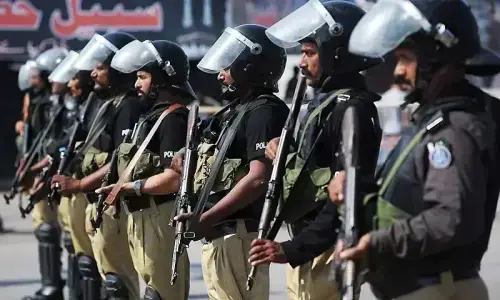
NWFP's top police officer admits that a security lapse led to Sunday's suicide attack in Mingora which killed at least 16 police cadets. While the admission itself and immediate orders for an inquiry are creditable — not many Pakistani officials are quick to accept their department's culpability — the security breach that led to the slaughter is inexcusable. The bomber stole into the police training centre, possibly by scaling the compound's wall, went up to the cadets and blew himself up. It is inexplicable that this could happen at a police academy in Swat's district headquarters where security ought to have been at its tightest. Preventing a suicide attack in a busy bazaar is a Herculean task but the same does not apply to a police facility. With the bulk of the battle in Malakand now apparently over, it is to be expected that the Taliban will resort to isolated attacks involving suicide bombers. And as is the case in the rest of the country, their primary targets in the Frontier and Fata are the security forces or other symbols of the state. All this is common knowledge and yet a suicide bomber managed to infiltrate, with apparent ease, what ought to have been a highly fortified police compound.
The dead and injured were all recruits of the newly established Community Police Force and the incident could have far-reaching implications for Swat. Residents there are still not sure if the state has indeed defeated the Taliban and live in a state of perpetual insecurity. Besides revenge for their losses in Swat and elsewhere, the militants are also seeking to derail attempts to rebuild the local security and administrative infrastructure. It remains to be seen whether Sunday's bloodbath will coerce existing and potential recruits into turning their back on the police. If it does, ongoing efforts to restore normality in Swat will be dealt a severe blow. The latest attack also sends a message that if members of the police are vulnerable inside their own facilities, then nobody on the outside is safe.
A 'decisive offensive' against the South Waziristan Taliban is now said to be on the cards. Though a welcome move it is fraught with danger, and not just on the battlefield. A military operation there could produce a backlash in the form of even more suicide attacks, with the security apparatus the most likely target. While it may be impossible to eliminate such bombings altogether, it is incumbent on the state to minimise their incidence. Much tighter security is needed, as is superior intelligence-gathering. Suicide bombers must, to state the obvious, be apprehended before the event.