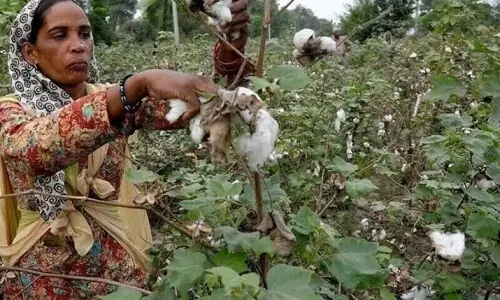
Textile mills face serious threats from increasing competition and the worldwide economic downturn -
Textile mills face serious threats from increasing competition and the worldwide economic downturn - File photo.

KARACHI Pakistan has failed to take necessary steps needed to meet post Multi-Fibre Agreement (MFA) challenges for its textile industry owing to lack of political will by the successive governments.


This was stated by foreign consultant, Gherzi, hired by the ministry of textile industry to draw a prospective plan for Pakistan textile and clothing industry up to the year 2015.


A draft presentation was recently made by the consultant's representative Keith Stuart Smith to the stakeholders and officials of the ministry in TDAP office.


In an interview with Dawn, the representative said after the end of textile quota regime in the year 2005, the Pakistani textile industry was today confronted with many issues, which should have otherwise sorted out much before.


He said as early as in the year 1978 the World Bank carried out a study on Pakistan's textile industry and suggested some measures to remove deficiencies and resolve issues faced by the textile sector.


Unfortunately, he said even today all these deficiencies and problems were there and the industry is unable to keep its foothold in the world market or improve its market share.


Mr Smith said whereas the other nations producing textile and clothing moved ahead and took some decisions, which prepared them to face the post-MFA challenges of the free market.

 

He further said that unfortunately, successive governments lacked the political will to implement reforms needed for upgrading human skills and adopting modern market techniques. As a result there are not only production losses but also poor quality goods.


Citing an example, Mr Smith said that when certain quality of fabrics are not locally available many nations quickly decide to allow their import but in Pakistan such decisions were not made, which could help the industry to keep its pace with the time.


There had been many studies in the past as well but they were never implemented, he added. There was Textile Vision 2005, and before this another study was made in 1993-94 and Vision 2000 prepared by Saigol Committee.


All these studies discussed in detail issues and also suggested measures needed to be taken before the phasing out of MFA. However, he said other countries took necessary measures and adjustment but Pakistan failed to do so.


He said that today China had become major supplier of textile and clothing worth $180 billion in the world market. India was struggling at $20 billion exports of textile and clothing against their target of $40 billion.


Mr Smith said Bangladesh which did not have any export of textile and clothing up to year 1990, is now exporting more than Pakistan whose exports are staggering around $11 billion only.

Opinion

Editorial

Pressure politics
Updated 28 May, 2026

Pressure politics

The attempt to connect the Iran conflict with the Abraham Accords makes little sense.
Eid’s true spirit
Updated 27 May, 2026

Eid’s true spirit

Pakistan celebrates Eid while grappling with economic strain that continues to weigh heavily on ordinary households.
Cotton crisis
Updated 29 May, 2026

Cotton crisis

We need a coherent long-term cotton strategy or else, Pakistan might lose a key pillar of its export economy.
Balochistan tragedy
Updated 26 May, 2026

Balochistan tragedy

The state keeps reiterating the role of hostile foreign actors in fomenting unrest, yet seems to be short on ideas on how to prevent the ingress of such actors and their ideologies in Baloch society.
Economic engagement
26 May, 2026

Economic engagement

AN array of investment MoUs valued at $7bn signed during Prime Minister Shehbaz Sharif’s China visit signifies...
Flotilla abuse
26 May, 2026

Flotilla abuse

THE testimonies that have emerged from international activists, who were part of a Gaza-bound flotilla, paint a...