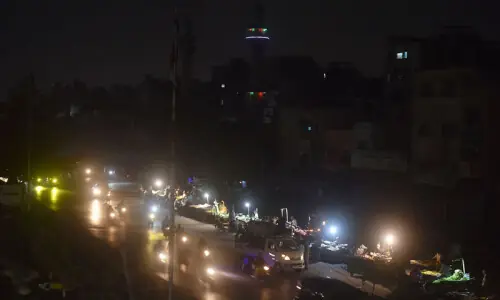
HYDERABAD, April 20: Long hours of power outages have taken a heavy toll on the residents and traders in Hyderabad district, besides causing an acute shortage of water.
Loadshedding lasting around 10 hours in the urban and 14 hours in the rural areas of the district has been taking place in Hyderabad for quite some time triggering street protests by consumers, who are fed up with indifferent attitude of the Hyderabad Electric Supply Company (Hesco) and the Water and Sanitation Agency (Wasa) towards their plight.
A resident of Latifabad unit 5, Syed Imtiaz Naqvi, says that loadshedding runs into about 10 hours in a day and when the electricity is restored the voltage keeps seesawing at night. He said that whenever he tried to lodge a complaint at the Hesco sub-division office, either the landline is found busy or officials do not respond.
Mr Naqvi said that there was also an acute water shortage in the area owing to loadshedding since people can not fill up their overhead water tanks.
Mohammad Asif, a resident of Heerabad, said it was surprising that sub-divisional officers of Hesco were unaware of power outages in their respective areas. Or maybe they just pretended not to know about them, he added on an afterthought.
He said that Wasa officials attributed the water shortage to loadshedding but there was no water in pipelines even when there was electricity.
There has been no water supply in Pathan Colony for several days, according to a resident, Arif Yousufzai. He said that he had complained to the Wasa office but it was of no use since the officials, like those of Hesco, paid no heed to complaints till people took to the streets and block thoroughfares with burning tyres and junk.
Hesco spokesman Sadiq Kubar said that eight to 12 hours of loadshedding took place in the urban and rural areas of 12 districts, falling within the jurisdiction of Hesco, because of a shortfall of 365 megawatts against a demand of 825 megawatts.
The districts include Hyderabad, Tando Mohammad Khan, Tando Allahyar, Jamshoro, Thatta, Matiari, Mirpurkhas, Shaheed Benazirabad, Badin, Sanghar, Tharparkar and Umerkot.
The spokesman admitted that unannounced power outages also took place when there was too much load on the transmission system forcing Hesco to disconnect power supply in order to save it.
He said that there were three power generation plants in Jamshoro, Lakhra and Kotri. However, he said he did not know how much power was produced by them since the plants transferred electricity directly to the National Transmission and Dispatch Company (NTDC) and the National Power Control Centre, Islamabad. Hesco received electricity produced by these plants after it had passed through six phases.
Wasa Managing Director Mr Saleemuddin said that the utility was not responsible for the water shortage being caused by the prolonged loadshedding and low voltage supply.
“In Hyderabad, power cuts last at least 10 hours hampering the pumping process and causing a shortfall of about 30 million gallons a day while the requirement surges to 60-70 million gallons per day in summers,” he said, adding that consumers at the tail-end had to suffer more. The Wasa chief said that the utility managed to supply water to tail-end areas at slack (night) hours. However, he said, it was unfortunate that power breakdowns continued at night as well.
The tail-end areas include Latifabad units 5, 8, 10 and 11, Sarfaraz Colony, Heerabad, Dadan Shah, Pathan Colony, Pak Colony, Doctors Colony, Hali Road, Liaquat Colony, American Quarters, Tando Agha, Sehrish Nagar, Hussainabad, Prince Town and Teen Number Talab. He said that Wasa was trying its best to supply water to consumers but could not afford generators to run pumping stations because of acute financial constraints, adding that 3,000 employees had not been paid for the past five months.