0
0


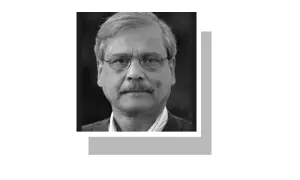
Raza Ali Abidi is a writer of consequence because of his travels. He owes almost all his writings to his travels but he doesn’t travel at random. There is one part of the earth which lures him to travel and that is South Asia. Each time there was a mysterious call from this ancient land, Abdi found it irresistible and embarked on a journey.
Abidi long remained associated with the BBC’s Urdu service. There seems to have been an understanding between the BBC and South Asia as each time it was the BBC which had a project in store for him. And each time it was a journey in a different manner. The first was bus travel on the Grand Trunk Road, commonly known as Jurnaili Shahrah, from Peshawar to Calcutta, now called Kolkata.
After the journey, Abidi headed to London and narrated his adventures to his listeners at the BBC Urdu service. The programme was aired in the form of a serial.
Next, he travelled the same route, from Peshawar to Calcutta, by train. Once again he narrated, serially, the story of his travels. But this was not the end of the story and Abidi wrote a book about his journeys called Jurnaili Shahrah. It is a valuable prose narrative with literary value.
Soon Abidi had the opportunity to embark on a journey which had a scholarly significance. The BBC entrusted him with a project to make an extensive tour of Pakistan and India and trace old personal libraries, whose bookshelves contain precious old books and handwritten manuscripts. Abidi reached distant places where he made contacts with old families and coaxed them into allowing him to take a look at the collections bequeathed to them by their ancestors.
Once again, back in London, Abidi narrated the valuable information on radio. Later, he also wrote an account of it and published it under the title Kutub Khana. In it, Abidi narrates the sad stories of the innumerable old book collections he was able to trace in the distant corners of India and Pakistan which are in danger of being lost because of the carelessness of the families who have inherited them. These treasures, a heritage passed on from their ancestors, are not kept with the dignity they deserve. They can be saved from destruction if given over to the custody of archives. But the unworthy owners will not part with them.
The other part of this project was to pay a visit to different Indo-Pak cities and towns and meet his listeners. Abidi did so and kept a record of these visits. It was after 30 years that he recalled those times and the people he had met. This is how he compiled his memoirs. He took care to compile a book where he recalls people he had met in times gone by and things he had seen and events he had witnessed. A whole age comes alive through his words.
Abidi’s manner of speaking has helped him become a popular voice at the BBC. This very tone permeates what he writes. And that is why he is loved. He writes with care in chaste Urdu. The style brings with it a flow free of cumbersome Persianised expression.