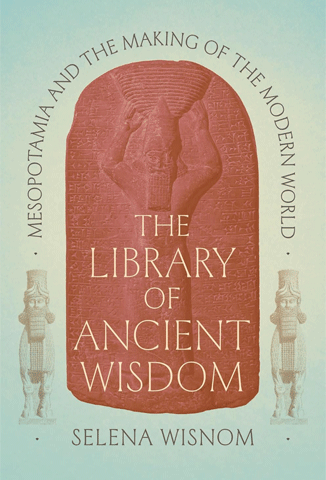
The Library of Ancient Wisdom: Mesopotamia and the Making of the Modern World
By Selena Wisnom
The University of Chicago Press
ISBN-100226822559
398+ pp.
A doctor is summoned to examine a patient who has come down with alarming symptoms. The doctor arrives, observes the symptoms and attempts an initial diagnosis based upon clinical experience and knowledge of the medical literature.
The disease isn’t easy to identify but, given the symptoms, it is most probably highly contagious and so, as a precaution, the patient is placed in isolation and strict instructions are issued that no one is to share utensils, stay in the same room or have any direct personal contact with them.
This is not a description of a modern response to a disease but an account from some 3,000 years ago. And the place where this was happening corresponds to modern-day Iraq.
As a doctor-patient interaction played out in one place, the Ancient Mesopotamians knew, as a matter of common knowledge, that washing their hands with soap made everyone healthier. They also understood the principle of sterilisation when dressing wounds, had guidelines for helping those who live past 70 to cope with the effects of ageing, and they preferred to use clean indoor toilets.
Elsewhere, the monarch’s future bride is being scolded for not practising her writing skills, a customer is complaining that the wrong items were delivered to him and an official is on the trail of a thief who has stolen valuables from a temple.
We know of all these instances because the Mesopotamians invented writing and many of the clay tablets they used have survived to our own time. Their writing is complex compared to modern phonetic systems, but it encoded information superbly and only a small number of characters were needed to be learned to be functionally literate.
Both men and women learned this craft, but scribes and priests excelled in it and were the de facto and de jure managers of the realm. These examples mentioned briefly earlier are but a few of the vignettes from Selena Wisnom’s The Library of Ancient Wisdom: Mesopotamia and the Making of the Modern World.
Wisnom brings the world’s first civilisation back to life with exquisite detail, excellent delivery, and the ability to encapsulate the vastness of the millennia during which Ancient Mesopotamia existed, as well as to bridge the tremendous gap in time that separates modern Eurasian civilisation from its first iteration.
There are very good reasons why Mesopotamia is considered the cradle of modern civilisations
There is much to recommend in Wisnom’s book but what is most striking is her ability to enter the perspectives of the societies and individuals she writes about. For anyone seeking an example of writing that is simultaneously rigorous, deeply informed, rational and empathetic, The Library of Ancient Wisdom stands out. Ancient debates and problems come alive from different versions meticulously dissected and pieced together for the reader.
At one moment, the Assyrians don’t seem to be all that bad. In the next, they are ravaging their enemy’s lands, not even sparing Babylon and, in the instance after that, they are rebuilding what they destroyed while subtly (or not so subtly!) realigning things to exalt their own rulers and pantheon.
While politics and warfare occupy a lot of attention, given the tendency of states to record much of what is relevant to these two activities, Wisnom takes the reader on a grand tour of Mesopotamian art, culture, astronomy, rituals and beliefs. And it is through this holistic recounting of the past that something conventional Eurocentric history-writing ignores is brought out of the shadows — the emergence of historical consciousness is a Mesopotamian achievement.
Wisnom explains that the Mesopotamian civilisation was aware of its past in a way that people today can relate to. And this past, if we pick up the story from the zenith of the Assyrian age of empire, circa 700BC, it was already some 3,000 years old. Through the preservation of language, records and customs, ruling classes and their literate compatriots felt a link to their remote past and saw themselves as successors to earlier cultures and empires that arose in the Tigris-Euphrates River Valley. Rulers worried about how they would be remembered and went to great lengths to preserve records of their reigns on cylindrical tablets, to be buried and later retrieved as time capsules.
The Assyrians, for instance, prided themselves on their martial prowess but were equally impressed by the scholarly abilities of their rulers and higher bureaucracy. Ashurbanipal (r. 669–631BC), arguably the greatest of Assyria’s monarchs, depicted himself with writing implements tucked in his sash even on a hunt, and probably assembled the first great library in history. Mesopotamia, in other words, existed as a self-aware civilisational continuum, conscious of its past, worried about its present and future, and was both enriched and troubled by the momentum of history.
The Roman Empire, which committed atrocities on a far greater scale than the most fearsome of its Mesopotamian equivalents, has been substantially redeemed in the eyes of later generations by appreciation of its cultural and technical achievements. Wisnom sets out to do for the Assyrians and their predecessors what others have done for Rome, revealing not just the sword but also the stylus.
And it is with its discussion of the latter that The Library of Ancient Wisdom is at its most illuminating, for it is ultimately a book about books. Here, mastery of the original texts and the ability to contextualise for a modern reader are immensely helpful. The classical works of Ancient Mesopotamia, be they epics, medical texts, or political and military accounts, are explained in terms a non-specialist can easily understand and there is a most helpful bibliographic essay. This is intellectual history at its most captivating.
But what of the debt we owe to the Ancient Mesopotamians? Well, just think about it. If you are reading this review, you are drawing upon the historical legacy of Mesopotamia and its invention of the earliest writing systems. Much of the mathematics that is familiar to us via the Ancient Greeks (who weren’t particularly ancient by Mesopotamian standards) originated in Babylonia.
The food you consume comes from intensive agriculture, first developed by the Sumerians. If you live in a city, as much of the world now does, you draw upon the legacy of Uruk. If you see a doctor when you feel sick, or read your horoscope in a newspaper or online, the original credit goes to the Mesopotamians. If you are a student of history, then it is in Mesopotamia that the origins of historical consciousness lie.
If you are fascinated by empires and geopolitics, well, Sargon of Akkad (r. 2334–2279 BC) got the drop on practically everyone and developed the prototype of the imperial state that Babylon and, eventually, Assyria grew into a world order. What Wisnom does remarkably well is make the ‘ancient’ appear much closer to our lives and our times.
If you have time to read just one book on history this summer, then The Library of Ancient Wisdom should be it. Wisnom paints a brilliant and compelling portrait of a civilisation which achieved so many firsts that it is almost pointless to read about the others until you have read about the Ancient Mesopotamians.
The reviewer is most recently the author of New World Empires: Cultures of Power and Governance in the Americas and is Professor of History at the Quaid-i-Azam University, Islamabad. X: @IlhanNiaz
Published in Dawn, Books & Authors, June 14th, 2026