The year 2021 marked 50 years of what is referred to in Islamabad as the fall of Dhaka and in Dhaka as the liberation of Bangladesh. The Awami League, the founding party of the state of Bangladesh, the former East Pakistan, was in power at that time and celebrated the year with enormous fervour.
Over the years, some Pakistani researchers, scholars, former bureaucrats, retired military officers and journalists have written books or published their memoirs about the former East Pakistan and its strained relationship with West Pakistan, which culminated in a bloody civil war, Indian military intervention and the dismemberment of united Pakistan. But the Hamood-ur-Rehman Commission’s report, commissioned by the then Pakistani government to investigate and explain the event, is not declassified in its entirety even now.
Increasingly, there is little desire among the powers that be to let intellectuals, politicians, journalists and students analyse and learn from what went wrong in united Pakistan. There was no serious introspection or political dialogue allowed to take place in public spaces or universities to mark 50 years of the country’s dismemberment.
I am aware of a conference to discuss and debate the creation of Bangladesh, planned by academics at a private university in Lahore in 2021. It was later called off on the university administration’s instructions. Besides other things, not learning from the past makes our future path even more steep and we continue to struggle with the problems faced in our political, social and economic spheres.
We are still not able to smoothly run the federation with a just and equitable distribution of resources or fully accept the people’s mandate to elect their political representatives. We have neither prioritised the arresting of economic disparities nor is there a demonstrable will to provide basic services to citizens.
About the fateful year of 1971, there are very few accounts available in Urdu or other Pakistani languages. Some translations about the events of 1971 written in English were also made available in Urdu and Sindhi. But altogether, original and translated works can still be counted on one’s fingers. Brig (retd) Siddiq Salik’s Main Ne Dhaka Doobtay Dekha [I Witnessed Dhaka Drown], Anwar Shahid Khan’s Padma Surkh Hai [Padma is Red] and veteran journalist Ali Ahmed Khan’s Jeevan Aik Kahani [Life is a Story] are among the books in Urdu that capture 1971 in different ways and inform the reader.
Naseer Memon’s book in Sindhi, Bangladesh: Bohraan Khaan Bohraan Taeen is a comprehensive account of the history of and political developments in Bangladesh, with some references to the changing social and economic life in the country.
Anwar Shahid Khan’s book remained banned for many years after its publication. Major Ishaq, Dr Tariq Rahman, Rasul Baksh Palijo and Col Nadir Ali are prominent among those few people who publicly spoke on or wrote about the issue in Urdu, Sindhi, Punjabi or English. Even fewer works, including articles, from Pakistani writers are available that can educate the reader about what has happened in Bangladesh after 1971.
Naseer Memon’s book in Sindhi, Bangladesh: Bohraan Khaan Bohraan Taeen [Bangladesh: From Crisis to Crisis], which has just been published by Roshni Publications, is a significant book because it begins from before 1971 and brings us to 2026. It is a comprehensive account of the history of and political developments in Bangladesh, with some references to the changing social and economic life in the country.
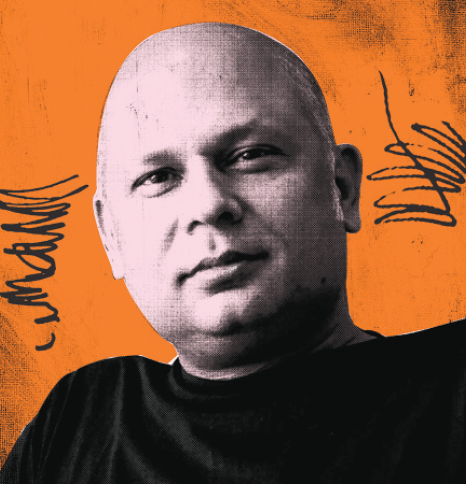
Memon trained as a civil engineer and taught at the Mehran University of Engineering and Technology before moving into the areas of social development, climate justice, water conservation and distribution in the Indus basin, corporate social responsibility and a broader analysis of developmental and environmental policies pursued by the decision-makers in Pakistan. He is a prolific author who has come out with several books and is a regular columnist in Sindhi, Urdu and English, writing on the subjects that are close to his heart.
He has been particularly vocal on the multiple challenges faced by the province of Sindh, along with the other smaller provinces, and seeks a fair governance mechanism in the country based on the spirit of the Constitution of Pakistan and its federal character. He has a deep sense of history and a keen eye for contemporary developments in Pakistan, the wider South Asian region and the rest of the world. It is no surprise then that he became interested in writing a book about Bangladesh.
In his book, Memon traces most, if not all, momentous events in the polity of Pakistan in its initial years, the language issue between Bangla and Urdu — which provided fertile ground for disharmony in the two wings of the country — the economic inequities that led to a sense of deprivation in East Pakistan, and the chequered democratic history of the country as a whole.
The reasons for the rise of Sheikh Mujibur Rehman and his party, the Awami League, as the sole representatives of East Pakistan are discussed at length. The attitude and role of the military, the civilian bureaucracy and politicians from West Pakistan towards East Pakistan after the 1970 elections and during the military operation in 1971 is effectively summarised.
Something that makes this account interesting and objective is Memon’s dispassionate analysis of the politics and policies pursued by Rehman — the founding father of Bangladesh — after coming to power, the role of his party when in power and, later, his daughter Sheikh Hasina’s politics as the leader of the party until recently.
Towards the end, the book provides insights into what is happening in Bangladesh after the ouster of Sheikh Hasina and the current challenges the country faces.
The columnist is a poet and essayist. His latest collections of verse are Hairaa’n Sar-i-Bazaar and No Fortunes to Tell
Published in Dawn, Books & Authors, June 14th, 2026