Oil prices tumbled further Thursday after US President Donald Trump and his Iranian counterpart signed off on a deal to end their war and reopen the Strait of Hormuz to tanker and cargo traffic.
European and Asian stock markets were mixed, with some major indexes retreating after steep falls on Wall Street after the Federal Reserve raised its inflation forecast and projected higher US interest rates this year, boosting the dollar.
“Politics and economics are front and centre for markets,” said Russ Mould, investment director at AJ Bell.
“The US and Iran have signed an initial deal to end the war, causing oil prices to fall further,” he said, but the Fed’s hint at a rate increase “took the market by surprise and caused a wobble” on Wall Street and elsewhere.
Kevin Warsh, the new Fed chief, vowed to “deliver price stability” after chairing his first policy meeting, even though Trump has repeatedly called for lower rates.
“Persistently high prices are a burden for the American people,” he said after the meeting, which followed an interest rate hike by the European Central Bank last week.
“The thought of a hawkish Fed policy and higher interest rates weighs heavily on risk appetite,” said Ipek Ozkardeskaya, senior analyst at Swissquote.
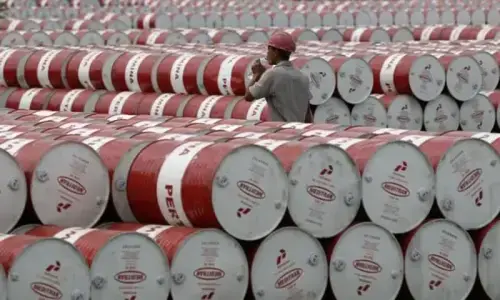
Crude futures slid around 2 per cent on Thursday after a deal that should bring an end to the US-Israeli conflict with Iran that restricted shipping in the Strait of Hormuz, causing a spike in energy prices.
But “the latest European Central Bank (ECB) and Fed decisions showed that policymakers do not necessarily rely on the idea that lower oil prices will immediately cool inflationary pressures,” Ozkardeskaya said.
In London, the benchmark FTSE 100 index was down nearly 1pc in late morning deals, with the Bank of England widely expected to keep its main interest rate on hold despite elevated inflation.
The eurozone’s major stock markets edged higher.
In Asian trading, Seoul was again at the forefront of gains, surging more than 2pc and ploughing past 9,000 points for the first time, thanks to a fresh surge in chip titans Samsung and SK hynix as the AI boom continues apace.
“South Korea supplies around 80pc of the world’s memory chips, and artificial intelligence is expected to continue growing for at least another decade,” Kim Dae-jong, a professor at Sejong University, told AFP.
“Semiconductors account for roughly half of South Korea’s industrial output, and this is seen as the biggest reason why Kospi broke through the 9,000-point mark.” Tokyo, meanwhile, finished above 71,000 points for the first time.