JHANG: The two-room bungalow, the birth place of Pakistan’s only Nobel laureate, today stands empty, testament to the indifference, bigotry and prejudice surrounding the country’s greatest scientist.
Professor Abdus Salam, the child prodigy born to a humble family on the sun-blasted plains of Punjab who won accolades all over the world for his ground-breaking research in theoretical physics, is all but forgotten.
He was the trailblazer who helped pave the way to the recently hailed discovery of the “God particle” — one of the greatest achievements in science for the last 100 years — but as the world went into overdrive, Pakistan stayed largely silent.
Not even boasting from India, whose late physicist Satyendra Nath Bose also contributed to the discovery, snapped Pakistan out of lethargy.
And the reason? Because in the eyes of the law, Salam was a heretic.
“Our people are not educated. They just know this is the house of Dr Salam, who was a scientist, and they, including me, are unaware of his contributions. They also know he was Ahmadi,” said local resident Kamran Kishwar, 23.
One of the most religiously polarised towns in Pakistan, Jhang, 188 miles southwest of Islamabad, is home to thousands of Ahmadis and tensions run high between the community and mainstream Muslims.
Ahmadis, were declared non-Muslims in 1974 as part of Islamisation.
In 1984, they were banned from calling themselves Muslim. They are banned from preaching and even from travelling to Saudi Arabia for pilgrimage. Their publications are prohibited.
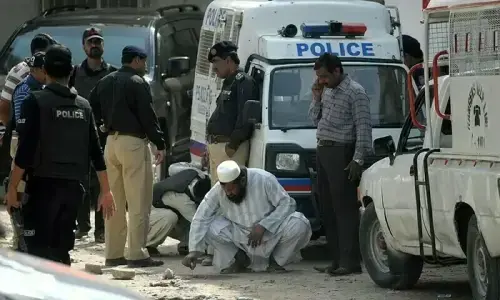
Ahmadi mosques have been shut down. Others have reportedly been desecrated. In May 2010, suicide bombers killed 80 people at two mosques during Friday prayers.
Dashed dreams
Salam’s portrait hangs in his old school and he paid for a block to be built in his father’s name in the 1970s, but locals are still fighting to have any connotations with him wiped from the premises.
“Elements are still trying to remove Dr Salam’s name from the school,” said Rana Nadeem, an Ahmadi who lives near Salam’s house.
It wasn’t like that when Salam was born in 1926, under British rule. The entire town turned out to welcome him after he scored the highest marks ever to get into the University of the Punjab.
After a PhD at Cambridge, he returned home to teach and determined to set up a centre to encourage world-class science from the developing world.
But his dreams were dashed. Associates say ignorant bureaucrats rubbished his ideas and to pursue an international career he returned to Britain in 1954.
In 1957, he was made professor of theoretical physics at Imperial College, London and in 1964 set up the International Centre for Theoretical Physics in Trieste in an effort to advance scientific expertise in the developing world.
He continued to advise Pakistan on science and atomic energy, and was chief scientific adviser to the president from 1961-1974. But after the law changed in 1974, he found an increasingly hostile reception on visits home.
After winning the Nobel prize for physics in 1979 with American scientists Steven Weinberg and Sheldon Lee Glashow, he was banned from lecturing at public universities under pressure from right-wing students and religious conservatives.
‘Victim of narrow-mindedness’
On the other hand, he was given a rapturous welcome in Bangladesh and India.
“Dr Salam is a great hero and possibly the most famous Pakistani in the world but he became victim of the narrow-mindedness of our society,” says Hassan Amir Shah, head of the physics department at Government College, Lahore.
Even in 1989, the world’s first Muslim woman prime minister, Benazir Bhutto, who herself knew prejudice, refused to meet him, recalls nuclear physicist Pervez Hoodbhoy.
“That day I was with Salam in his hotel in Islamabad and he had come all the way from Trieste. Salam was very disappointed when her personal assistant rang up to say the prime minister did not have the time,” he told AFP.
Although Salam’s achievements far outstrip those of A.Q. Khan, the father of Pakistan’s nuclear bomb and a Muslim, it is he who is revered as a national hero, despite Khan’s alleged role in nuclear proliferation.
“Ninety-eight per cent of people in this country are Muslim but still they are insecure and intolerant to the two-per cent minority,” said Shah.
It took until 2000 for Government College to establish a physics chair in his name. The university has also named one of its halls after Salam.
Salam’s colleagues also wanted to get the National Centre for Physics in Islamabad named the Abdus Salam Centre for Physics, whose first director had been a PhD student of the Nobel laureate, but Hoodbhoy said the authorities refused.
The Ahmadiyya community certainly feels he was betrayed.
“Even after he was buried, local administration asked the Ahmadi community to remove the word ‘Muslim’ from the inscription on the grave which said ‘the first Muslim Nobel laureate’,” said Shah.
The word has been painted over, leaving just: “the first Nobel laureate.”