QUETTA: Fourteen people, among them 12 members of the Shia Hazara community, were gunned down on the outskirts of Quetta on Tuesday.
The victims were going to Hazar Ganji area from Akhtarabad in a bus when the assailants riding a pick-up opened indiscriminate fire.
The bus was carrying about 30 passengers.
Sectarian attacks in Balochistan have claimed 45 lives over the past two weeks. On Sept 20, armed men attacked a bus carrying Shia Hazara pilgrims in Mastung district, killing 26 of them. The pilgrims were bound for Iran.
The Deputy Inspector General of Police (Operations), Hamid Shakeel, told Dawn: “The incident took place at 7am. The assailants were five or six in number. They had parked their vehicle in a street near the western bypass.”
The bus was on its way to the vegetable market when the assailants overtook it and blocked its way in Akhtarabad, near a bypass. Then they entered the bus and opened fire at the passengers, killing 10 of them on the spot and injuring 10 others. Four of the injured died in hospital.
A senior police officer, quoting an eyewitness account, said the armed men allowed non-Hazaras to leave before shooting the others to death.
“The gunmen standing outside the bus also fired on passengers and injured some of them,” he said. “A few bodies were also found outside the bus.”
People belonging to the Hazara community gathered along the Western Bypass and Brewery Road areas, pelting vehicles with stones and damaging government and private buildings. Later they set the bus on fire.
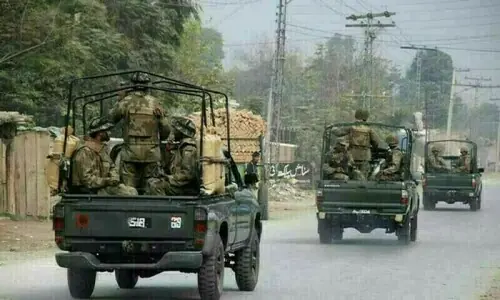
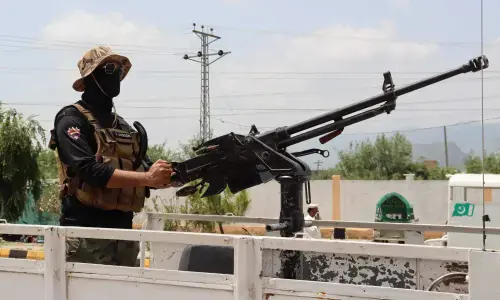
Personnel of the Frontier Corps cordoned off the area.
Capital City Police Officer Mehboob Ahsan rushed to the site with a heavy contingent of police. The dead and the injured were taken to Bolan Medical College Hospital. Later, the injured were shifted to the Combined Military Hospital, where three of them were stated to be in a critical condition.
The dead were identified as Zakir, Hussain Ali, Zaki, Noorullah, Mohammad Ali, Qurban Ali, M. Ali, Jan Ali, Hussain Bakhsh, Salman Ali, Akbar Ali, Rehmat and Abdul Rehman Achakzai Talking to newsmen at the hospital, Divisional Commissioner Naseem Lehri said: “It appeared that the assailants were not following the bus but were waiting in a side street, took the main road when their target appeared and then carried out the heinous act of terrorism.”
He said the entire area had been cordoned off and expressed the hope that law enforcement agencies would succeed in arresting the killers.
“Police have rounded up over a dozen suspects and are carrying out raids in more areas,” DIG Hamid Shakeel said.
The sources said the gunmen had attempted to attack two other vehicles carrying vegetables to Marriabad, but failed because they were under police protection.
Balochistan Governor Zulfiqar Magsi and Chief Minister Aslam Raisani condemned the incident and announced that the government would bear all expenses for the treatment of the injured.
Provincial Home Minister Mir Zafrullah Zehri held an emergency meeting to review the situation arising out of a series of sectarian killings in the province and directed heads of law enforcement agencies to take steps for arrest of the gunmen.
The Tahaffuz-i-Azadari Council called for a three-day mourning.
Twelve victims were buried in a local graveyard while one body was sent to a village for burial.
DSP Hamid Shakeel told AFP: Two of the injured who were in critical condition died in hospital. Twelve Shia Hazaras and one Pakhtun died in the shooting.”
Police said they had been escorting other Shias in the area, but insisted they had not been informed of the bus that was the target of Tuesday’s attack.
The Human Rights Commission of Pakistan said the killers had been emboldened by a persistent lack of action against sectarian militant groups, which have been implicated in thousands of deaths in past years.
Tuesday’s attack “exposes once again the diminishing writ of the state”, warned the HRCP.
London-based Amnesty International said the killings highlighted the failure of Pakistani authorities to address sectarian violence across the country.
“These are not random killings but demonstrate the deliberate targeting of the Shias by armed groups,” said Amnesty’s Asia-Pacific director Sam Zarifi.
“These attacks prove that without an urgent and comprehensive government response, no place is safe for the Shias,” Zarifi added.
The rights group said it had recorded details of at least 15 attacks specifically targeting Shias across Pakistan.
“Continued failure to address sectarian violence will only exacerbate the general breakdown in law and order in Pakistan,” it said.