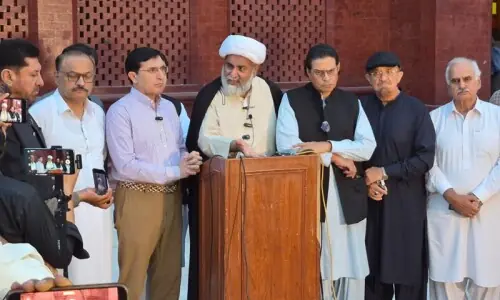
- Pakistani students and officials push a stretcher carrying the body of a school principal at a hospital in Quetta on March 22, 2010. – AFP (File Photo)
The Human Rights Watch report on Balochistan province shows that education in Pakistan is under threat not just in the northwest, where Taliban and al-Qaeda-linked militants have long harassed teachers and attacked schools, especially those for girls.
Suspected militants murdered at least 22 educators in Baluchistan between January 2008 and October 2010, according to the report. The most prominent killing was that of Shafiq Ahmed, the provincial education minister, who was shot dead in October 2009.
Militant separatists have threatened teachers and school officials to stop teaching Pakistani history, flying the Pakistani flag, and singing of the national anthem. Partly as a result of the threats, bombs or other attacks, government schools in 2009 were open only 120 days - 100 days less than in the rest of the country.
Balochistan is Pakistan's largest province, covering 44 percent of the country and bordering Afghanistan and Iran. It also is the poorest of Pakistan's four provinces and the most sparsely populated, with around 8 million people, or just 5 percent of the total population.
US officials suspect Quetta, the provincial capital, is a major base for the Afghan Taliban's leadership, a claim Pakistan denies.
But the main security threat in the province is militant ethnic Baluch separatists, who feed off resentment against the central government, which they say exploits the resource-rich province but shares little of the wealth. The groups frequently kill people from other parts of Pakistan who settle in the region.
"Teachers and students constitute a significant proportion of victims because militant groups view schools and educational personnel, particularly ethnic Punjabis, as representatives of the Pakistani state and symbols of perceived Punjabi military oppression of the province," the report said. Punjab is Pakistan's most wealthy and populous province.
The separatist leaders often justify the killings by saying they are revenge for government and military atrocities against the Baloch people.
In April, two masked gunmen on a motorcycle killed Nazima Talib, an assistant professor at Balochistan University, while she was traveling in an auto rickshaw in Quetta. Talib was an ethnic Punjabi who had moved to Balochistan decades before, Human Rights Watch said. Local media reported that the Balochistan Liberation Army said Talib's killing was retaliation for the deaths of two Baloch women and the torture of female political workers.
Sectarian violence pitting Sunni Muslims against Shia Muslims further plague the region, as do militant groups with other agendas, the report said. The latter at times target schools because they oppose what is being taught, especially if the students are girls.
Even aside from the militant threat, education has long been a neglected sector in Baluchistan. Net enrollment rates are the lowest in the country, and about half of 10- to 18-year-olds who do attend drop out before finishing primary school, the report said.
Researchers found that since 2008, more than 200 teachers and professors have transferred from their schools to relatively more secure Quetta, or they've left the province. Around 200 others are in the process of making such transfers, the report said. Many are ethnic Punjabis and Shiite Muslims and other targeted minorities.
Human Rights Watch, a New York-based group, said its report relied in part on press accounts, field investigations and some two dozen interviews with school personnel, students and others. It noted that the security situation in Balochistan "severely impaired" its ability to individually probe attacks. – AP