0
0

WASHINGTON, Feb 1: Pakistani troops have recently helped direct US artillery fire at suspected terrorist hideouts inside Pakistan, a senior US military officer told reporters in Washington on Tuesday.
Army Col Cardon B. Crawford, the director of operations for the US military command in Afghanistan, told a breakfast briefing in Washington that this new development was "a huge step forward" in the fight against Taliban and Al Qaeda suspects hiding along the Afghan-Pakistan border.
But Pakistan was still refusing to allow US troops to operate inside its territory, he added. In the past, the United States had urged Pakistan to allow its troops to cross the border while chasing Taliban and Al Qaeda suspects fleeing from Afghanistan.
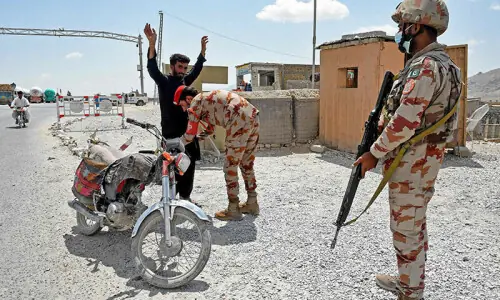
Islamabad refused to allow these hot-pursuits and instead deployed its own troops along the border to prevent the militants from crossing into Pakistan. Giving details of the Pakistani cooperation in the war against terror, the US military officer said Pakistani troops guided US artillery fire into their territory at targets Americans believed were terrorist hideouts.
The Pakistani cooperation, he said, has been very valuable because there were no US troops inside Pakistan but he refused to disclose where in the tribal region Pakistan had provided this assistance.
Early last year, Pakistan launched a major military operation in Waziristan to flush out Taliban and Al Qaeda suspects believed to be hiding there. In what was described as operation "hammer and anvil," Pakistan was to drive the suspects into Afghanistan where US and Afghan troops waited to catch them.
More than 220 Pakistan soldiers were killed and 482 were wounded in these operations. Explaining how Pakistani and American troops coordinate these artillery shootings, Col Crawford said: "A howitzer will shoot, let's say five, six, 10 kilometers.
There has to be somebody out there who says, 'Here's the target.' And when the round lands, he'll say "go left, go right, go up, go down." Col Crawford also said he believed Al Qaeda leader Osama bin Laden was still hiding in or near the Afghan-Pakistan border region and said that US and allied troops were doing their best to catch or kill him.
He said Al Qaeda has become less of a threat in Afghanistan and had "no effective presence" inside the country. The Taliban leadership, he said, was also divided and the Afghan government was working on a plan to further widen these divisions. The Afghan elections, he said, have isolated the Taliban and some Taliban leaders were now eager to become part of the Afghan political process.