0
0

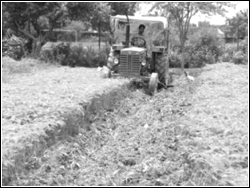 The land for agricultural uses has been reduced due to rapid urbanisation, dwindling water resources, erosion, salinity and degradation of soil fertility levels. This has led to indiscriminate use of high priced fertilisers for maximum crop productivity and ecological and environmental concerns.
The situation calls for developing and adopting economically viable, environmentally sustainable, and socially acceptable appropriate soil and crop management practices.
Soil fertility management is one of the most important factors affecting crop production. Green manure production and incorporation represents an alternative source of nutrients to mineral fertilisers. It can increase cropping system sustainability by reducing soil erosion, by increasing nutrient retention, improving soil fertility and by reducing global warming potential. Green manuring can help farmers sustain crop production.
Green manure crops can be leguminous as well as non-leguminous and can be grown or brought from outside as cuttings of trees and shrubs. Mustard, oats, rye, alfalfa cowpeas, clovers are used as green manure crops while sorghum-sudangrass, millet, forage sorghum are used as non-legumes.
Legumes are superior green manure crops compared to non-leguminous crops because they determine atmospheric nitrogen (N). Considerable variation in N fixation can occur, even among legume species. A green manure crop, to be agronomically attractive and economically viable, should have some important characteristics. These can easily be adjusted to produce sufficient dry matter to ameliorate soil’s physical, chemical, and biological properties to fix adequate N and require minimum cultural practices during growth period.
Legumes are used to maintain soil N fertility. The legume Rhizobium symbiosis is estimated to account for 40 per cent of the worlds fixed N. Symbiotic N2 fixation in legumes is determined by formation of effective nodules on the roots. Formation of effective nodules depends on plant, soil and climatic factors and their interactions. Hence, green manure legumes have different N2-fixation capabilities depending on environmental conditions, management practices adopted, and type of legume species nodulating. Green manure not only fix N but also incorporate other essential plant nutrients in reasonably good amount for succeeding crop.
Decomposition: Soil N availability is determined by its mineralisation, the microbial conversion of organic N to ammonium (NH+4) with further oxidation to nitrate (NO-3). Soil and plant factors mainly determine green manure decomposition and subsequent N release. Among dominant plant factors are quantity and quality of green manure incorporated into the soil. Soil factors, which determine decomposition rate and N release, are texture, structure, acidity, microbial activity, and soil fertility.
Organic residues decomposition is observed slow in soils with high clay content as compared with light textured soils. Similarly, microbial activities are determined by soil physical as well as chemical conditions. Residue decomposition depends mainly on temperature and soil moisture. Values of soil temperature in the range of 20-30æC and soil moisture in the range of -0.01 to -0.05 MPa are reported for fast release of NO-3 following green manure incorporation into soil.
C/N ratio: Carbon to N ratio of green manure or crop residue incorporated into the soil play an important role in the release or immobilisation of soil N because plant tissue is a primary source and sink for C and N. Historically, C/N ratio is most widely used index of crop residue quality and decomposition rate.
When plant residues having C/N ratio greater than 20 are incorporated into the soil, available soil N is immobilised during the first few weeks of decomposition. In aerobic soils, C/N ratios <20 for organic matter are required for net mineralisation to occur. The C/N ratio of legume crops is low as compared with cereals and the narrow C/N ratio of legume residue enhances soil N availability. Availability of C and N, rather than their total concentration in the residue, play a critical role in residue decomposition and nutrient release. Generally, residues with low N content or high C/N ratios have slow decomposition rates.
Amelioration properties: Green manuring has significant positive influence on soil physical chemical and biological properties and consequently on crop yields. It is stated that all other factors being equal, a soil with a high soil organic matter level has good physical conditions. Addition of organic matter by green manuring helps to stabilise soil structure, increase its water holding capacity , and increase infiltration of water into soil and percolation through soil. The process also helps in reducing soil erosion. Improved soil physical conditions may promote root growth and increased use of soil water and nutrients.
Legume crops in rotation improve physical and biochemical properties of soil by increasing labile organic matter. Legume green manures also maintain ground cover, usually between cultivated crops, reducing erosion, and providing weed control. Furthermore, crop uptake of soil NO3, reducing risk of leaching, reduced water run-off, and soil losses during intense rainfall and enhanced N availability to succeeding crop and thus reduce need for N fertiliser
Green manuring promote mycorrisae on the roots of succeeding crops, increase soil phosphorus (P) and micronutrient availability, also suppress plant pests such as nematodes can be used to control weeds and other pests. Weed emergence suppression by green manure may be associated with reducing light penetration and soil temperature fluctuations.
Yield response: Yield increase by green manuring depends on crop species, environmental conditions, and management practices adopted for green manuring crops as well as succeeding field crops. Grain yield increase with green manuring are reported in rice, tomato and sorghum.
Limitations: Green manuring may pose some limitations if not managed properly. Nitrogen immobilisation and consequently N deficiency for succeeding crops may be one, if green manure crop is not incorporated in advance of planting cash crop to allow sufficient time for decomposition. Problems following green manure crops have been also recognised. Reasons for these include low temperature, NH3 toxicity, insect and slug predation, diseases, deleterious rhizosphere micro organisms, and allelopathy. To avoid stand establishment problem, killing of green manure or cover crops with tillage 2-4 weeks prior to sowing subsequent crops is recommended.
Adoption of soil and crop management practices by farmers depends on agronomical and economical viability. However, it also should be minded that green manuring alone cannot supply sufficient essential plant nutrients for maximum or maximum economic crop yields. Hence, the best strategy is to use green manure in conjugation with chemical fertilisers. The combination may reduce application rate of inorganic fertilisers and risk of environmental pollution, and can provides sustainability to crop production systems.