0
0

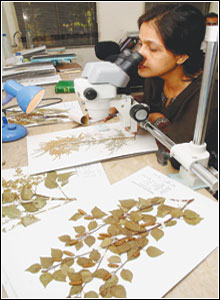 KARACHI, Nov 25: The 215th and last volume of a research project titled The Flora of Pakistan, initiated 35 years ago to record the scientific details of all the indigenous flowering plant species of the country, is being finalised by senior professors at the University of Karachi’s botany department. The study, the most comprehensive and authentic scientific work ever on Pakistan’s flora, would be completed next year.
Dr Mohammad Qaiser, the in-charge of the KU’s herbarium and adviser to the vice-chancellor, told this to Dawn in an interview.
Of the total 6,000 flowering species in Pakistan, information about 4,900 species has been recorded, Dr Qaiser said, adding that 90 per cent of the work of the series’ last publication has been completed.
“All over the world plant conservation has assumed a lot of significance in recent years due to increasing biodiversity loss. Every living organism has a role to play in nature and its loss can translate into a bigger threat to the environment. To tackle the issue, we need complete information about an organism and the correct identification of a specimen is the first and most vital step that forms the basis of research”, Dr Qaiser said while elaborating upon the significance of plant research and conservation.
Initially christened the Flora of West Pakistan, the project, funded by the US department of agriculture, was launched in 1968/69 in two institutions, Gordon College Rawalpindi and the University of Karachi simultaneously. The then chairman of the KU’s botany department, Professor Dr Syed Irtafaq Ali, who is still one of the chief editors of the publication, and Mr E. Nasir, a botany teacher at Gordon College, were the premier researchers who, with the help of other staff, collected the initial data.
Starting from scratch
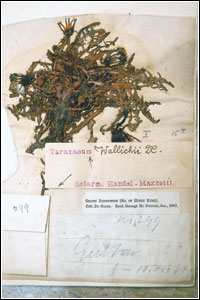
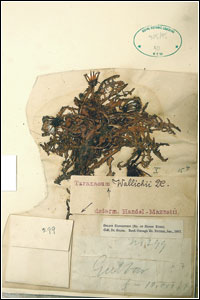 “Unlike the Indians, who had the entire infrastructure and literature available with a large collection of species all left intact by the British, we started from scratch. Gordon College Principal Dr R. Stewart’s collections that comprised species mostly of the Northern Areas were the only work available for guidance”, Dr Qaiser said.
Gordon College’s contribution, however, ended with the death of Mr E. Nasir after 17 years and the project, which was renamed after the fall of Dhaka as The Flora of Pakistan, was solely looked after by KU, which was supported by the Missouri Botanical Gardens once the agreement with the US department of agriculture ended.
The KU’s botany department, which had only 1,000 specimens at the time of its establishment in the 1950s, now boasts of 150,000 specimens of flowering and non-flowering plants, the largest collection of dry plant specimens at any university in the country.
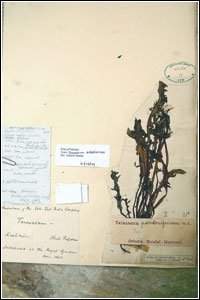
Of them 300 are type specimens, which means they were named for the first time in the world by the KU team. The collection includes some very old specimens of the 19th century, many gifted by the Royal Botanic Gardens, Kew, and the British Museum. The rest were either acquired in exchange or brought on loan to be returned later after study.
Besides KU, there are three major institutions that have herbaria; the National Herbarium PARC, Quaid-i-Azam University and the Pakistan Museum of Natural History, all in Islamabad. The other educational institutions located in Peshawar, Hyderabad, Mirpurkhas, Lahore, Faisalabad and Quetta have quite small collections.
Local expertise
 About the unique aspects of The Flora of Pakistan, Dr Qaiser asserted that the work has mostly been done by locals while in most neighbouring countries, the major research and editing in recording the flora is done by foreign experts. For instance research on Sri Lanka’s flora is written by Americans, Iran’s by Austrians, Turkey’s by Scots, Saudi Arabia’s by mostly Pakistanis and Iraq’s by an English team of the Royal Botanic Gardens, Kew.
“Our work is more advanced and critical and the study is considered as one of the most authentic in the scientific world. It’s superior in quality and content even to the Indian research that has been found to be plagued with mistakes despite having a vast collection and literature of the British period, 50 herbaria with 500 staff, two permanent staff at Kew Gardens as well as an entire body, the Plant Survey of India, working for decades”, he said.
About the plant details being recorded in the latest volume, Dr Qaiser said that it contained information about the habitat, characteristics, distribution, local names, identification of threatened species, chemical and medicinal properties, besides the scientific names of flowering plants.
At the moment, research is being carried out in Thar, Chitral, the Northern Areas as well as in Sindh and Balochistan. The project team includes Dr Sultanul Abedin, Dr Y. Nasir, Dr Rubina Abid, Dr Surriya Khatoon, Dr Anjum Parveen, Dr S.M.H. Jafri, Abdul Ghafoor, Jan Alam, Sherwali and Zumrud Tajuddin.