



 0
0

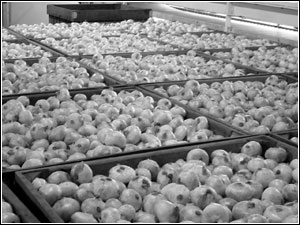 Despite huge import of the commodity during these months, there has been no let-up in price of onion. The local markets are flooded with imported Chinese and Indian onion.
An agricultural country once known as a bread basket for the region, is now failing to feed its people with this essential food item.
The reason often given for the sudden rise in prices of vegetables is usually a bad crop. For recent price hike, the blame is being put on a bad crop in Sindh which accounts for some 45 per cent of the country's onion output.
One does not just wake up one day to find that a certain crop has not had its expected yield. The agriculture department, by its own admission, knew that the last monsoon season's unusual rains had affected the onion crop and yet the officials concerned chose not to plan ahead on how to meet the gap between demand and supply.
This apathetic attitude on the part of the agriculture department is simply not acceptable. The sudden and manifold rise in the price of the staple produce is causing hardship to people who can ill-afford to purchase onions at their current and still rising prices.
The government must find ways and means to stabilise the produce's price at the earliest. It will also be worth investigating how much of the current price hike has to do with hoarding by the unscrupulous middlemen and profiteers who are known to create artificial shortages of essential commodities.
Onion is the largest produced vegetable and is consumed not only in Pakistan but all around the world. It has special qualities which add to taste and flavour to food, hence is used in all our traditional cuisine and culinary preparations. In addition, it is also relished in raw form with meals. Since it is consumed by all classes of people, therefore assumes a place of essential item in our daily food intake.
Onion is produced in at least 170 countries of the world. According to the United Nations Food and Agriculture Organisation, there are an estimated seven million acres of land in the world, producing over 32 million tones of onions each year. Approximately nine per cent of this global onion production is traded internationally.
Pakistan has been on the list of the leading onion producers of the world. China ranks first in world onion production followed by India, USA, Turkey, Pakistan, Iran, Indonesia, Vietnam and Myanmar.
Interestingly, Pakistan not only stands with world's top onion producing countries but also find itself among countries having highest per capita onion consumption. The average onion consumption is approximately 6.5 kg of onions per person each year across the world. Per capita consumption of onion in Pakistan is reported to be 10 kgs per annum.
However, Turkey has the highest onion per capita consumption with an astounding 36.6 kgs each year leaving behind Libya which has 32 kg peryear consumption.
Keeping in view the consumption level and rate at which our population is expanding, Pakistan must produce around 15 million tones of onion annually.
In order to remain self sufficient in onion, not only the area of production but our lower national yield will have to be increased substantially. Our current national average onion yield stands some where around 14 tones per hectare against Korea 54, Australia 45, Japan 37 and Iran 30 tonnes per hectare. If we are able, some how, to reduce this huge yield gap one can imagine, where could we go.
Although there has been a progressive increase in area and production of onion in Pakistan, but this increase has not served the local requirement consistently as evident from recurring shortages during past many years. In 1999-2000, the area increased to around 110 thousand hectares, production was at1648 thousand tones and yield was 15 tones/ha. Since then, both the area and yield has been declining continuously creating commodity shortages. Poor storage facilities with farmers is also a major factor in post- harvest losses.
Despite being among the leading onion producers of world, availability of the commodity round the year in our country has remained an issue which needs to be addressed urgently.
Over- production some times take the price of onion to rock bottom due to non- availability of proper storage facilities and absence of export guidance, discouraging the farmers to go for the higher production. In contrast, some times the price of the commodity goes sky rocketing because of extreme shortages due to production, pest attack, hoarding, and illegal export to neighbouring countries. This shows that concerned agencies make no reliable assessment of production and consumption of onion and for export of the surplus commodity.
Keeping in view the favourable agro-climatic conditions for onion production,\particularly in Sindh and Balochistan, it is required that small to medium size onion farms be set up in potential areas and all sort of help from the concerned line departments be extended to these farms.
South East Asian and Middle Eastern countries are major importers of the onion and offer great potential for exports. There is an urgent need to adopt diverse strategies and produce newer varieties of onion to carve out a niche in the nearby international markets.
The qualitative and quantitative improvement in both production and marketing over the years has established onion cultivation as a safe source of earning to farmers and to internal traders and exporters. Onion has now become a cash crop which is in demand in export market throughout the year.
Agriculturists still believe that the country can become an even big producer and exporter of onions in the region. In order to achieve this task, arrangements would have to be made to ensure that onion producing areas are catapulted to the front-line by expanding its sowing area and increasing the yield.
For this to happen, the government must plan and implement various schemes like imparting technical guidance at each stage from sowing to production and post- harvest management including proper storing of surplus quantity.




























