0
0

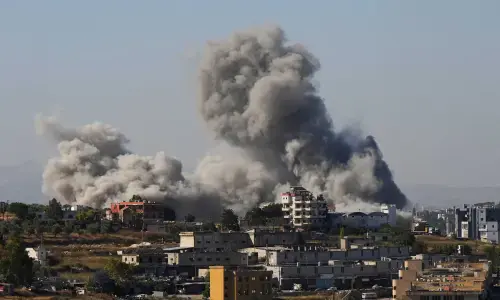
WASHINGTON, Nov 2: A prestigious US think-tank, the Council on Foreign Relations, on Thursday quoted counter-terrorism experts as saying that an unmanned US predator drone may have directed Pakistani military’s air strike on a madrassa in Bajaur on Oct 30.
The report also referred to Pakistan’s claim that Pakistani officials had gathered intelligence and carried out the attacks without US help and targeted only terrorists.
“Still, questions remain about what transpired on Monday at the madressah,” the report noted. “Despite Islamabad’s insistence that the operation only employed Pakistani military helicopters, some locals claim they saw an unmanned US Predator drone fire at the religious school.”
The CFR also mentioned a report published in the Counterterrorism Blog, an online forum of terrorism experts, which cited a military intelligence source confirming that a Predator worked in concert with helicopters to launch the attack.
In that report, a counter-terrorism expert Daveed Gartenstein-Ross claimed that he `spoke with a military intelligence source who confirmed that the Bajaur air strike was conducted by a US Predator, adding that helicopters were also involved.”
The CFR report also examined the claim that the attack targeted senior terrorist leaders. The report noted that the US carried out a similar air strike on a village in Bajaur in January which killed 18 civilians but missed its target, identified by US officials as Al-Qaeda deputy Ayman al-Zawahiri, by a matter of hours.
After the Oct 30 attack, a Pakistani security spokesman said the latest attack also targeted Zawahiri, along with Abu Ubaidah al-Masri -- a suspect in the plot to down transatlantic airliners with liquid bombs this summer -- though neither man was present when the helicopters opened fire.
The report in the Counterterrorism Blog also examined this claim, saying that Zawahiri sightings are a dime a dozen.”
“Decapitations of an organization’s leadership, known as targeted killings, play an increasing role in US counterterrorism efforts, though it’s not clear whether Pakistani officials have increased use of this method,” the CFR report added.
CFR also referred to a recent report in its Foreign Affairs magazine in which US terrorism expert Daniel Byman questioned the strategy’s effectiveness.
Referring to a recent targeted killing by Israel, Mr Byman wrote: “The reaction to the attack was overwhelmingly negative. Hamas called it a massacre and said it would fight until "Jews see their own body parts in every restaurant, every park, every bus and every street." Hundreds of thousands of Palestinians turned out to mourn the victims. World leaders condemned the attack, and even the Bush administration called it heavy-handed.”
Similarly, the Oct. 30 bombing of a madrassa in Bajaur has provoked widespread protests in Pakistan, highlighting the political tightrope walked by President Pervez Musharraf “who finds himself sandwiched between domestic pressure to resist Western influence and international pressure to pursue terrorists on his territory.”
The report recalled that while addressing a CFR meeting in New York in September, President Musharraf also acknowledged that this “makes his the most difficult job in the world.”
The report said that although President Musharraf was a partner in the war on terror, his critics -- including Afghan President Hamid Karzai, and numerous NATO commanders -- accuse him of turning a blind eye to the resurgent Taliban.
The CFR also referred to a Dawn report which said that people inside Pakistan railed against his alliance with the United States.
“Intelligence analysts condemned a September peace agreement with tribal leaders in the North Waziristan as surrender to the terrorists. … Indian and British officials have accused Pakistan’s intelligence agency, the ISI, of aiding terrorists who operate in India, Afghanistan, and elsewhere.”
The report noted that last month on Meet the Press, President Musharraf conceded that retired ISI officers might be aiding the Taliban.