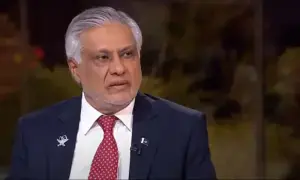
IN April last year, India suspended the decades-old Indus Waters Treaty, which contains no provision allowing it to be held in abeyance unilaterally. In doing so, New Delhi also breached the broader principles of international law governing shared water resources. Last June, the Permanent Court of Arbitration ruled against the suspension, saying that it went against the letter of the treaty. The same court ruled last month on India’s hydropower projects at Ratle and Kishenganga; it found that India had been inflating storage capacity through engineering workarounds. While addressing a seminar recently, Deputy Prime Minister Ishaq Dar said that India’s actions were based on “imagined capacity” and “artificial load curves” used to dodge the IWT’s release limits. India rejected both rulings, calling the court illegitimate. A country that loses twice in arbitration and criticises the court both times is actually saying that it is above the law and that no rules apply to it.
India’s actions match the rhetoric of its leadership whose controversial infrastructural ambitions are reflected in their menacing words. The water minister C.R. Patil has openly said the goal was to ensure that not a drop of water reached Pakistan. His boss PM Narendra Modi has repeatedly tied this shared natural resource to his security doctrine. Coming from the top leadership, these remarks underscore the Indian strategy. According to Mr Dar, at least 17 Indian projects are underway on Pakistani rivers that he has rightly pointed out will “drastically alter the Indus River System as a whole, giving New Delhi the tools for ‘hydro-hegemony’ that it so desires”. Such actions constitute the weaponisation of water by an upper riparian and threaten the future of a population of 240m. Islamabad has sensibly stuck to the arbitration process, despite having previously warned that altering the river flows could be treated as an act of war. What is missing is international pressure on New Delhi to right the wrong it has done. What the world needs to understand is that the precedent that India is setting will not remain confined to the Indus. Every upper riparian state is watching the saga unfold to see what will happen to a country that blatantly ignores its international treaty obligations. If it appears that there are no consequences for such a criminal act, India will not be the last country to weaponise water.
Published in Dawn, June 20th, 2026