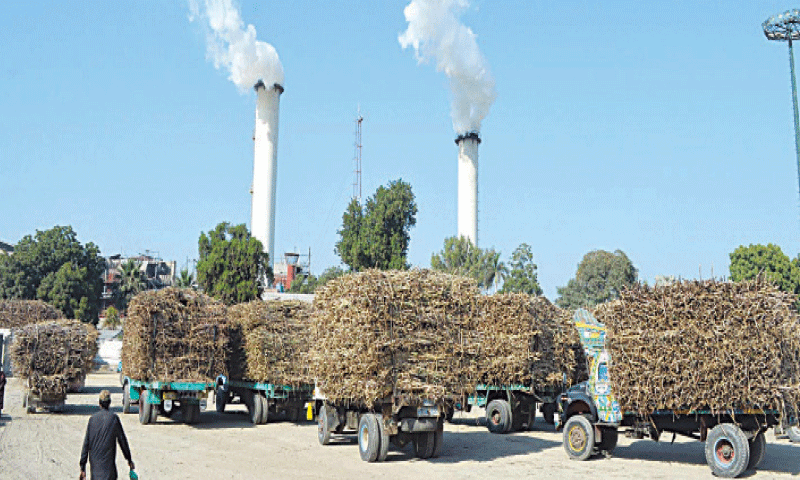

Every year, as November approaches, Pakistan’s sugar sector gets embroiled in a familiar cycle of controversy, uncertainty and competing interests. Growers want millers to start crushing on time, offer fair prices and ensure timely payments. Millers, on their part, cite unsold inventories, uncertainty over export and financial constraints as reasons for delaying operations. Caught between the two, the government struggles to protect consumers by keeping sugar prices affordable without undermining the financial viability of the industry. More often than not, it fails to satisfy either side, leaving the sector mired in uncertainty at the start of another crushing season.
This recurring confrontation is more than a seasonal disagreement between farmers and industrialists. It rather reflects the failure of successive governments to evolve a coherent, long-term framework for managing sugarcane production, procurement, processing and marketing. Consequently, what should be a routine agricultural and industrial activity has instead become an annual flashpoint, holding everyone – rural livelihoods, the sugar supply chain and consumers – hostage for the next entire year.
In recent years, alongside this annual controversy, an equally contentious pattern has emerged: a recurring cycle of sugar exports, subsequent price hikes and eventual imports. Under pressure from millers, the government invariably allows export, sometimes even subsidising it – ostensibly to earn foreign exchange, offload surplus inventories and help start crushing season. However, as domestic supplies tighten and prices begin to soar, the government scrambles to import sugar to stabilise the market.
Farmers are protesting delay in crushing; millers want export of sugar, holding crushing season hostage; the government appears reluctant and the situation is approaching a boiling point. A policy can only be sustainable if it balances the interests of all three parties.
Right now, the situation is exactly the same. Farmers are protesting the delay in crushing operations. Millers, not satisfied with export permission of 200,000 tonnes, want to send out another 1.1 million tonnes. The government, bitten by the last experience of export, is reluctant.
According to the Pakistan Bureau of Statistics, Pakistan exported approximately 765,734 tonnes of sugar (against permitted 700,000 tonnes) during the first 11 months of FY2024-25, generating around $411 million. These exports were authorised in phases after the government and industry apparently sat together many times and identified a substantial domestic surplus.
However, the domestic price situation belied surplus claims. In December 2024, ex-mill sugar price was around Rs125-130 per kg. By June 2025, retail prices jumped to Rs200 per kgi n most parts of the country, and the government approved an import plan for 500,000 tonnes to boost domestic supplies.
The SBP in a 2024-25 report linked export with squeezed domestic availability and sugar price trends. It also noted that sugar contributed significantly to urban food inflation during the same period.
This reversal raised a fundamental question: how did a country, with surplus stocks for exports, find itself in short supply within months and was forced to import the same commodity? Though the government never answered this question, the critics, however, did. To them, most of the millers belong to, what they pejoratively call, sugar mafia, and the ruling elite and it is the most convenient way to make a windfall of hundreds of billions of rupees within a few months.
The State Bank of Pakistan, in its 2024-25 report, linked export with squeezed domestic availability and sugar price trends in the second half of the financial year. It also noted that sugar contributed significantly to urban food inflation during the same period.
The foreign exchange argument proved equally false. The average export value during the process was around $537 per tonne. By comparison, the average import price was $575 per tonne. Price differential is a routine when transactions take place at different times, but the comparison does raise questions about the assumptions and consequences of exporting sugar and then importing at a higher price.
A briefing to the National Assembly in October 2026 further deflated the export case when it was told that 306,737 tonnes of sugar was imported at a total cost of Rs54.16bn. Approximately 198,668 tonnes had been sold at an average price of Rs168 per kg, while 108,069 tonnes is still with the Trading Corporation of Pakistan, and the government is considering the export option.
Now consider the final reality: Pakistan first exported sugar, subsequently imported to restore domestic supplies, and then faced the cost of unsold imported stocks. The ECC this September noted inaccurate demand-and-supply projections and the cost of holding imported sugar stocks.
It is not to say that sugar exports or imports are undesirable: both can be justified under appropriate circumstances. The problem is when such decisions are made without reliable assessments of production, consumption, carryover and strategic reserves – or, as critics allege, at the behest of vested interests, the consequences are then borne by all, by consumers through price volatility, by farmers through market uncertainty, and by taxpayers through the costs of inventory management.
Millers are once again pressing for export of sugar, with the crushing season being held hostage. The government appears reluctant and the situation is approaching a boiling point.
What Pakistan needs, therefore, is not another round of ad hoc and unsubstantiated decisions on exports, imports or prices, but a predictable, long-term, transparent and rules-based policy framework that brings certainty to the sector.
To achieve this, it must establish a credible system for assessing sugarcane production, expected sugar recovery, domestic consumption, carryover stocks and exportable surpluses before authorising any exports. It must be linked to independently verified estimates and the maintenance of strategic reserves, rather than granted permission for export under pressure from the industry, later lick price wounds and scramble to contain price increases through import.
Similarly, any decision to import sugar should be based on transparent assessments of actual domestic requirements, with clear accountability for procurement costs, pricing and inventory management.
Equally important is the need to address the underlying conflict between growers and millers. Crushing should begin at a predictable schedule, growers should receive a fair and timely price, and millers discouraged from using delayed operations as leverage in negotiations over exports. The government must also ensure that its decisions do not disproportionately favour one stakeholder at the expense of others. A policy can only be sustainable if it balances the interests of farmers, millers and consumers.
Ultimately, sugar is too important to be managed through annual bargaining, myopic political calculations and reactive interventions. The recurring cycle of surplus claims, export permissions, domestic price hikes and emergency imports reflects a failure on all fronts: policy, planning and institutional coordination. Unless this cycle is broken through credible data, predictable rules and accountability, Pakistan will continue exporting sugar when it believes it has too much, import it when it feels left with too little, and pass the burden on to consumers and taxpayers.
Published in Dawn, The Business and Finance Weekly, November 16th, 2026