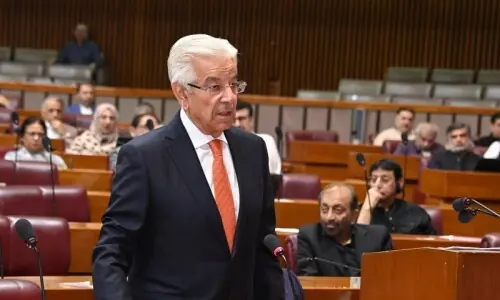
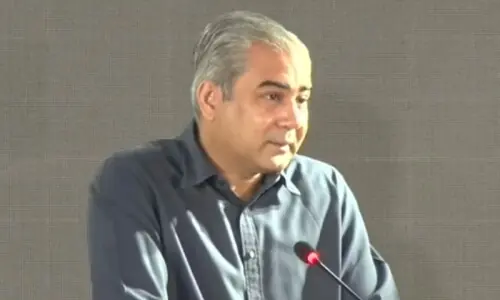
THERE is quite a bit of noise and confusion emanating from Islamabad on the question of new provinces. The defence minister, Khawaja Asif, recently suggested the possibility of there being as many as 12 provinces under a new configuration, drawn on administrative rather than ethnic or linguistic lines. Now, Interior Minister Mohsin Naqvi wants to hold a referendum to ‘settle’ the matter.
In between, there has been talk of a 28th amendment being rushed through before the year is out. Which one is it going to be? Interestingly, Mr Naqvi has also claimed that he and PPP Chairman Bilawal Bhutto-Zardari are “almost on the same page”. He was referring to the latter’s suggestion for a “political reset”, but one wonders if there’s more to it. It would be difficult to square an agreement on new provinces, given the PPP’s stated stance so far. Mr Bhutto-Zardari only recently said he’d like to see the matter buried.
Is one to understand that while the PPP is opposing any division of Sindh, it is more relaxed to the possibility of new units elsewhere? If so, it would not be standing on principle. It cannot be that the party wants one province’s boundaries to be respected as sacred while every other’s are considered negotiable. Unless the PPP is deliberately using Sindh as a bargaining chip, it should issue a clarification with a clear, consistent position on new administrative units, not one tailored to protect its home turf.
As regards the possibility of a referendum, it must be pointed out that while there is no harm in conducting one, it will not clear the constitutional hurdle. Article 239(4) requires any amendment to a province’s limits to be passed by two-thirds of that province’s assembly. No matter how resoundingly a referendum is passed, it will not override that condition. This suggests the idea was not thought through.
There is also the question of credibility. The chief election commissioner recently accused the federal government of trying to sabotage Islamabad’s local government polls by creating hurdles in the appointment of teachers for election duties. How can a government that is not even letting the federal capital elect its own councils be preaching about bringing power closer to the people through new administrative units? To be clear, none of the above means that any debate on administrative reforms is illegitimate.
However, a change of this magnitude must be built on consensus, not handed down by a dispensation whose mandate remains contested. If the ruling parties want new provinces, or a referendum on them, they should put it in their manifestos and seek a mandate at the next general election. If voters endorse it, the next parliament can act. Until then, the idea is best left to marinate a bit more.
Published in Dawn, November 14th, 2026