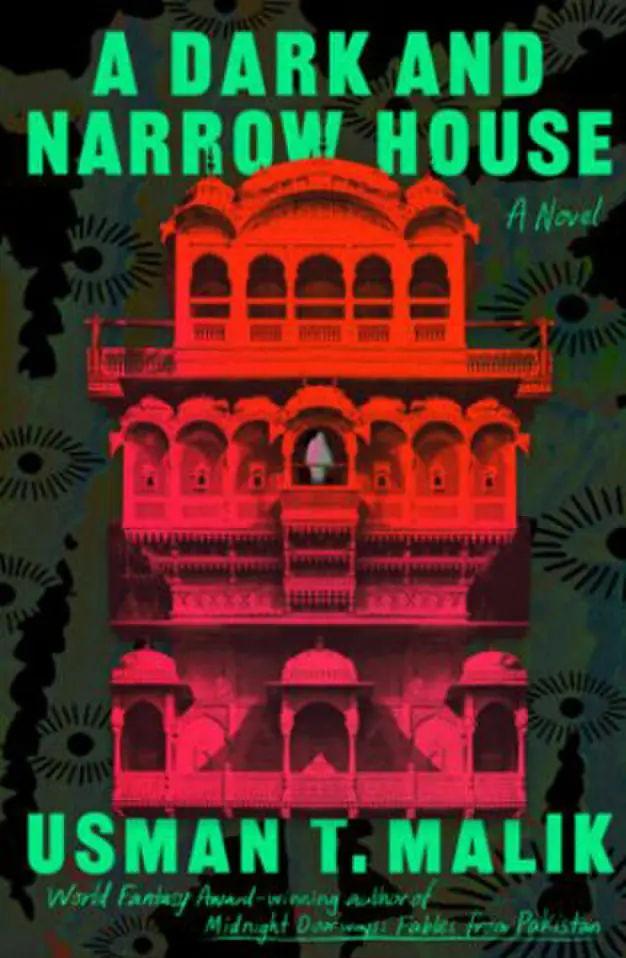
A Dark and Narrow House
By Usman T. Malik
Penguin
ISBN: 9798217043910
448pp.
The tradition of oral storytelling has long been considered a medium of recording history. Stories are a collective heritage, an integral part of the human experience. They function as bridges, connecting cultures and traditions while defying the bounds of time, geography and language.
Before the written word, it was storytellers who would pass on generational wisdom and caution, steeped in imagination and colour. With the passage of time, these stories became intertwined, as they travelled across oceans and continents like migratory birds, making their way into human imagination. Stories and their narrators have profound power in a way that, with each retelling, the sphere of their influence grows, as they ripple through art, music and written literature, becoming a part of the culture that receives and nurtures them.
This is what lies at the heart of Usman T. Malik’s debut novel A Dark and Narrow House, as he delves into the hold that stories have on us — stories we have grown up listening to and those that we tell ourselves to keep the monsters at bay.
Malik’s novel begins at a crossroads; the world is in the throes of a mysterious plague. Seven friends congregate at a palatial mansion, Parvati Haveli, in Lahore’s countryside. It is here that the group unearth a sealed chest from a hidden cave and, as they pry it open and carry it across the threshold of the haveli, they realise that they have unwittingly awakened a sinister force — a faceless adversary, waiting to be set free and one that imprisons them within the confines of the haveli.
Like a siren song, the same haveli that had beckoned them with the promise of escape from a world besieged by sickness, now traps them and reveals itself as a deceptive labyrinth. It doesn’t take long for the friends to realise that, in order to escape the haveli, they must first face their own demons.
Blending gothic fiction and folklore, this atmospheric debut novel explores the power of stories to shape our understanding of the world and ourselves
There is Mira, who carries the weight of a great personal tragedy that makes her feel detached from the world of the living but not yet part of the world of the dead. Omar, an accomplished young man, hides a dark secret right below the surface that threatens to erupt at the sight of any weakness. The other five friends also carry their own crosses, hidden away in the crevices of their personalities.
Malik highlights these shortcomings as part of human nature but doesn’t allow them to make the characters feel small. They persevere silently without grandiose speeches, and it is this steadiness that makes them stoic. As a writer, Malik demonstrates his own humanity, as his protagonists, who are ordinary, damaged people, keep choosing to face what they would rather avoid, and this is what makes them so relatable.
Malik’s writing has an almost rhythmic quality to it. The novel unfolds like an epic poem steeped in Middle Eastern folklore, Subcontinental tales about tilisms [enchantments] and Islamic mysticism. Like the hudhud (hoopoe) in Farid-ud-Din Attar’s mystical 12th-century poem The Conference of the Birds, Malik gathers his protagonists, guiding them to embark upon a journey that is as much about a search for individual truths as it is about trying to find an escape from the haveli.
Malik enables his reader to experience how the characters transform as they immerse themselves in the topsy-turvy reality of the haveli. He understands human nature and what it costs to confront the self. Like the birds who follow Attar’s hoopoe in search of the Simorgh [phoenix] and end up discovering their inner selves, Malik’s protagonists step into an abyss, struggling against what seems an external enemy, only to realise that victory and freedom will require them to overpower their own demons first. Be it Attar’s birds or Malik’s characters, neither emerge unscathed.
This sensibility also shapes Malik’s writing technique. His prose reminds me of Spanish author Carlos Ruiz Zafón, renowned for blending gothic fiction and magical realism, all the while creating atmospheric settings and treating a place as a living thing. As Zafón gives Barcelona and its crumbling mansions breath, Malik gives Parvati Haveli and its surroundings a pulse and a heartbeat the reader can feel beneath the words.
Malik builds the atmosphere with quiet restraint; it is less about an event and more to do with silences that last a beat too long, an overwhelming stillness that engulfs the ancient mansion. A sense that the setting itself is watching. This is reminiscent of Zafón’s Cemetery of Forgotten Books, a labyrinth of abandoned stories, unsettling by their mere existence and with no announced menace. Malik’s dread works similarly, without breaking into a spectacle; it is visceral and palpable, drawing in the reader who feels it coming before the character admits to it.
Parvati Haveli becomes an extension of the protagonists, as Malik breathes life into it: “So many jharokas [enclosed balconies] with so many windows. With its dozens of ocelli, what depth of vision must the house possess? The Yellowstone of its skin, the mouths of its arches, the fingers of minarets in its corners, forever spinning those cupolas — the haveli sat majestic like a sphinx on secret sands.” The haveli exists beyond the confines of the physical world, a silent observer of the lives lived within.
Reading A Dark and Narrow House is a richly cerebral experience. Malik’s prose is evocative of a Sufi allegory in that it carries the spiritual searching of Farid-ud-Din Attar’s epic poem, together with the command of setting and imagery that marks Zafón’s best work. Malik’s command over his prose is omnipresent throughout the novel as he leads his reader through the enchanted worlds of Tilism-i-Hoshruba and the transformative work of the artist Sadequain, all towards a single idea: the search for one’s true self.
Each layer rewards the reader’s attention and, like a matryoshka doll, as the story unfolds, the depth and nuance fully register in retrospect. Malik’s novel is a reminder of the importance of storytelling and the power of the human imagination.
“Conscious thought, imperative thought comes from the godhead,” writes Malik. “It carries a spark of divinity in it, and imagination, with its wild confusion and bursts of inspiration, reshapes the universe every second.” Nowhere is this more demonstrable than while reading A Dark and Narrow House.
Long after I turned over the last page, Malik’s novel stayed with me and, like the birds in Attar’s poem, I finally left it changed by the journey.
The reviewer is a freelance writer with a background in law and literature. X: @ShehryarSahar
Published in Dawn, Books & Authors, November 15th, 2026