For one woman interviewed for the 2019 social assessment of Karachi’s planned Yellow Line Bus Rapid Transit (BRT), getting to her job destination meant walking 20 minutes to a road crossing, paying for a rickshaw and then paying again for a bus.
Other women interviewed for the assessment relied on shared three-wheelers that waited to fill up with passengers before leaving. For some, the journey could take two hours each way. Monthly transport costs ranged from Rs3,000 to Rs6,000 in households where incomes of Rs20,000 to Rs30,000 were common.
Fares can eat into an already modest wage. An unreliable connection can make a worker late. A second fare at each end of the journey can make studying at a college or a job across town too expensive a proposition to take up.
The draft for Pakistan’s Auto Policy 2026-31 revolves around car prices, manufacturers and tariffs. Yet, most households in the country own no car and struggle with the daily cost of commuting. Mobility for work, education and healthcare remains restricted due to unavailability of affordable and safe public transportation choices. How can Pakistan’s auto policy serve the people at large and not just the top decile of households in the country?
THE FAULT IN OUR DRAFTS
In April, when petrol rose by more than Rs137 a litre, governments briefly treated the price of a bus ticket as a cost-of-living issue. Islamabad announced 30 days of free public transport. Punjab’s relief ran for 69 days, with authorities estimating that hundreds of thousands of passengers a day used the free services. The relief ended, but the daily cost of getting to work remained.
Pakistan now has a chance to address some of that cost through its next auto policy. The draft Auto Policy 2026-31 has been okayed by Prime Minister Shehbaz Sharif but is still awaiting final approval as the Ministry of Industries and Production is set to forward the draft policy to the Ministry of Finance, which aims to share it with the International Monetary Fund (IMF) for review.
This policy would reportedly reduce tariffs, open a formal route for commercial used-car imports and expand the role of electric vehicles. These changes could give car buyers more choice. The draft also shapes how buses and two-wheelers are taxed, which vehicles get incentives and where the proceeds of a proposed automobile levy go.
The problem, in my view, is that the debate remains organised around the vehicle and its producer. The household experiences it as a sequence of fares, waits and transfers. An auto policy cannot run provincial bus services, but it can reduce fleet costs and make public support conditional on affordable service. That connects industrial policy to the ability to earn a living.
Those decisions should be judged by what they do for the journeys people make every day. For most Pakistani households, the price of a bus ride is a more immediate concern than the price of a new car.
WHO’S BUYING THE ALTO?
Pakistan’s assemblers sold 155,631 passenger cars in 2025-26. Including separately reported jeeps and pick-ups takes four-wheeler sales to about 206,000. Motorcycle and rickshaw sales totalled roughly 1.97 million.
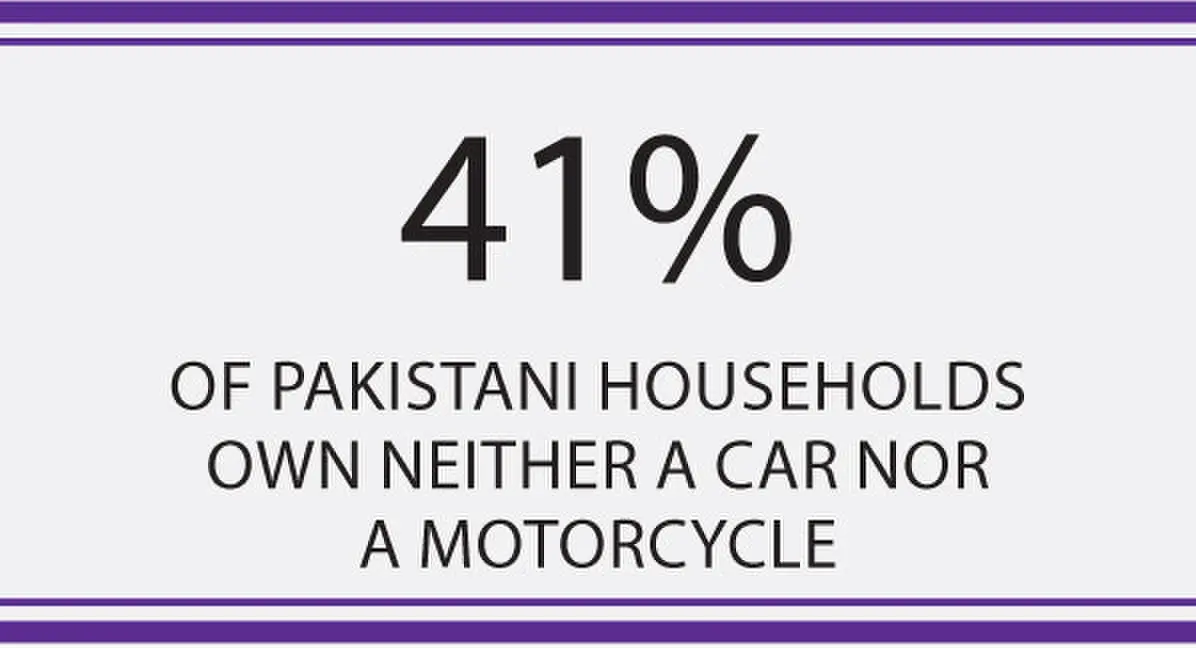
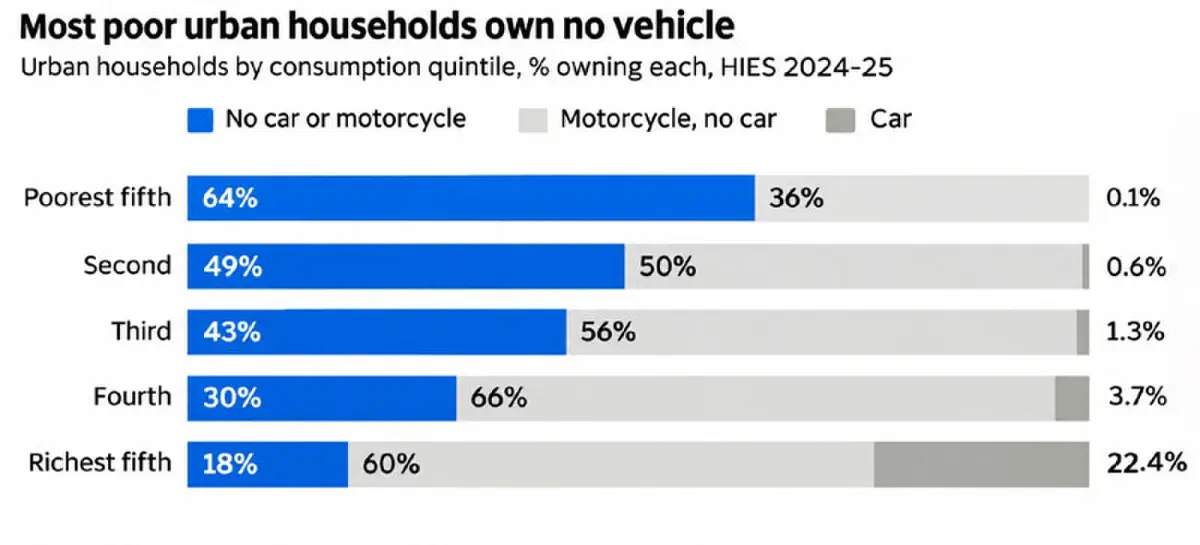
My analysis of the 2024-25 Household Integrated Economic Survey (HIES) shows how differently Pakistanis get around. About 6.6 percent of households own a car and 57 percent own a motorcycle. Roughly 41 percent own neither. Among the poorest fifth of urban households, nearly two-thirds have neither vehicle and only about one in a thousand own a car. Among the richest urban fifth, more than one in five own a car.
A Suzuki Alto VXR lists at about Rs2.99 million. The survey puts average household income at Rs82,179 a month, so the Alto costs more than three years of total income, before a household pays for food, rent or anything else. One reported estimate puts the likely reduction in small-car prices under the Auto Policy draft at around nine percent over five years. Applied to the Alto, that would still leave it costing about 33 months of average household income.
There is a case for bringing those prices down faster.
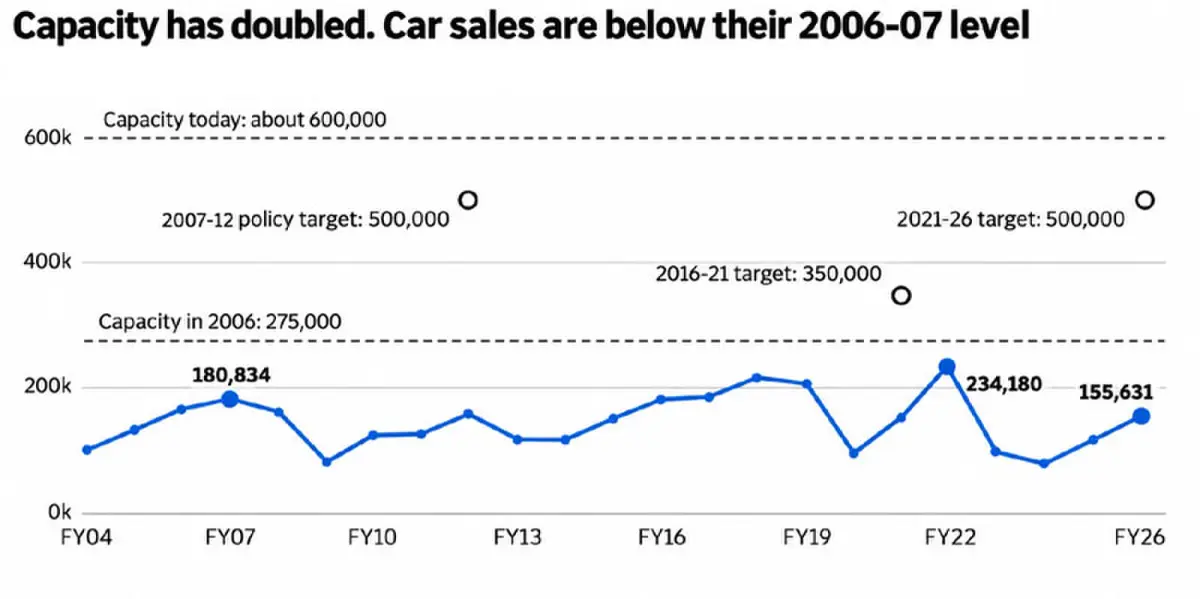
In 2006-07, local assemblers sold 180,834 cars, whereas passenger car sales reached just 155,631 in 2025-26. The figures are imperfectly comparable because classifications have changed and SUVs have become a bigger part of the market. Still, Indus Motors estimates that the industry can assemble about 600,000 vehicles a year and uses roughly 30 percent of that capacity. New manufacturers have entered the market, but factories still have far more capacity than the market can absorb.
The entry of more assemblers does not by itself resolve this. If each operates a small plant behind similar tariff protection, the market can acquire more brands without acquiring the scale or price competition consumers need. Lower duties on finished cars would strengthen the pressure to compete, but duties on imported components also matter. A sensible transition should expose producers to competition while allowing them to obtain inputs at competitive prices.
For some smaller imported cars, one reported tariff schedule keeps customs duty at 50 percent for the first two years and then brings it down in stages to 15 percent by 2030-31. Bringing those cuts forward would put earlier pressure on local producers to compete on price and quality. If the government also wants to discourage fuel-hungry vehicles, it can tax size or fuel use directly.
A cut in customs duty does not translate directly into an equal cut in the showroom price. Exchange rates, other taxes and producer margins impact what the buyer pays. I would judge success by actual prices and product quality, rather than the number of assembly licences issued. A tariff timetable that can repeatedly be deferred offers consumers little assurance.
AN ELECTRIC SOLUTION?
The distribution of electric vehicle incentives deserves the same scrutiny.
Some reported proposals for electric cars include a favourable sales tax rate and a financing ceiling of Rs10 million. If a 17 percentage-point tax preference (the difference between tax rates on electric vehicles as compared to on an internal combustion engine vehicle) is applied to an Rs8 million pre-tax car, the buyer’s tax advantage would be Rs1.36 million.
That is roughly the value of 21 electric-motorcycle subsidies of Rs65,000 each under the Pakistan Accelerated Vehicle Electrification (PAVE) programme. The actual benefit would depend on how the tax is applied and what the government ultimately approves. The comparison shows how much support can go to a single purchase.
Equivalent fiscal support does not mean equal benefits from different vehicles. A higher loan ceiling does little for someone without a down payment or an income that a lender will accept. Eligibility matters as much as the advertised concession.
Electric cars can cut petrol use, especially for people who drive long distances. But a household that cannot finance any private vehicle needs a different kind of help. A bus fare can determine whether someone in that household works at all.
THE HIDDEN COST OF BEING UNABLE TO TRAVEL
The poorest fifth of Pakistani households spent 4.8 percent of their budgets on transport, compared with 6.7 percent for the richest fifth. In cities, the respective figures are 4.2 and 6.5 percent.
If spending were the measure of need, the figures would suggest transport was a bigger problem for the rich. But consider: a household survey counts the fare someone paid. It has no fare to record when a worker walks to save money, a woman turns down a job she cannot reach safely or a student stays home because college is too far away.
The poorest fifth also spends almost half its budget on food, compared with about 29 percent for the richest fifth. Once food and the estimated rental value of housing are set aside, transport takes up a more similar share of what remains.
The estimated rent includes the value of living in an owner-occupied home, even though no rent changes hands. Removing it from the comparison does not create cash for a bus ticket — it changes the denominator. I read the low transport share as a reason to investigate journeys people cannot make. The expenditure survey alone cannot tell us how many jobs were declined or classes missed.
My analysis puts transport spending for the poorest fifth at about Rs254 per person a month. At Rs20 a ride, that pays for six complete return trips. A World Bank benchmark used in urban transport affordability studies allows for roughly 60 one-way trips a month. Even if someone in the poorest fifth put their entire transport budget towards a bus, they would still be well short of a month’s travel to work or school.
Among poor urban households with at least one earner and neither a car nor a motorcycle, the survey implies about Rs9 in reported in-city fares per earner per working day. People may forget small fares when asked to recall spending over a year. The figures also cannot separate journeys made on foot from those abandoned altogether. Project documents for Karachi’s Red Line BRT estimate that about 40 percent of trips in the city are made on foot or by bicycle. Some people choose to walk or cycle. For others, it may be the only way to avoid paying for several rides on a single journey.
The cost is easier to see against a wage. My analysis of the survey puts median monthly earnings for an urban paid worker at about Rs32,000. At Rs80 each way over 26 working days, the commute costs Rs4,160, or 13 percent of pay. A combination of wagons and rickshaws costing Rs200 a day takes Rs5,200, or more than 16 percent of pay.
At the household level, two earners, each paying Rs20 in both directions over 26 working days, would spend Rs2,080 a month. Against the roughly Rs40,146 monthly budget for the poorest urban households in my analysis, that is just over five percent. At Rs80, the same journeys cost Rs8,320, or about 21 percent. These comparisons use survey-period budgets and illustrative fares, not today’s measured burden. They show why a fare that looks modest per trip can be unaffordable when paid repeatedly.
For women in paid urban work, reported median monthly earnings were about Rs10,000, partly reflecting fewer hours of paid work. A 26-day commute at Rs80 each way would take about 42 percent of that amount. This is an illustration, since a woman earning Rs10,000 may work fewer days. It shows what fares can do to the gains from taking on more work.
Distance can also put education out of reach. In the survey, about 1.3 million girls and young women and 900,000 boys and young men aged five to 24 had never attended school and cited distance as the reason. Where there is a school to go to, a safe, affordable journey can remove one of the barriers to getting there.
Motorcycle ownership only partly solves this problem. A single motorcycle cannot necessarily serve two earners travelling in different directions and children going to school. Nor can we assume that every household member can ride it. Therefore, counting households with a vehicle tells us less than knowing who can use it, when and for which journeys.
A BUS PEOPLE CAN RELY ON
On Lahore’s Orange Line train, about 51 percent of reported journeys were for work and 33 percent for education. In Peshawar, a 2023 account citing TransPeshawar (a public company established by the Government of Khyber Pakhtunkhwa to manage, operate and maintain the Zu Peshawar BRT system) put women at about 30 percent of passengers on the bus rapid transit system, up from an estimated two percent on earlier services.
Other published accounts put the newer figure closer to 20 percent. The new system offered separate entrances and reserved areas, better lighting, station security and more predictable service.
Research in Lahore by economists Robert Garlick, Erica Field and Kate Vyborny offers a closer look at how transport impacts decisions about work. Through a job-search platform, the researchers offered commuting services to women. The offer of women-only transport more than doubled job application rates, while mixed-gender transport produced little response. The study measured applications, not jobs secured. It shows how the commute can deter women before an employer has even seen their names.
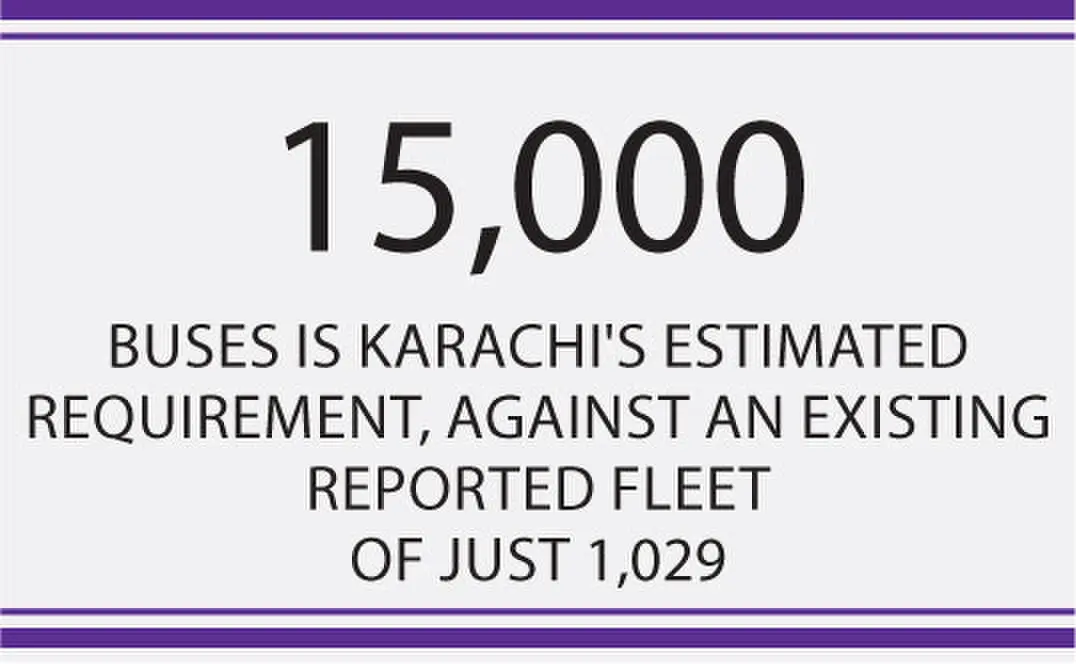
Even a new bus can be difficult to board. Writing in Eos earlier this year, Samina Hassan Laghari and Arif Hasan described Karachi’s electric buses with about 30 seats carrying 70 or 80 people, sometimes more than 100. Women told them they had given up work because of the journey. The city’s bus fleet was reported at 1,029, against an estimated requirement of 15,000.
Building more corridors can help, but people have to reach them. A cheap fare on the main route can lose much of its value if a passenger has to pay for a rickshaw to get to it. A well-lit stop is of limited use to a child who has to cross a dangerous road to reach it. The World Health Organisation (WHO) estimates roughly 28,000 road deaths a year in Pakistan, with pedestrians accounting for a large share. Official reported totals are much lower. Both the walk to the bus and the ride itself belong in a transport plan.
Reliability matters as much as the fare. A daily-wage worker who cannot tell whether a bus will arrive in five minutes or 45 has to leave early or risk losing a shift. Karachi’s Red Line has faced a much longer timetable than originally envisaged. While cities build major corridors, they also need buses running between neighbourhoods, regular departures and connections that people can use without building an hour’s uncertainty into the day.
A dependable service also reduces the unpaid time a worker must allow for delays. Time savings belong in the economic appraisal, even when they produce no additional fare revenue. They should be measured through actual waiting and journey times, rather than assumed whenever a new bus or corridor is announced.
THE COST OF THE COMMUTE
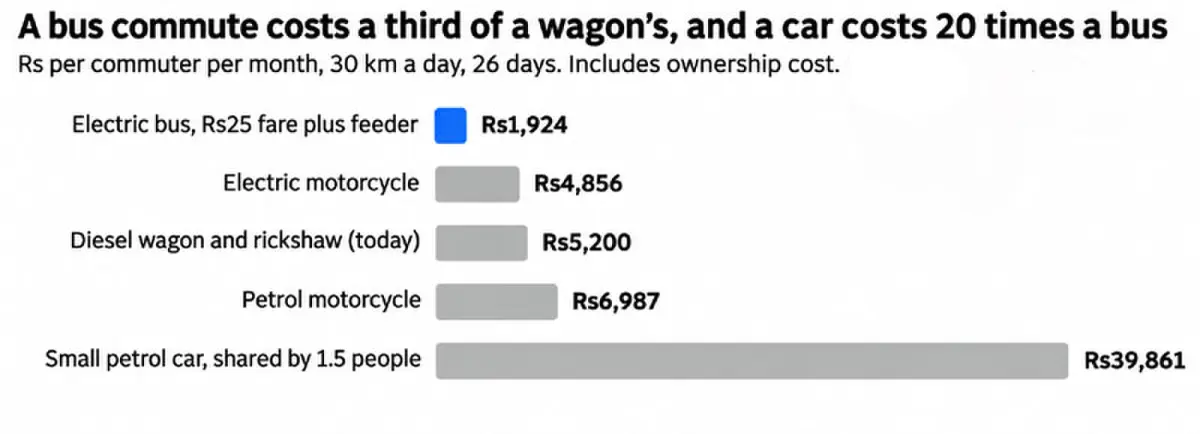
To compare the choices, I modelled the same trip across five modes, with 30 kilometres covered a day, 26 days a month. For private vehicles, the calculation includes ownership and financing costs as well as fuel or electricity. For the bus passenger, it includes a low main fare and some travel to and from the route.
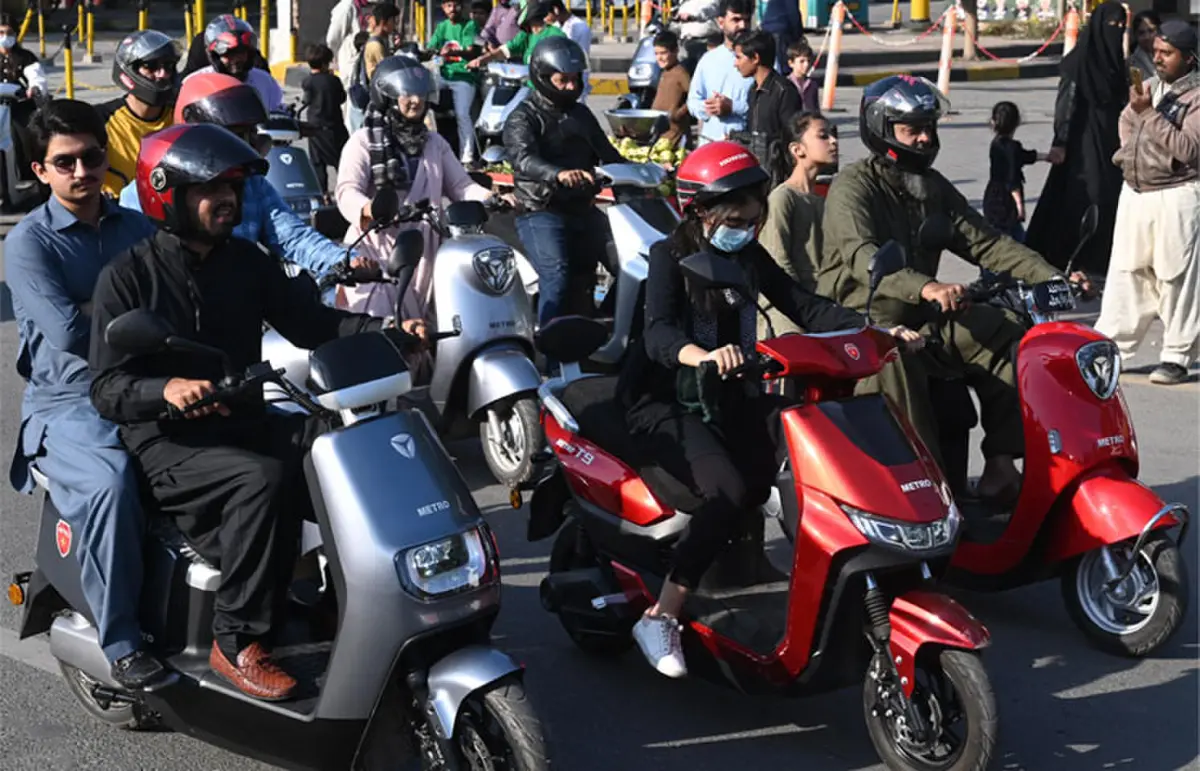
Under these assumptions, monthly costs per commuter are roughly Rs1,900 for a bus, Rs4,900 for an electric motorcycle, Rs5,200 for wagons and rickshaws, Rs7,000 for a petrol motorcycle and Rs39,900 for a small petrol car. The bus estimate includes a Rs25 fare and feeder journeys.
The model assumes petrol at Rs378 a litre, 15 percent vehicle financing and some sharing of private vehicles. These are modelled costs, not quoted monthly instalments. The bus figure is what the passenger pays after public support; it is not the full cost of providing the service.
The difference matters for the country’s import bill as well as the commuter’s wallet. Pakistan spent about $16.9 billion on petroleum imports in fiscal year (FY)26, compared with roughly $2.1 billion on imported vehicle assembly kits. The totals cover different categories, but they give a sense of the scale of dependence on imported fuel. In the model, moving one million daily commuters from motorcycles into small petrol cars would add about Rs394 billion a year to household costs and roughly $440 million to imports, including fuel and vehicles.
Electric motorcycles offer substantial savings where people already ride petrol bikes. In the model, each rupee of public support for electric motorcycles saves households more cash and generally saves more on imports than a rupee spent on buses. A bus reaches people a motorcycle subsidy cannot readily serve, including students, older passengers and households that cannot buy a vehicle. That makes a case for supporting both.
The journey being replaced matters. A bus carrying former wagon passengers has a different effect on imports from one attracting motorists. An electric motorcycle replacing a petrol motorcycle is different from an additional vehicle bought for convenience. My calculations assume those substitutions — they are not a forecast that every subsidised purchase will deliver the same saving. I would assess the programmes against what riders actually stop using.
There is a case for electric buses on routes where charging and electricity supply can support them. In an illustrative comparison, a diesel bus covering 80,000 kilometres a year uses about 18,000 litres of fuel. At the diesel price of Rs395.20 a litre, effective on November 3, that costs about Rs7.1 million. Meanwhile, an electric bus, using about 96,000 units of power at an assumed Rs39.70 per unit, would spend about Rs3.8 million on electricity. The roughly Rs3.3 million difference comes before maintenance, financing and battery costs. A city weighing the higher purchase price should count that annual saving and the reduced exposure to a diesel price spike.
Battery replacements and charging equipment also belong in the calculation. High utilisation helps recover the higher purchase price only if charging arrangements allow buses to run the promised service. Electric buses eliminate exhaust at the roadside, but overall emissions also depend on electricity generation. A national pollution claim needs a separate estimate.
HOW MANY BUSES CAN A LEVY BUY?
The Automotive Development Levy (ADL), proposed in the draft for the Auto Policy 2026-31, could raise around Rs232 billion over five years. Its reported uses include export rebates and industrial upgrading. The government should consider putting a share towards public transport and say which proposed uses it would scale back to do so.
Spread evenly, the projected revenue comes to about Rs46 billion a year. In my model, an electric bus running around 70,000 kilometres a year with 800 passenger boardings a day needs about Rs21.5 million in annual public support if borrowing costs 18 percent. At 11 percent, the contribution falls by about Rs5.5 million, to roughly Rs16 million.
At that lower cost, the entire annual levy could support close to 2,900 buses. Using only a share would pay for proportionately fewer. The levy still needs approval and the figures depend on what buses cost, how much operators collect in fares and how many people ride.
The assumptions also deserve scrutiny before anyone commits public money. Eight hundred boardings are not 800 different people: a commuter travelling both ways boards twice. At Rs25 a ride and 312 operating days, 800 daily boardings produce Rs6.24 million in annual fare revenue.
If boardings halve, that revenue falls by Rs3.12 million, while much of the cost of owning the fleet remains. The model also assumes non-fare revenue at 37 percent of fares, which requires testing against actual advertising receipts. The 11 percent financing rate is an assumption rather than a financing commitment. Any interest subsidy must be funded and a guarantee can leave the state liable if repayments fail.
Supporting 15,000 buses on those terms would cost around Rs240 billion a year. That is a recurring public expense. Pakistani households already spend an estimated Rs2.37 trillion a year on transport, according to the household survey. The question for the government is how much of that spending on a better service could save households and which trips people could make if the fare came down or the bus turned up regularly.
Household savings cannot simply be netted against the government’s subsidy bill. A lower fare partly shifts costs from passengers to taxpayers — it does not eliminate them. Nor is all of the Rs2.37 trillion available to finance urban buses. The economic case must rest on savings in fuel and time, safer journeys and better access to work, alongside a credible plan for meeting the recurring budget commitment.
WHAT THE POLICY NEEDS
The policy can start by reconsidering the reported two percent development levy on buses and reviewing duties on electric buses and charging equipment. It can give affordable electric motorcycles and rickshaws greater priority in vehicle incentives. And it can make bus funding conditional on the service that provincial authorities and operators deliver.
Localisation targets also need care. A rule designed around a petrol engine can penalise an electric motorcycle because its battery is imported. I would reward the value actually created in Pakistan, with a transition that allows battery and component suppliers to develop. The aim should be competitive suppliers that can sell beyond one protected domestic market.
For bus funding, that means setting routes, fares and safety standards, then paying operators for running the scheduled service and maintaining the fleet. Provinces would have to pay on time and operators would have to run the promised service. Passengers should be able to see how often buses ran, how long they waited, and how many services were cancelled. Cities should also track who uses the system and ask people which journeys they still cannot make.
A contract can make those obligations enforceable. The province could retain fare revenue and pay an operator for service delivered, with deductions for missed trips and safety failures. That reduces the incentive to overcrowd buses but leaves the province carrying the risk of weak ridership. Payment reserves and dependable budget releases would be necessary — private finance does not remove that obligation. Depots and power connections must be ready when the fleet arrives. I would begin with routes where demand can be tested, publish the results and expand where the service earns continued support.
I would also want a travel survey to test the arguments made here. If low reported spending chiefly reflects short, affordable journeys and incomplete recall, the case for suppressed travel (when individuals do not undertake trips or activities due to barriers or constraints) would weaken. If well-run buses attract few riders, routes and spending should be reconsidered. A policy should allow those findings to change where the next rupee goes.
Pakistan can keep a tally of cars coming off assembly lines. Over the next five years, it should also count how many more people can get to a job, a classroom or a clinic without buying a vehicle.
For a woman making that journey, it comes down to what happens after the 20-minute walk: how long she waits, whether there’s room to get on and how much of her pay she has left when she gets home.
The writer is a macroeconomist and professor of practice at IBA, Karachi. He can be reached at ammar.habib@gmail.com
Published in Dawn, EOS, November 8th, 2026