• Trump describes strike on Qeshm ‘anti-aircraft facility’ as a ‘minor attack’
• Pezeshkian says Tehran committed to talks, insists ‘no one will benefit’ from renewed hostilities
• Qatar steps up mediation to prevent renewed Iran conflict after midterm
TEHRAN: US President Donald Trump on Tuesday confirmed fresh strikes on Iran, as President Masoud Pezeshkian warned that no one would benefit from a return to war, while mediator Qatar stepped up efforts to bridge differences and avert renewed escalation.
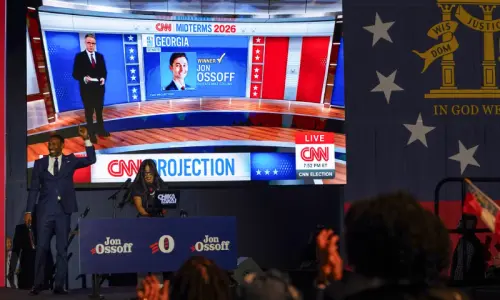
The development came as US voters prepared to cast their ballots in midterm elections that threaten Trump’s grip on power.
Iran’s chief negotiator in talks with the US, Mohammad Bagher Ghalibaf, said the Islamic republic was “ready for battle with its finger on the trigger”, while deputy foreign minister Kazem Gharibabadi said Iran retained the right to “legitimate self-defence” after the strikes.
But Pezeshkian said his government was still trying to resolve the crisis “through dialogue”, adding that “no one will benefit from this war” if it reignited, and emphasising that the country’s supreme leader had recently granted the government new powers to negotiate issues that were previously “off-limits”.
Trump confirmed the strikes on Iran in an interview with Fox News, after the Wall Street Journal, CNN, The New York Times and other outlets had reported strikes on Qeshm Island in the Strait of Hormuz.
“They built an anti-aircraft facility... As soon as it was completed, we hit it last night very nicely,” Trump said on the Fox & Friends show, adding that it was a “minor attack”.
The US and Israel launched their war with Iran with a massive wave of strikes in late February. The conflict has been stalemated for months.
Asked if Israel was involved in the latest reported strikes, an Israeli military spokesperson told AFP, “No”.
‘Iran wants a settlement’
The Qeshm attack came just hours after Trump signalled a deal with Iran “could happen”, as US voters prepared to cast their ballots in midterms dominated by public dissatisfaction with the war and the inflation it has brought.
“Iran wants a settlement, as soon as possible,” Trump posted on his Truth Social platform.
Iranian state news agency IRNA reported five explosions in rapid succession on Qeshm island, and that some residents reported seeing two aircraft flying in its skies.
Ghalibaf said Tehran had made its position clear. “The countries of the region should know that, just as the Islamic Republic of Iran stands ready for battle with its finger on the trigger, it has also given the American side a powerful and rational response,” he said in a televised speech.
“The ball is now in America’s court to prevent war.”
Qatar, a mediator in protracted indirect negotiations between the US and Iran, intensified mediation efforts amid fears the conflict launched could flare up again after Tuesday’s midterms.
Qatar said it remained hopeful of an interim deal in the war. “Both parties remain committed to the negotiation process; as we mentioned, we are facilitating the real-time exchange of proposals between them,” foreign ministry spokesman Majed Al Ansari told reporters.
Both sides “are currently reviewing the ideas and proposals we have presented,” he added.
“We remain hopeful that there is still a chance for a deal to take place,” he said, adding that Doha was working “towards an interim deal”.
“Mediators are working hard to narrow gaps between Tehran and Washington,” a senior Iranian official said, speaking on condition of anonymity. Qatari mediators travelled to Tehran on Monday night for talks on a version of a draft US-Iran deal discussed over the past eight days.
“Tehran’s conditions must be met if the US wants Hormuz reopened,” the Iranian official cautioned, referring to Tehran’s demands, including waiving oil sanctions, ending the US naval blockade and releasing frozen Iranian funds.
Mohsen Rezaei, secretary of Iran’s Supreme National Security Council, later said the US response to Iranian demands “was not convincing”, adding that Washington “must fully and explicitly address Iran’s seven conditions and act upon them”.
“Only in this case will the Strait of Hormuz be reopened,” he wrote on X.
Published in Dawn, November 4th, 2026