
Auto parts industry in panic over New Energy Vehicle policy
The Auto and Auto Parts Policy 2026-31 has turned into a mystery. Multiple drafts are circulating, yet no one outside close government circles knows the exact contents of the document, which was approved “in principle” by Prime Minister Shehbaz Sharif in early September and forwarded for “IMF review” late last month.
The country’s 1,200 auto parts manufacturing companies, which employ 300,000 people directly and 1.8 million indirectly, are in a state of panic after reading multiple leaked drafts. The latest draft begins by acknowledging the scale of the sector, noting $4 billion in foreign and domestic investment and domestic production valued at $6bn in 2026. The sector constitutes 4.5 per cent of the nation’s large-scale manufacturing, features more than 13 car assemblers, supports 1,200 auto parts manufacturers, and contributes Rs600bn in annual tax revenues.
The draft highlights three significant structural challenges. First is a distinct lack of domestic parts integration in New Energy Vehicles (NEVs) and vehicles introduced since 2016. Second is that export revenues have stagnated at just $190m. Third is a severe structural “cost of production” disadvantage relative to regional peers.
The draft celebrates a 40pc year-on-year increase in units produced. However, it fails to recognise that overall domestic demand is still lower than it was 20 years ago. For comparison, Indonesian auto demand grew by 279pc over 11 years from 318,367 units in 2003 to 1.21m units in 2014 on the back of an improved security situation after the 2002 Bali bombing, stable GDP growth, and enhanced consumer buying power.
Concerns among 1,200 manufacturers; policy gives six major shocks to the domestic industry
To address these hurdles, the draft outlines several key objectives: growing exports through integration into Global Value Chains (GVCs), promoting NEV adoption, lowering automobile prices, improving quality, protecting consumer interests, encouraging innovation through competition, and increasing transparency. The document boasts of benchmarking these proposals against peer states, emphasising a sharp reduction in tariffs to bring Pakistan’s overall weighted average tariff below 6pc by 2030. Finally, it claims a focus on increasing local value addition to reduce imports, especially for parts where the technology is already available domestically.
While the stated intentions are noble, the actual proposed measures completely contradict the objectives. The policy presents six major shocks to the domestic industry. The first shock is aggressive Completely Built Unit (CBU) duty cuts. The CBU import duties will progressively drop to 15pc by 2031. This defies all regional benchmarks; India’s CBU duty stands at 120pc, Thailand’s at 80pc, and Indonesia’s at 52pc. A tariff cut of this magnitude will trigger massive imports at the expense of domestic assemblers, worsening unemployment and straining Pakistan’s current account.
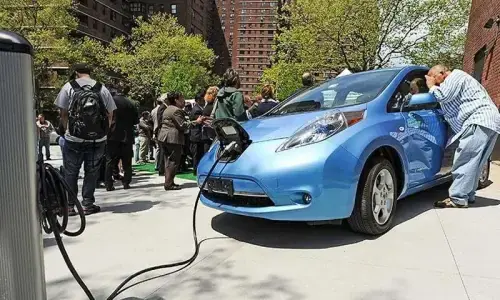
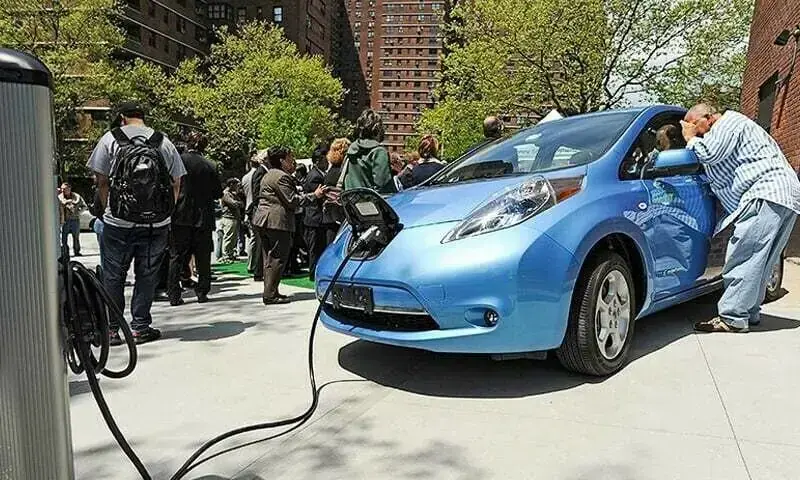
The second shock is subsidised NEV imports. Import duties on CBUs priced under $15,000 will be reduced to a mere 5pc. This is compounded by incredibly low sales taxes: 1pc on Battery Electric Vehicles (BEVs), 6pc on Range-Extended Electric Vehicles (REEVs), and 9pc on Plug-in Hybrid Electric Vehicles (PHEVs). Subsidising CBU imports directly conflicts with the goal of domestic industrialisation. A $15,000 car may be entry-level by global standards, but at over Rs4m it is out of reach for the vast majority of Pakistani households. The government will therefore sacrifice vital tax revenue to lower vehicle prices for a small, affluent minority, while simultaneously putting low-income factory workers out of jobs in a country where 40pc of the population lives below the poverty line.
The third shock is the phasing out of localised Internal Combustion Engine (ICE) parts. Import duties on existing, localised parts for conventional ICE vehicles will plummet from 46pc to 30pc in 2026-27, and down to 15pc by 2030–31. This means local manufacturers of auto parts who already operate at a 34pc structural cost disadvantage, will face extinction, wiping out billions in plant investments and hundreds of thousands of livelihoods.
The fourth shock is the blocking of future localisation. Tariffs on non-localised conventional ICE parts will drop from 30pc to 10pc (2026-27) and then to 5pc by 2030–31. By making imports this cheap, the government will permanently close the door on the local development of high-tech components like speedometers, automotive electronics, and engine/transmission parts.
The fifth shock is the disincentivising of NEV localisation. For NEV assemblers, locally produced parts that are common to both ICE vehicles and NEVs will carry a 20pc import duty. This makes local manufacturing financially unfeasible as assemblers will simply import them as part of Completely Knocked-Down (CKD) kits. Meanwhile, non-localised NEV-specific parts will face a mere 1pc customs duty, eliminating any incentive for future investment in domestic EV batteries, controllers, motors, or other new technologies.
The sixth and final shock is weak domestic value addition requirements for NEV assemblers. The Minimum Domestic Value Addition Requirement (MDVAR) for NEVs has been set at half the rate of conventional ICE vehicles. Specifically, the MDVAR for NEV Original Equipment Manufacturers (OEMs) is set at only 10pc for the first two years, 15pc for the third and fourth year, and 20pc for the fifth year of the life of the policy. As NEVs inevitably capture market share, this low threshold ensures assemblers will bypass domestic vendors entirely.
To summarise, the government’s stated intentions are correct. But the execution is deeply flawed. Historical evidence shows that policy mismatches damage localisation. Post-2016, localisation levels dropped because the government allowed new entrants to import localised parts at a concessionary 25pc customs duty. Conversely, older OEMs operating under stricter pre-2016 rules and at a 45pc tariff successfully achieved local value addition of 50pc to 65pc by value while keeping car prices lower than in Thailand, Indonesia and Malaysia (net of taxes).
If the current drafts are implemented without alignment, the country risks destroying its local industry and creating mass unemployment in pursuit of cheap imports. To achieve a competitive domestic auto industry with up to 50pc local content, Pakistan Association of Automotive Parts & Accessories Manufacturers sent its recommendations to the government in August.
The proposed tariff formula is based on 2007-2016 experience which showed that localisation required CBU import duties at minimum 50pc, localised parts (ICE & NEV) at minimum 40pc and non-localised parts (ICE & NEV) at minimum 30pc.
Any tariff structure below these thresholds risks permanently dismantling the domestic industrial infrastructure and wiping out the skilled jobs built in Pakistan over decades of painstaking effort.
The writer is a former chairman of PAPAAM
Published in Dawn, The Business and Finance Weekly, November 2nd, 2026