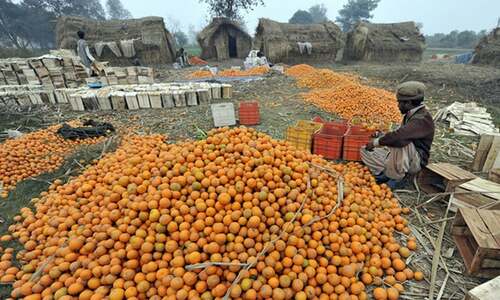
Govt directs preparation of 5-year roadmap to boost kinnow exports

ISLAMABAD: The government on Wednesday moved to address long-standing bottlenecks hampering Pakistan’s kinnow exports, directing authorities to prepare a five-year roadmap.
The proposal was presented at a meeting of a subcommittee constituted on the directives of Prime Minister Shehbaz Sharif and headed by Minister of State for Health Dr Malik Mukhtar Ahmad Bharath. Representatives of 41 relevant organisations and institutions attended the meeting.
The committee reviewed implementation of the prime minister’s directive for a 60 per cent tariff concession at Port Qasim and discussed measures to resolve exporters’ problems and increase the country’s share in global citrus markets.
Dr Bharath called for stronger coordination among federal ministries, government agencies and the private sector to facilitate exporters and improve their access to international markets.
The meeting proposed ensuring daily convoys for the transportation of fruits across the Iran border. It also discussed introducing a “green channel” for the immediate customs clearance of perishable agricultural products.
The state minister directed the relevant authorities to take steps to extend exporters’ financial instruments before November 15. The meeting was informed by the State Bank of Pakistan (SBP) that the maximum prescribed period for repatriation of export proceeds was 120 days.
Dr Bharath directed the Pakistan Horticulture Development and Export Company to prepare a five-year roadmap within 15 days for increasing exports and promoting value addition of kinnow and other citrus fruits.
Another major proposal was the operation of a weekly refrigerated freight train from Sargodha to Karachi and Quetta. The Ministry of Railways was asked to prepare a feasibility report for the proposed service.
The committee also directed relevant departments to urgently address issues concerning import duties on Pakistani produce in the Philippines and additional valuation-related matters in Russia.
Dr Bharath stressed that exporters should be provided maximum possible facilities and that practical measures must be taken to improve access to global markets, saying stronger coordination between public institutions and the private sector was essential for expanding agricultural exports.
Last year, the government announced a set of measures aimed at enhancing the global recognition of Pakistani kinnow, with a focus on improving its export potential and value-added products.
These included promoting seedless kinnow, value-added citrus products such as juices, concentrates, and essential oils, capacity building for growers and exporters, as well as registration of new exporters for markets like Uzbekistan and other Central Asian countries.