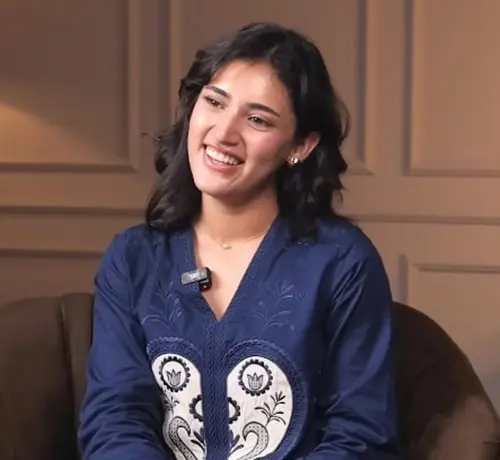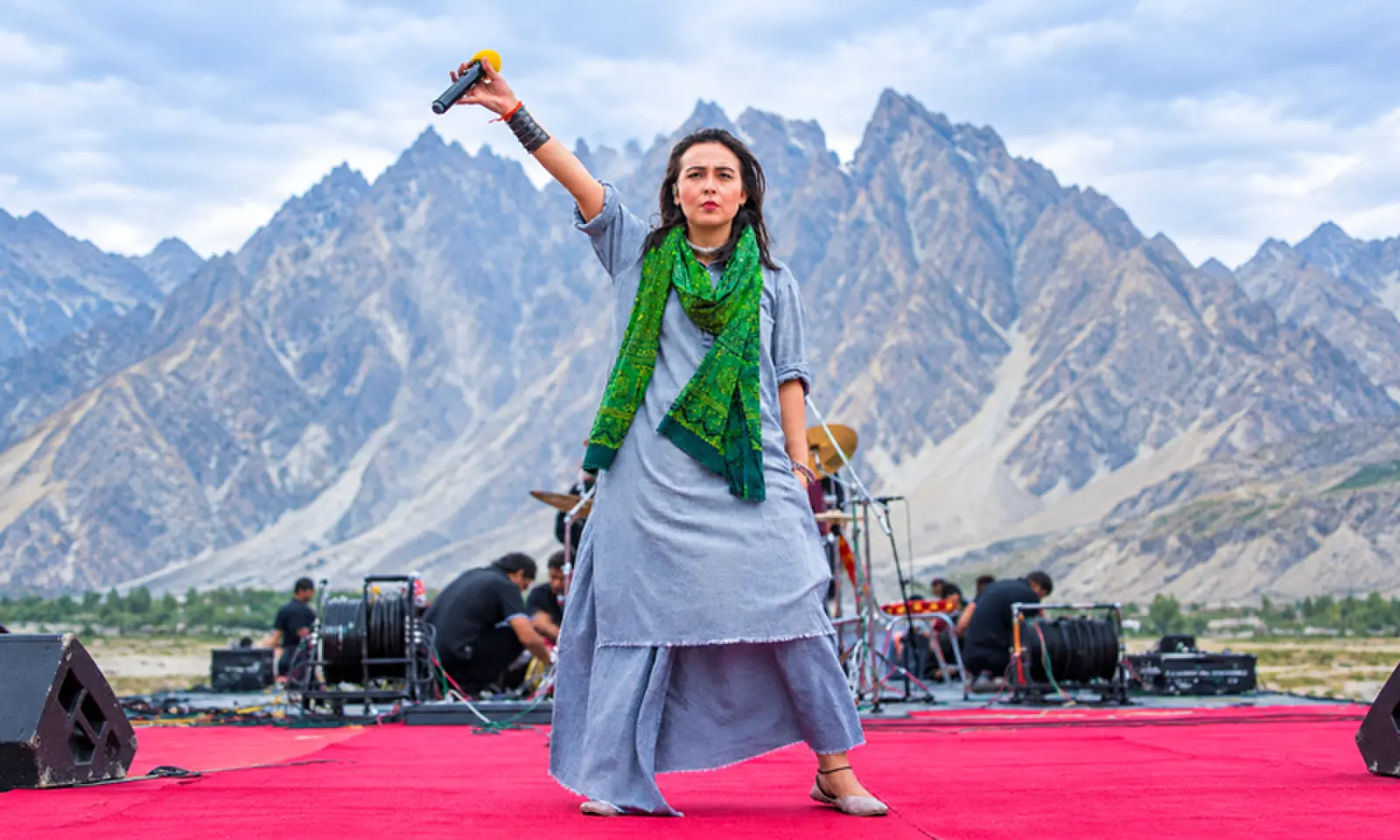
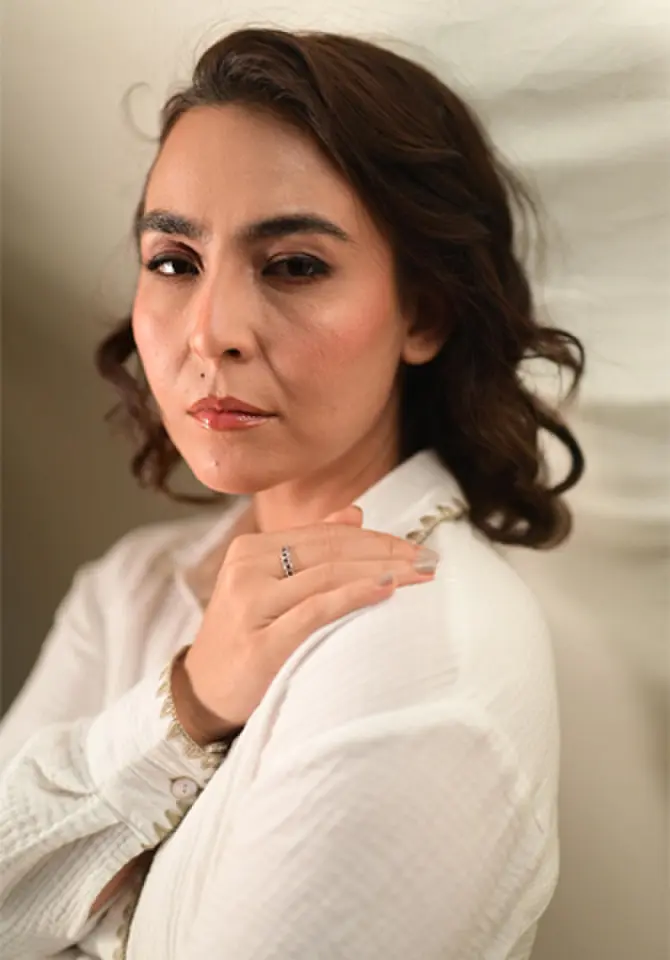
I meet Natasha Baig in a coffee shop during a brief window between her trips to and from Pakistan, while she was in Karachi. She’s been quite active in the music scene recently, releasing her third album, Khushboo, which features Parveen Shakir’s poetry, and collaborating with the former winners of Pepsi Battle of the Bands, the band Kashmir, and bizarrely even the late Nusrat Fateh Ali Khan — but more on that later.
Younger listeners know her for ‘Banjarapan’ — the OST of the recent drama Jinn Ki Shaadi Unn Ki Shaadi — while those with more mature tastes remember her for other soulful renditions, including the popular 2018 ‘Shikwa Jawab-i-Shikwa’ from Coke Studio, with the qawwal troupe of Fareed Ayaz and Abu Mohammad.
But few people know she recently also collaborated with one of China’s most popular singers, Lay Zhang, on a song called ‘Pak-Cheen Dosti Zindabad’ which celebrated the 75th anniversary of Pak-China relations. It is available on major platforms, including YouTube and Spotify.
Despite her Hunzai roots, Natasha behaves more like a Karachiite than many of the Karachiites I know. She was born in the city and raised there in part; however, people often mistake her for a foreigner in her own country. In fact, on her recent trips to China, people mistook her for Chinese.
From Allama Iqbal and Parveen Shakir’s poetry to a collaboration with the late Nusrat Fateh Ali Khan, the singer has taken some unexpected turns in her musical journey. Add a Chinese pop star, a love of cricket and a determination to do things her own way, and there’s plenty more to her story than meets the ear
PARVEEN SHAKIR AND THE POETRY THAT STAYED
Since making her mark in the music industry, Natasha has released several albums. If her debut album Zariya (2020) introduced her to many new followers worldwide, Khirad (2022) came out as a tribute to the legendary poet Allama Iqbal, whose poetry was the backbone of each song.
The album featured the massively popular ‘Shikwa Jawab-i-Shikwa’, as well as ‘Wajood-i-Zan’, a women’s empowerment song; the title track ‘Khirad’ and ‘Ne Mohra’ were also praised for their Western-style composition with an Eastern touch. However, she admits she knew little of the late Parveen Shakir’s work before starting Khushboo (2026), her third album in six years.
“I hadn’t read Parveen Shakir’s poetry in depth before this album,” she says. “I knew of her, obviously, but when I started working on her poetry, I realised how much there was to it.”
What stayed with her was Shakir’s ability to write about love without losing dignity. “Her writing gave me a lot of validation and dignity. The way she talks about love, accepts love and expresses herself — it empowered me.”
Natasha also mentions the graciousness of Parveen Shakir’s son, Murad, who gave her permission during a video call to use his mother’s poetry and wonders what she would have felt had she been alive. Shakir passed away in a car accident in 1994.
“I don’t know whether she would like it, but I hope she would understand that we are trying to honour her writing,” says Natasha.
THE CHINESE CONNECTION
In her mind, if the Shakir album requires her to stay attuned to Urdu’s nuances, her international collaborations demand the opposite — communicating through music even when words fail.
The songstress made two trips to China this year: first to record the Pak-China Friendship song, and second to perform as a showstopper at an international event. She was overwhelmed to realise that, by sharing the recording booth and the music video with Chinese sensation Lay Zhang, she became huge in China, where local girls apparently told her, ‘You must be big in Pakistan to record a song with Lay Zhang!’
Her collaboration in China led her to a well-equipped international studio, where she recorded material in Chinese and Urdu as part of celebrations marking the 75th anniversary of Pakistan-China friendship.
“The Chinese were looking for someone from Pakistan who could sing a few verses in Chinese and found me on YouTube,” Natasha explains. “At first, I wasn’t that thrilled, because I viewed it as just another collaboration with any other artist. But when I saw their internationally equipped studio and their passion for their work, my perception changed.”
She adds that during the music video shoot, she filmed at the Great Wall of China, a feat no other Pakistani artist can claim.
“Thank God Lay Zhang could speak English because of his K-Pop connection. Despite being a major star in China, he served as an interpreter during the song’s production.”
THEN THERE WAS JIMMY CHOO…
On her second trip to China, she was invited to appear as a showstopper at the World Dance Competition. She tells me, in her usual rapid-fire style, that while she was responding to the many people who came to congratulate her on her performance, an older gentleman approached her, took her hand and asked for a picture.
He then directed his friend to take the photo, beaming with pride. Only later did Natasha discover who they were. The friend who took the photo was an ambassador attending the event; the polite older gentleman was none other than the legendary designer Jimmy Choo.
“I had no idea who he was at the time. He was just a very sweet and humble person who wanted a picture with me. Later, when someone asked me, ‘Do you know who that was?’ I was like, ‘What!’” Natasha is nothing if not expressive.
“That is one of the things I love about travelling and performing,” she adds. “You meet people from completely different worlds, and sometimes you don’t even realise who you are standing next to.”
CANADA, KARACHI, HUNZA AND EVERYTHING IN BETWEEN
Natasha also had a successful tour of Canada this year, where she performed for a crowd that featured many people who didn’t understand Urdu. Their reaction afterwards surprised her.
“I couldn’t believe how they were meeting me,” she says. “Their eyes were almost bursting with excitement and appreciation. And I thought, ‘You don’t even understand the language.’ They informed me that it didn’t matter to them whether they understood the language or not. They loved the way I performed.”
She adds that by going to different countries and interacting with locals, she can safely vouch for the saying that music is a universal language. It does not need known words to connect.
Natasha is a happy-go-lucky soul who embraces cultures wherever she goes, and credits her upbringing in both north and south Pakistan for it. “I am a very good blend of a Hunzai and a Karachiite,” she offers. “I wear the route I have come from as a badge, because it made me unique.”
Karachi, meanwhile, instilled in her the confidence and independence that became central to her personality. “Karachi has made me who I am. This personality — it has been given to me by this city.”
BEFORE MUSIC, THERE WAS CRICKET
Natasha credits her perseverance, adaptability to different surroundings, and never-say-die attitude to sports, particularly cricket, which taught her a lot.
Cricket? Natasha Baig? That was news to me, even though I was active in the sports scene. I realised why it was a miss — she represented the Karachi region as an off-spinner at the Under-15, Under-17, and Under-19 levels in the domestic circuit as Natasha Zakir, not Natasha Baig.
“Cricket was my first love,” she enthuses. “I didn’t want to leave it, but it was difficult for me because, when you play, the player’s mind is focused on the game.”
She believes playing with the best, including Sana Mir, who later captained the national side, helped her a lot. However, despite her potential, her career was cut short because she lacked support at home. Natasha still had another year of under-19 cricket remaining and was offered another trial with the Karachi team, but she declined. Another reason was that music had already entered her life.
“I was very depressed after leaving sports,” says Natasha, then adds: “I was basically dating sports. So when I broke up with sports, music entered my life as a friend. I fell in love with music. I think I was meant to do this.”
It’s an analogy that amuses me. But I hold off on asking her about her personal life.
FINDING A VOICE OF HER OWN
But how did the young Natasha find her voice? Unlike youngsters who know they want to become a singer when they grow up, Natasha was late to the party; only in her teens did she consider her voice a singer’s voice.
“In my mind, Lata Mangeshkar, Noor Jehan, Nayyara Noor and Alka Yagnik — these were voices. When you hear them, you think, ‘This is what a singer sounds like.’ I never thought I could sing.”
Only after people who listened to her sing in private told her she had a good voice with a unique tone did she believe it. “And I thought, okay, there are so many singers. Will people accept me?”
Hassan Ali Effendi, her manager and long-time collaborator, played a key role in helping her understand her talents. Their creative partnership also extended to Laal Series, the production company and media consultancy firm they co-founded, which has released all her albums and promotes original music, folk tunes and artistic projects.
She also credits Sounds of Karachi with her early musical development, when Ahsan Bari invited her to join the ensemble soon after she appeared on the scene in 2013.
Although she has performed all kinds of songs, Natasha is still largely regarded as a Sufi singer. “I don’t want to put myself in that bracket where I’m just a Sufi singer,” she says honestly. “However, when I perform a Sufi song, the fun comes naturally. It is very effortless.”
THE FEAR OF A POWERFUL WOMAN
How does she see herself as a female artist, I ask. “I have never tried to see myself as a woman artist,” she responds immediately. “I have only seen myself as an artist.”
But she believes powerful women still make people uncomfortable. She says her voice has sometimes made other musicians reluctant to collaborate because they fear she might overpower them.
“People think I will overshadow them. I used to ask, why? How? You bring your expression, and I will bring mine.”
Her recent collaboration with Kashmir reinforces the point. The band approached her for ‘Kyun’ because they heard something in her voice that she couldn’t initially recognise.
“I was amazed when they approached me for a collab because they could hear only me singing those verses. Even though I felt the song could have done better with another artist, they saw in me what I couldn’t see.”
She also joined a project called Ustad: Chapter One that centres on the late Nusrat Fateh Ali Khan’s music and reimagines his work with a new generation of artists.
“The project was offered to a lot of individuals a few years ago by Universal Music, who were reviving Nusrat Fateh Ali Khan’s music, and I was part of one of the collaborations. I worked with Haider Ali and Bol Jani and we chose ‘Maikhana’ as it was one of my favourite Nusrat Fateh Ali Khan songs.”
Natasha adds that she nearly forgot about the whole episode until she learned her collaboration was selected as the best and that they would digitally add her voice to Nusrat sahib’s.
“I didn’t even ask about the money. I just heard Nusrat and thought, ‘I want to do this.’ Now it has made my checklist. Even Nusrat sahib is with me. I got to collaborate with him. It’s a big deal.”
THE PEOPLE WHO STAYED
Natasha’s journey has not been effortless or without its heartbreaks. Her father never accepted her decision to pursue music. They remained estranged over it, and he died during the Covid pandemic without the two resolving their differences.
“Some people came and told me he was really proud of me, but maybe he didn’t have the heart to say so,” she says, subdued for the first time in our talk.
She attributes her success to her mother, who has been instrumental in her journey. “If she hadn’t supported me and believed in me, I wouldn’t have made it here today.” Natasha reveals that her mother was a huge Nazia Hassan fan in her youth and loved music, but an early marriage ended her dreams.
“Maybe that’s why she supported me and my younger brother, Sameer, who is less active on the scene these days. By making music and performing together, we fulfil the dream my mother had before it was taken away.”
WHAT KEEPS HER GROUNDED
For someone who represented her city at the national level in cricket and continues to be a proud ambassador of her country through music, Natasha’s ability to stay grounded is a remarkable achievement. She credits her ‘faith’ for it.
“If people see any talent in me, it’s because of sports,” she says. “I have played so much that it has kept me very grounded. God has blessed me.”
I finally ask her about her personal life. Away from music, her life is surprisingly quiet, she tells me. Happily single, she spends time with her rescued cats, declutters when she feels overwhelmed and sometimes picks up a guitar.
“My favourite thing to do when I have nothing planned is to open YouTube and watch an artist play the handpan for hours,” she says. “It’s a kind of meditative therapy that relaxes me. I sing along to the songs or sometimes create one.”
Perhaps that is the best way to understand Natasha Baig at this stage in her career: an artist who keeps moving between worlds without feeling the need to choose one.
She can return to Parveen Shakir’s Urdu, sing Sufi music for an audience that cannot understand the words, reproduce a Chinese phrase after hearing it once, collaborate across borders, be mistaken for a local in China — and then return to a Karachi coffee shop to speak perfect Urdu in the fast-paced Karachi style, as if none of it were unusual.
“I once left music to prepare for the CSS exam, but music never left me behind,” Natasha informs me.
The detour was temporary, but the music wasn’t.
The writer is a broadcast journalist who writes on sports, film, television and popular culture.
X: @omair78
Published in Dawn, ICON, October 25th, 2026