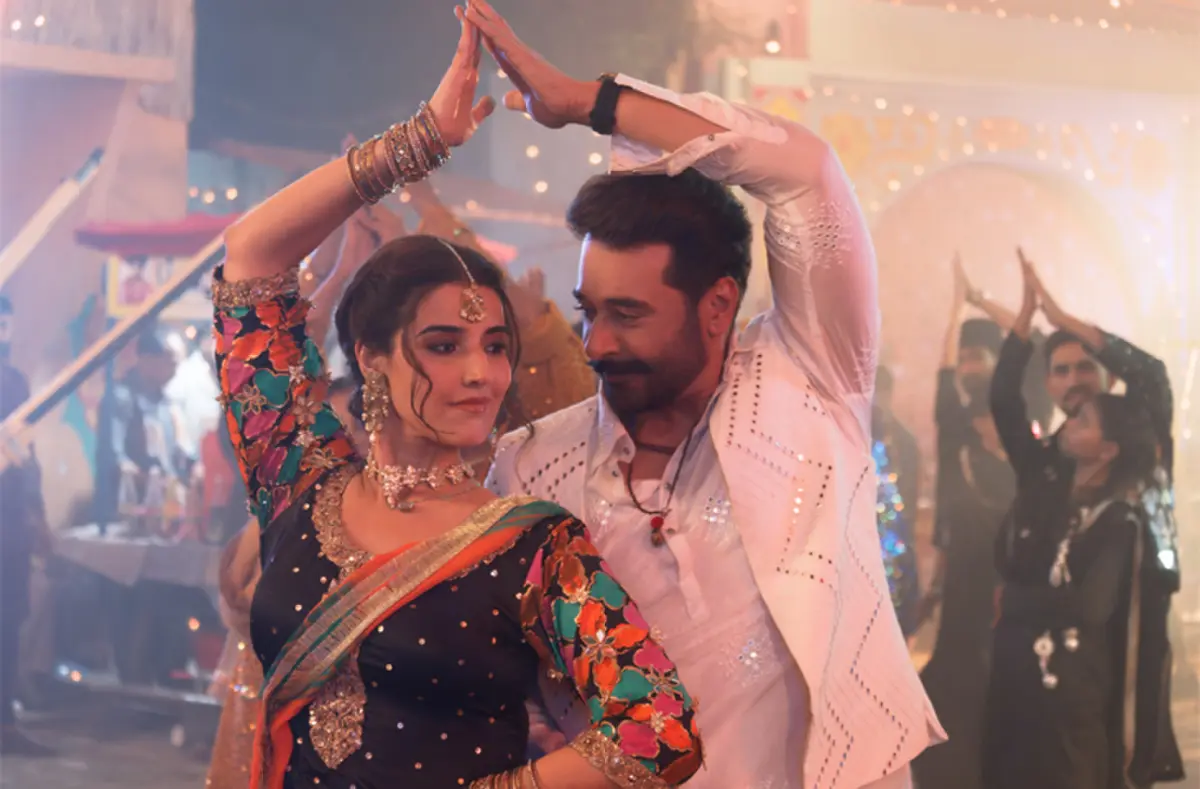
When Mango Jutt opens with Murad Jutt (Faysal Quraishi) entering a villains’ den wearing the most ridiculously fake prosthetics ever shown in the history of cinema, you begin to fear for the next two hours of your life. But then, you notice a few things.
The cheap mask is most likely a production mistake (I hope so), yet Quraishi wears it with perplexing ownership and a sheer will to milk the absurdity. The scene probably wasn’t written as a comedy, but it became one, and worked better than it should have. The result is as disarming as it is entertaining: an actor owning his film, for better or worse, and pushing whatever skills he has to elevate it.
As far as initial reactions go, one cannot help but sympathise. My sister — a hard-to-please fellow film critic — and I had already steeled ourselves. The grapevine wasn’t good, and it showed. After nearly three years in the making, one cannot help but notice that the cast members’ appearances have visibly changed. A bigger eye-opener, though, is that Mango Jutt carries no writer, director or editor’s credit.
The editor is from India and therefore uncredited, probably because post-production and release funds came from the Punjab government’s film grant (its first release); a local company, Post Fusion, gets an all-encompassing ‘post-production’ credit. The creditless writer-director is Abu Aleeha (Mera Lyari, Taxali Gate), who apparently directed nearly the entire film before Syed Nini replaced him, reshooting and streamlining sections. Nini, too, gets no credit.
After years in the making and a troubled production, Mango Jutt arrives as a chaotic mix of slapstick, missed opportunities and spirited performances. Faysal Quraishi does his best to turn a muddled film into an entertaining romp
One expects, and sees, a wonky, half-baked storyline, missed opportunities and a score that ill-fits most scenes and never lets up. As these issues (minus the score) are typical of an Aleeha film, there’s little doubt whose hands shaped the spine of the film. That spine, however, has been violently adjusted by producer and lead actress Hareem Farooq to create the best possible version. The manhandling (or is it woman-handling?) works better than one anticipates.
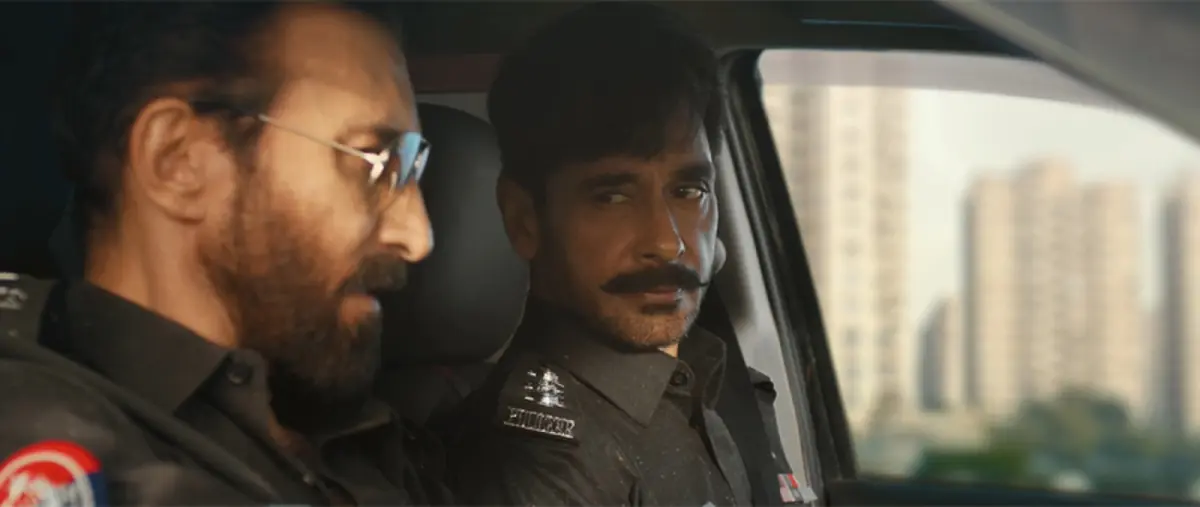
Quraishi’s Murad Jutt is a Karachi-based cop with a spunky, vaudeville-ish streak, who can throw punches and punchlines simultaneously. After beating the ruffians in the first scene, Murad gets a ride home from his superior (Aijazz Aslam in a special appearance), who also speaks Punjabi. Aslam’s unnamed character says Murad’s vacation is sanctioned and that, once in Punjab, he must infiltrate a land-grabbing mob.
Murad says not to worry, for it is “Mango Jutt”, not he, who goes to Punjab. Why that name, Aslam’s character asks? Because Murad wants to be a common man, and common means ‘aam’ in Urdu, and that the word ‘aam’ is also used for mangoes. Say what?!?
Murad has an estranged, recently widowed sister, Mariam (Ayesha Jehanzeb), who lives in Punjab with her three kids Deju, Eeloo and Qalboosh (Hiba Kiyani, Adan Kashif, Arham Khan). As expected, Murad gets stuck with the kids who don’t like him much, and their self-proclaimed butler Ramzani (Qaiser Piya), a comic relief whose punchlines don’t always work, while his sister Mariam flies off to Dubai on a family business trip.
As if two caretakers weren’t enough, enter Noor Jahan (Hareem Farooq), his sister’s friend and the vice principal at the children’s school, who also agrees to look after them. With the hero and heroine under one roof, there’s bound to be romance. Imagine Main Hoon Naa’s Shah Rukh Khan-Sushmita Sen romance mixed with One 2 Ka 4’s children-caretaking; however, neither angle has a clear storytelling trajectory here.
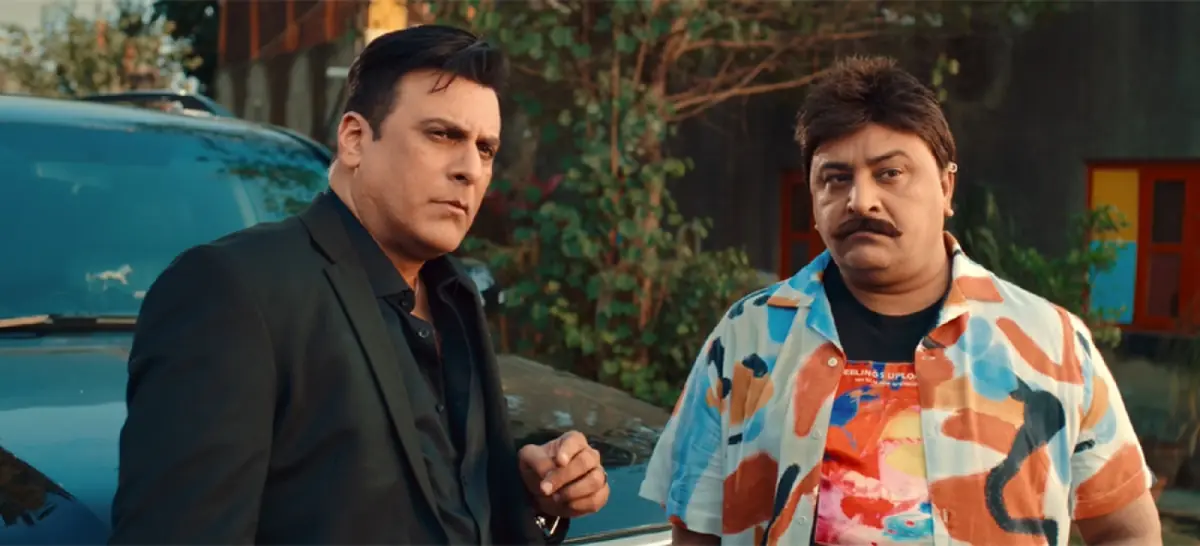
Before flying off, Mariam also puts her late husband’s former partner, Munawar Mirza (Shamoon Abbasi), in his place. Mirza, in an expensive car and sharp-looking suit, has the aura of a magnate who bullies first and ruins people later. Smarting from Mariam’s ridicule, he hires goons (read: comic reliefs) — led by Honey Albela, Muhammad Ali (aka Motu Bhai) and Shahid Khan — to kidnap the children and seize the widow’s business and property.
However, post-interval, we flashback and see a 180-degree flip avatar of the man. This Mirza — sporting a menacing beard, surma-laden eyes and a dark kurta pajama — is the kind of ruffian one sees in backwater towns. Like any villain, he wants to marry the town belle, Noor Jahan. But the underlying reason for the character’s rural-to-modern transformation is simply left unexplained!
Storytelling-wise, not much happens in either half. The film is a smattering of ideas pushed and pulled into sense by the film’s unnamed editor. The hastened pace nearly covers up the slack, yet the missed opportunities go beyond what editing can fix.
October releases have never worked in the history of films, and adding to the problems is that there’s a visible lack of PR strategy and the plot points go nowhere. For example, there really is no reason for Murad to take on the alias of Mango Jutt, since he does no police work. The screenplay forgets to build a relationship between Murad and the children, which should have been central. And, late in the film, an acid attack on Noor Jahan is thrown in as a twist that never comes together.
The comedic supporting cast doesn’t work. Piya gets the most screentime, but none of the screen worth. The others do something far worse than ill-timed jugaarr [improvs]: they huddle around Mirza, turning his ferociousness into farce. These are writing and directing problems; a quality-control pass could have nipped them in the bud… but I’m told the film was re-written several times, so one shudders to think what it originally was.
Quraishi, Abbasi and Farooq — in that order — shoulder the burden, layering their scenes with heightened performances and quips. The punch-up, mostly in Quraishi’s and Abbasi’s scenes, turns dullness into entertainment in an effort to turn dirt into gold. The rest of the cast — Albela, Piya, Ali, Jehanzeb, and the three kids — come and go in patches.
Technically, one wishes the production wasn’t trapped within a house, a school and a farmhouse, or that the usually reliable Asrad Khan hadn’t opted for painful split-lighting setups (the stark shift in colour temperatures is ugly). The songs by Ali Allahditta, Faysal Abbas and Master Abdullah are quite good. The main theme in music director Ali Mustafa’s score is among the most ear-catching pieces of music one has heard in Pakistani movies. However, being too good is a detriment in this case — the theme is slapped on to most scenes, regardless of the mood.
But despite this laundry list of foibles that no edit can mask, Quraishi — the film’s heart and soul — alongside Abbasi and Farooq, make Mango Jutt fun and dismissible at the same time. Compared to what Pakistani cinema has disgorged in the last year or so, it is still one of the better releases of the lot. A film that makes up for what it lacks with sheer will to entertain.
It is a pity that what could have been Aleeha’s best film doesn’t carry his credit.
Produced by Hameem Films and released by Mandviwalla Entertainment, Mango Jutt is rated U — as in, suitable for “U” and the entire family, Punjabi-speaking or not
The writer is Icon’s primary film reviewer
Published in Dawn, ICON, October 25th, 2026