A rare rock carving depicting a four-horse chariot has been discovered in the Helan Mountains of Ningxia Hui autonomous region, offering new clues about cultural exchanges across the Eurasian grasslands and potentially extending the known history of the region’s rock art traditions, an expert said recently.
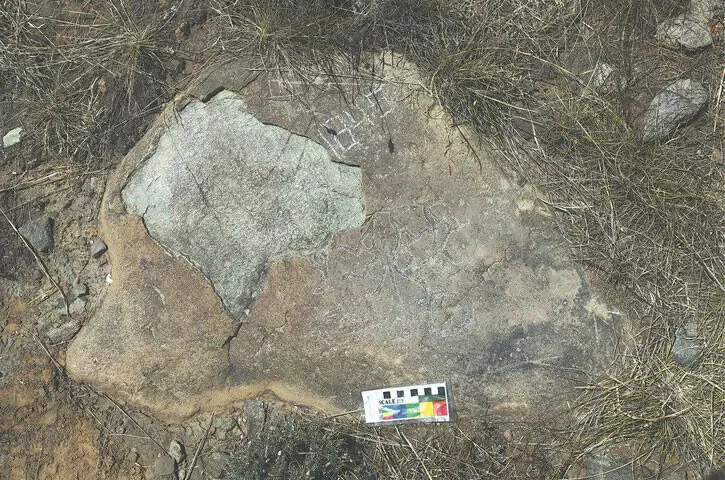
The carving is the first of its kind found in the local area. It is also rare nationwide, according to the Helan Mountains rock art management office based in Yinchuan, the region’s capital.
Zhang Jianguo, deputy director of the management office, said in an interview with China Daily that the rare four-horse chariot image was found in late May on a partially buried boulder in an alluvial fan area during a routine re-survey of the Helan Mountains rock art area. The discovery was recently announced to the public.
The carving, measuring 24 by 20 centimetres with grooves roughly 1.5 millimetres deep, was surrounded by thick grass. Only about 15 cm of the rock was exposed above ground, making it difficult to spot. Zhang said staff members discovered the carving with their eyes and years of experience examining the mountains’ rock art, without using any specialised equipment.
According to Zhang, the image depicts wheels, a carriage and an axle, the vehicle pulled by four horses.
Though part of the carving was damaged, possibly due to weather, its basic composition remains clear, he added.
According to the management office, about 20 chariot-themed petroglyphs have been recorded across the Helan Mountains. Those previously discovered depicted two-horse chariots. Zhang said the number of horses depicted may offer clues about the society that produced the image.
Using horses to pull a vehicle required considerable skill in domestication and control, he explained, adding that two or four horses also had to move in coordination and exert force together.
Published in Dawn, October 19th, 2026