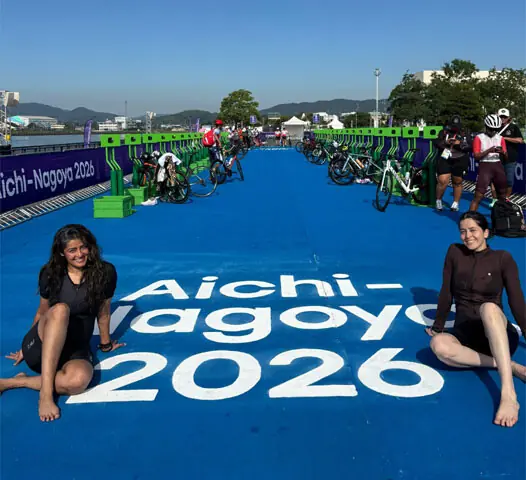
For Sana Arif, the journey to the Asian Games began with a sport she had only learnt a few years earlier.
One of Pakistan’s pioneering women triathletes, Sana learnt to swim only in 2021, and went on to complete three Ironman 70.3 races — a gruelling endurance event combining a 1.9km swim, 90.1km of cycling and a 21.1km run. Born in Kuwait and raised in Lahore before returning to Kuwait, she had built her triathlon career largely through her own determination and training.
In 2026, that journey took her to Japan, where she and fellow Pakistani triathlete Anisha Ali from Hunza became part of the country’s first women’s triathlon contingent at the Asian Games. They were joined by male teammates Ali Hassan, Mohid Sadiq Lone and Muhammad Mustaghis Noor.
Sana’s teammate Anisha, 26, brought a very different sporting background to the team. A national-level athlete in judo, martial arts, rowing, boating, tug-of-war and fencing, she was no stranger to competition or rigorous training. But triathlon presented a new challenge, requiring her to master three disciplines simultaneously. Hailing from Gilgit-Baltistan, she says her upbringing around mountains taught her to embrace challenges rather than shy away from them. This was a mindset she carried with her to the Asian Games.
For Pakistan’s first women triathletes at the Asian Games, the competition was about more than medals. It was about simply showing up…
For Sana, the call that changed everything came almost by chance. She was in Pakistan on holiday when a friend told her that trials were being held for the Asian Games triathlon team. The timing was fortunate. She went along with a handful of other athletes, some stronger cyclists, others accomplished runners. But Sana had one advantage that mattered in a sport demanding proficiency in all three disciplines: she could swim well too.
A week later, she received a call from the Pakistan Triathlon Federation. She had been selected to represent Pakistan at the Asian Games.
The selection marked a first. Pakistan was sending women triathletes to compete at the continental Games, and Sana and Anisha would be part of a small pioneering team, entering a competition in which the country had never before had female representation.
Following her selection, Sana trained largely on her own. The federation president remained in regular contact, checking on her progress and advising her on areas that needed attention. But, beyond that, there was no extensive national high-performance training programme in place.
For a sport that combines swimming, cycling and running — each requiring its own technical skills, coaching and equipment — much of the responsibility remained with the athlete.
Even meeting her teammates was a relatively new experience. Sana had crossed paths with two of them during the trials, but they had been too occupied with the selection process to get to know each other properly. Their team chemistry would develop only after they arrived in Japan.
When they did, something unexpected happened. The team became a source of strength for one another.
“We all knew who we were competing against,” Sana says. “Everyone was friendly, shared their experiences and supported wherever it was needed.” There was also an awareness that they were entering the competition at a disadvantage. “Though we were the weaker team compared to others, none of us even for a second thought of giving up. We fought till the end.”
That spirit extended beyond Pakistan’s team. Sana recalls meeting athletes from other countries, including competitors who were among the best in their respective nations and had professional-level experience. Rather than making her feel inadequate, they did the opposite.
When she explained that the sprint format was very different from the long-distance races she was accustomed to, they reassured her. “They were there to calm me down and tell me that it was all okay,” she says.
Some even pointed out what Sana herself had begun to realise: simply being there had significance. She was representing a country that had never before sent women triathletes to the Asian Games. That, in itself, was an achievement.
The experience in Japan also challenged some of the complaints circulating about conditions for athletes at the Games. For the triathletes, the arrangements were, Sana says, excellent. The team was based in Gamagori, a city designated specifically for the triathlon. Their accommodation was close to the race venue and the beach, with an island visible from their location and a running track in the surrounding garden.
Food was another pleasant surprise. There was a dedicated table for Muslim athletes, as well as vegan options — details Sana appreciated as an athlete travelling from Pakistan. “The staff and people were great, and there was a lot of security too,” she recalls.
The competition itself, however, brought the inevitable nerves. “It was great, but there was also a lot of anxiety, stress and excitement — mixed emotions,” she says.
There were no medals for Pakistan. But for Sana, the value of the experience cannot be measured by a podium finish. If anything, the race revealed the gap between Pakistan’s ambitions and the support required to turn those ambitions into sustained international competitiveness.
Her diagnosis is blunt: Pakistan needs to treat the triathlon as a long-term high-performance sport rather than something athletes prepare for only when a major Games approaches. “If Pakistan wants competitive Asian Games athletes, they shouldn’t start receiving support six months before the event,” she says.
The problems begin with the basics. Athletes need proper equipment, financial support and structured training. Sana points out that Pakistani competitors arrived on rented bicycles, while the tri-suits provided to them were also not suitable for the demands of the sport. They were not even made from the appropriate fabric required for the triathlon.
It is difficult, she argues, to expect international-level performances without first investing in the athletes expected to deliver them. Her point goes beyond the triathlon.
Her teammate Anisha believes more Pakistani women are doing sports, but says many talented girls — particularly those from rural, remote and mountainous areas — still lack the facilities, coaching, financial support and safe spaces they need. Representation matters too, she says: seeing Pakistani women compete internationally can help young girls believe that sport is a possibility for them as well.
Pakistan has repeatedly produced athletes who reach international competitions through individual determination, personal sacrifice and, often, their own financial resources. But competing at the highest level requires more than determination. It requires a system.
For Sana, the Asian Games were therefore both an accomplishment and a starting point. The experience showed her what elite triathlon looks like and, perhaps more importantly, what Pakistan needs to build if it wants to compete seriously in the future.
The response at home has largely been encouraging. There has been criticism too, as there inevitably is whenever Pakistani athletes compete without winning medals. Sana, however, has little interest in allowing that noise to define the experience. “People will always have something to say whether you win or lose,” she says. “No one understands your struggle, and that is okay.”
What she does remember is the overwhelming support. “The amount of positivity I have received from everywhere is unexplainable.”
For a first appearance, perhaps that is the more important result. Sana, Anisha and their teammates did not return from Japan with medals. They returned with something less tangible but potentially more consequential: proof that Pakistani women can enter a demanding sport like triathlon, compete on an international stage and hold their own against athletes from countries with far more developed systems.
The next step is no longer simply getting them to the starting line. It is giving the next generation the training, equipment, coaching and financial support to arrive there ready to compete. The first women have now gone. The question is whether Pakistan will build a path for those who come next.
The writer is a journalist, documentary filmmaker and radio correspondent. Instagram: @madeeha.syed
Published in Dawn, EOS, October 18th, 2026