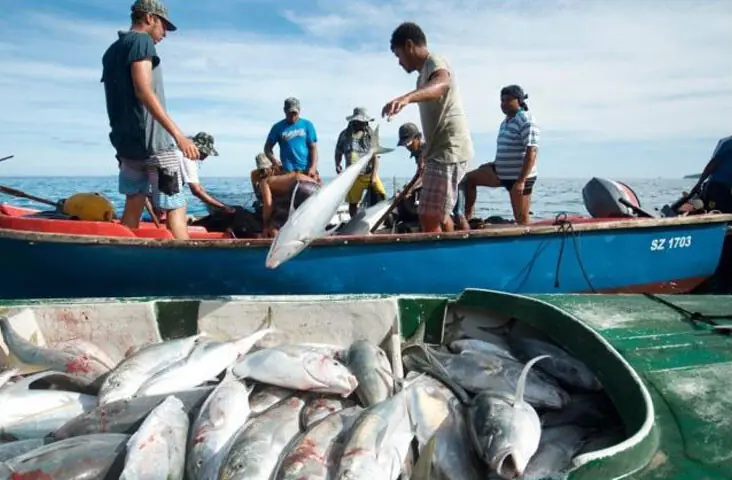
During a recent visit to Borneo island in the Malay archipelago, I came across a shrimp farm on the coast of the rainforest-covered island, run by a Chinese woman entrepreneur. Using a seawater reservoir behind a mangrove forest, she had built a business exporting shrimp around the world.
My mind drifted home to Pakistan’s 1,058-kilometre coastline, along Sindh and Balochistan. Why, I wondered, do we see so little aquaculture of this kind?
I was reminded of a conversation I had with the owner of a hatchery recently established in Gharo in Sindh. He told me that one of his biggest worries was transporting the hatchlings quickly and safely to fish and shrimp farms in Muzaffargarh, Punjab.
The irony struck me. The hatchery is in coastal Sindh, close to the sea and the Indus delta, yet its young fish and shrimp have to travel hundreds of kilometres inland to find farms. I asked him why people were not investing in fish and shrimp farming in Sindh? He did not have a clear answer, except to say that there were not enough investors and the business climate is also not supportive.
But the lack of investors is not really an explanation. It is itself a question.
The problem in rural Sindh may not be a lack of capital, but its concentration — and the failure to create the conditions in which small businesses can grow into industries
Sindh has fertile land, a long coastline and a river, alongside abundant agricultural produce, livestock, fisheries and traditional crafts. Yet much of this potential has not translated into local processing, packaging and cold-chain businesses that could create jobs beyond agriculture. Why did this not happen?
THE AGRARIAN DIVIDE
Economic historian Imran Ali has documented how British canal colonies transformed western Punjab from the late 19th century. Irrigation brought semi-arid land under cultivation, encouraging commercial agriculture and the growth of new settlements and market towns. The colonial project also served revenue, political and military objectives. Regardless of their motives, the economic landscape was transformed.
Sindh too underwent an irrigation revolution, particularly after the Sukkur Barrage opened in 1932. But perhaps the social structure on to which this new agricultural wealth was grafted was different.
Economist Mahmood Hasan Khan points out the growth of small owner-cultivators and market relations in parts of Punjab, while the older landlord-sharecropper structure remained much stronger in Sindh. Economist Akmal Hussain argues that owner-cultivators have greater incentives to invest, potentially generating the savings and demand needed for industrialisation.
Where agricultural income is concentrated in fewer hands, the pattern of investment may be different.
THE CONCENTRATION OF CAPITAL
It would, however, be too easy to explain Sindh’s predicament simply by invoking “feudalism.”
Political economist Akbar Zaidi argues that agriculture in Pakistan has undergone a substantial capitalist transformation. Commercialisation and the ‘Green Revolution’ brought capitalist farmers, machinery and wage labour and, in some areas, small manufacturers, skilled workers and service businesses.
Sindh’s sugar mills, cotton ginning and rice milling show that agricultural wealth did become industrial capital. But large enterprises owned by wealthy families are not the same as a broad base of independent businesses. Both represent investment and capitalism, but the latter creates a much wider entrepreneurial class.
A farmer investing in transport, a workshop repairing agricultural machinery or a manufacturer producing spare parts can generate further demand for suppliers, traders and services. Why has this chain remained so weak across much of rural Sindh?
THE CITY AND THE HINTERLAND
Perhaps the problem was never simply the absence of capital. It may have been the concentration of capital and the failure to spread entrepreneurial investment widely enough through its towns and communities.
And then there is Karachi. Economist Kaiser Bengali has described Sindh as having a “dual identity”: Karachi on one side and the rest of the province on the other.
Partition created another rupture. Much of Sindh’s Hindu mercantile and entrepreneurial class migrated to India, while Muslim migrants from different parts of the Subcontinent brought new commercial skills, networks and capital to Karachi. Over the following decades, Karachi became Pakistan’s great port, financial centre and industrial metropolis. For someone from rural Sindh with money to invest, a good education or entrepreneurial ability, Karachi offered far greater opportunities than his own town.
Perhaps herein lies another paradox. Sindh generated considerable wealth at both ends of its economy: agricultural wealth in the countryside and commercial and industrial wealth in Karachi. Yet the economic centres in between remained relatively weak.
BEYOND INDUSTRIAL ESTATES
History, however, can only explain so much. Nearly eight decades have passed since Independence, and we also have to ask what we have done since then. Why have Sukkur, Larkana, Nawabshah, Mirpurkhas, Khairpur, Thatta and Badin not developed stronger clusters of small industry?
Industrial estates and special economic zones have been established or proposed outside Karachi, but infrastructure alone does not create an industrial ecosystem. Regional businesses also need technical training, accessible finance, shared processing and testing facilities, and reliable market connections.
Perhaps the more fundamental question is why we wait for investors instead of creating the conditions that produce investors.
THE MISSING STEP
A recent article by journalist Owais Tohid about thousands of women establishing tiny businesses across rural Sindh provides an interesting clue. These women are raising livestock, stitching clothes, producing handicrafts and running other small businesses with relatively modest amounts of capital.
Perhaps entrepreneurship was never absent. The problem is what happens next. How does a woman employing herself begin employing five or ten other women? How does a workshop become a factory? How does one successful shrimp farm become twenty, surrounded by hatcheries, feed suppliers, cold storage, processors, transporters and exporters?
This brings me back to that hatchery in Gharo. The coastline is there, as are the seawater, the hatchery, the technical knowledge and the market. And yet the hatchlings travel hundreds of kilometres to find the entrepreneurs willing and able to farm them.
Successive governments in Sindh must also bear part of the responsibility. A political economy historically dominated by large landowners may not have had sufficient incentive to create a broad class of independent entrepreneurs.
Industrial estates have been established, but we have rarely pursued industrial development around the natural strengths of individual regions with the persistence it requires: dates in Khairpur, fisheries and aquaculture along the coast, rice in upper Sindh, fruit processing around Mirpurkhas, and livestock and dairy across much of the province.
Nor can poverty alleviation alone be an economic policy. There is an obvious need for social protection in a province where millions remain poor. But cash support, however necessary, cannot by itself create economic mobility. The larger challenge is to create the conditions in which people can move beyond poverty.
A tenant becoming an owner, a woman running a tiny business beginning to employ others, a workshop growing into a factory, or a farmer’s produce being processed and packaged before it leaves the district rather than being sent elsewhere for someone else to add value to it — these are perhaps better measures of economic development.
The challenge for rural Sindh, therefore, may not simply be to find more investors. It is to understand why enterprise has failed to spread despite the province’s considerable natural resources and agricultural wealth, and then to create the conditions in which capital, skills and entrepreneurship can come together.
Ultimately, the measure of development should not merely be how many poor people the state is able to support, but how many people are able to reach a point where they no longer need that support.g
The writer is an entrepreneur and President of WWF-Pakistan
Published in Dawn, EOS, October 18th, 2026