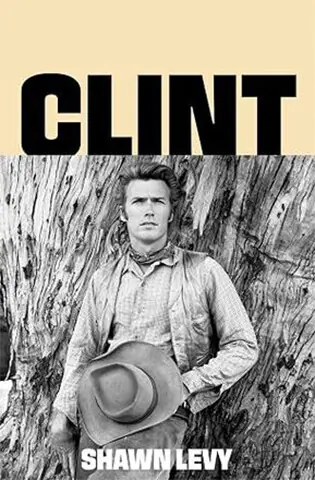
Clint: The Man and the Movies
By Shawn Levy
Mariner Books
ISBN: 978-0063251021
560pp.
What is the first thing that comes to mind when you think of Hollywood legend Clint Eastwood? For some, it is the scene in Back to the Future Part III where Michael J. Fox’s Marty McFly adopts Eastwood’s name to save the space-time continuum. For others, he is the gruff veteran filmmaker behind countless acclaimed films, many of which have earned Academy Awards over the past two decades.
In reality, Eastwood is one of the defining figures of modern cinema — a man who celebrated his 96th birthday last May and concluded his remarkable filmmaking career on his own terms in 2024 with Juror No. 2. From minor roles in the 1950s to becoming one of Hollywood’s most respected actors and directors, his journey mirrors the evolution of the American film industry.
In Clint: The Man and the Movies, acclaimed biographer Shawn Levy undertakes the formidable task of chronicling that extraordinary journey and does so with considerable skill. The result is more than a biography of an actor or filmmaker; it is a tribute to one of the few Hollywood figures to achieve lasting success both in front of and behind the camera, and it raises the bar for contemporaries and successors alike.
From his appearances in Spaghetti Westerns in the 1960s to his final film as a director, Eastwood has remained active across nearly every phase of filmmaking. According to Levy, he continually reinvented himself at a time when many of his contemporaries retired gracefully, accepted supporting roles, or withdrew from public life altogether.
A new biography of Clint Eastwood moves seamlessly between discussions of his filmmaking, celebrity culture and American social history
The author deserves extra credit for his exhaustive research into the actor who turned the “Man with No Name” into a pop-culture phenomenon, transformed Dirty Harry into a household name, and later reinvented himself as a filmmaker whose efficiency on set became legendary among fellow actors and crew.
Before this one, there were two major Clint Eastwood biographies — one by Richard Schickel and another by Patrick McGilligan. While the former presents Eastwood as an all-American hero, the latter is far more critical of both the man and his career. Levy’s work leans closer to Schickel’s interpretation but does not ignore the more controversial aspects of Eastwood’s life that McGilligan explores, including episodes that led to legal disputes and public scrutiny.
Divided into seven sections and 32 chapters, this book gives Eastwood’s extraordinary career the scope of treatment it deserves. The early chapters focus on his childhood, when his family moved frequently and the lanky young Eastwood struggled to put down roots. Readers then follow his enlistment in the United States Army, from which he was discharged in the early 1950s, but not before impressing with his swimming skills.
His eventual path to Hollywood came later, after years of frustration as he struggled to establish himself first in film and then on television. He spent years in minor roles and forgettable productions before finally achieving a breakthrough, first on TV’s Rawhide and later in the Westerns that transformed his career.
One of the book’s greatest strengths is its detailed chronicle of Eastwood’s professional evolution. Readers are guided through every significant stage of his career and shown how each project shaped Eastwood’s standing in Hollywood. The author meticulously examines each film’s production, critical reception, and commercial performance without revealing the plot, a novel approach that entices readers to watch the movie.
For readers who grew up watching Eastwood’s films, these sections are especially rewarding. Whether discussing Dirty Harry, The Outlaw Josey Wales, Pale Rider, Unforgiven, Mystic River, Million Dollar Baby, Gran Torino, or American Sniper, Levy consistently links the films to the broader narrative of Eastwood’s life. The result is a portrait of an artist who repeatedly adapted to shifting tastes without ever abandoning the qualities that made him distinctive.
And then there is the author’s willingness to examine the man behind the screen persona. Eastwood’s public image has long been associated with toughness, independence and stoicism, but Levy reveals a far more complex individual. The biography does not shy away from detailing his numerous relationships, marriages, and affairs, nor does it attempt to excuse or sensationalise them. Instead, these episodes are presented as integral to a life that was often as dramatic off-screen as on-screen.
Given Eastwood’s decision not to participate directly in the project, Levy relies heavily on archival sources and decades of interviews, an approach that proves remarkably effective. He lets Eastwood’s own words, recorded at different points in his life, illuminate his motivations and perspectives, resulting in an effort that’s balanced rather than judgemental and comprehensive rather than intrusive.
Whether it is his controversial political views or his tenure as mayor of Carmel-by-the-Sea, this book also offers a thorough look at Eastwood’s off-camera activities. Readers also learn about his business ventures, particularly his fascination with real estate and investment. His love-hate relationship with the Academy Awards, including the time he was hurriedly handed a speech written for Charlton Heston, is discussed, as is his award-winning streak, which his mother Ruth witnessed before she passed away at 97.
Despite covering nearly a century of history and a career spanning dozens of films, Levy’s prose is consistently accessible and engaging. The author has a critic’s eye for cinema and a biographer’s instinct for storytelling, allowing him to move seamlessly among discussions of filmmaking, celebrity culture and American social history.
So is Eastwood a hero or an antihero? This book doesn’t offer a definitive answer, but what emerges from these pages is a portrait of a man full of contradictions. He never trusted Hollywood despite being associated with the industry for eight decades; his distrust of politicians is well known; and he hates being labelled monotonous, which is why he switched genres whenever he could. By the end of the book, Eastwood appears neither a saint nor a villain but a relentlessly driven artist, whose life mirrors many of the cultural shifts that shaped modern America.
More importantly, it reminds readers why Clint Eastwood remains one of the most enduring and influential figures in the film industry.
The reviewer is a broadcast journalist who also writes on sports, film, television and popular culture. X: @omair78
Published in Dawn, Books & Authors, October 18th, 2026