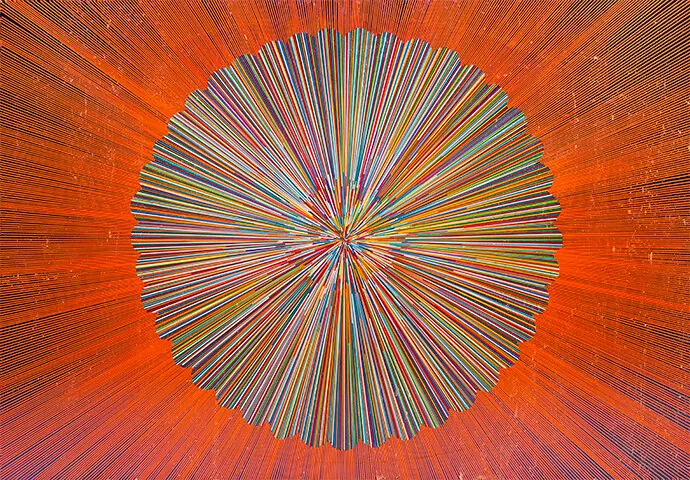
Yaseen Khan’s art shows a cultivated relationship with material, meaning and imagination. His works first dazzle and then arrest the viewer with their finesse and depth. Khan’s exhibition ‘Line After Line’ comprises six large canvases and more than 20 smaller works. It is a remarkable exploration of his medium of choice, chamak patti, within the ever-widening field of contemporary visual art. But neither the choice of material nor Khan’s fascination with it is accidental.
Explaining his personal relationship with chamak patti, Khan says, “I grew up around the visual culture of decorated trucks. From an early age, I worked as a mechanic. Next to the place where I worked was a truck decoration shop that led to my fascination with the way trucks were transformed through colour, paint, chamak patti, patterns and decorative details.”
Truck art has long been part of Pakistan’s visual and cultural identity. What began primarily as a means of personalising commercial vehicles has evolved into a widely recognised cultural symbol, subsequently finding its way into design, fashion and contemporary art. Transport companies originally employed craftsmen to decorate their vehicles to give them an edge over rivals and attract more clients. Gradually, these designs acquired a greater purpose and significance, becoming a source of pride for truck owners and drivers and a distinctive expression of popular aesthetics.
Khan, an alumnus of the National College of Arts (NCA), Lahore, says, “I am interested in what happens when materials are taken from their familiar context and used on a different medium and scale in contemporary settings.” Born in Peshawar and raised partly in Hyderabad, Khan is now based in Lahore. Having learnt chamak patti from various ustaads [teachers] rather than through an art-school curriculum, he carries that acquired craft knowledge into his fine-art practice.
Yaseen Khan has developed a distinctive artistic language around chamak patti
Chamak patti, literally a shiny or reflective strip, began not as an art material but as reflective tape used for road safety. Its gradual transformation from a utilitarian material into an essential component of truck decoration, and now into a contemporary art medium, is fascinating. Khan is not alone in exploring its possibilities. Durriya Kazi and David Alesworth’s collaborative Very Very Sweet Medina from the 1990s immediately comes to mind, while Abdullah M.I. Syed’s Brut for Men series, as well as the ‘Weapon/Pen’ show by Qutub Rind and Ayan Aftab Hussain’s No Signal also demonstrate how the material has travelled beyond its original context.
Moving back to Khan’s work, his particular form of cut-and-paste practice combines chamak patti with oils, acrylics, foil and, in some works, crystal beads. The results include Sun, Moon, Dancing Tree I and II and Blue Tree. The precision with which almost all the works are executed is impressive, but Peacock and Line After Line are spectacular. Here, technical mastery does not overwhelm the image, instead making the visual experience all the more compelling.
Trees recur throughout the exhibition. Their juxtaposition with built landscapes becomes an implicit commentary on the encroachment of nature through urbanisation. The triptych The Hidden Sun, for instance, presents a large fallen tree, while other works feature palms and leafless ‘dancing’ trees, their contorted forms suggesting both resilience and release.
It is therefore curious that, among these indigenous references, Khan has chosen to depict The Baobab, a tree native to Madagascar, mainland Africa and Australia. The work possesses an exquisite luminous quality and is beautifully executed, but its presence seems less convincing conceptually. When so much of the exhibition draws its strength from a distinctly local visual vocabulary, firmly rooted (pun unintended) here, the baobab feels like an unexplained detour.
Perhaps Khan wants us to consider what happens when a material so firmly embedded in one cultural context is made to travel, to change scale and meaning, and to acquire a new visual language. In ‘Line After Line’, chamak patti has travelled a considerable distance — from roadsides and truck workshops to the gallery wall, without entirely losing the memory of where it came from.
‘Line After Line’ was on display at Canvas Gallery in Karachi from September 8-17, 2026
Rumana Husain is a writer, artist and educator. She is the author of two coffee-table books on Karachi, and has authored and illustrated 90 children’s books
Published in Dawn, EOS, October 18th, 2026