The transformation of the human body has been a recurring concern of science fiction for more than 200 years. It has reflected both our hopes of overcoming physical limitations and our fears about how technology may change what it means to be human.
Science fiction is an important creative and speculative space in which to explore these possibilities and the ethics surrounding them. It encourages us to reflect on the values that shape the futures we are building.
Ranging from the iconic to the overlooked, these six screen offerings have all stretched our understanding of what technology could do to humans — in ways that provoke thought, wonder, and a little fear.
EXPANDED VISION
Strange Days (Director: Kathryn Bigelow, 1995)
Bigelow’s cult cyberpunk noir imagined wearable recording technology and immersive first-person experiences decades before Meta smart glasses became our unnerving reality.
How might humans of the future be augmented? Six striking ideas from science fiction films and series explore not just bio-technology but its ethics and what it means to be human
Former police officer turned black-market dealer Lenny Nero (Ralph Fiennes) trades in “squid” (Superconducting Quantum Interference Devices) recordings — a concealable wearable that records experiences directly from the brain. Users do not simply watch a clip — they relive events through another person’s senses, as if they were their own. A recording might offer the exhilaration of scaling a mountain as an expert climber, or the sensation of running despite physical disability. More often, though, squid recordings circulate through black markets in violence, pornography and exploitation.
Like today’s smart wearables, the technology blurs the boundary between body and machine. Experiences can be recorded discreetly, sometimes without consent, questioning the ethics of recording, sharing and commodifying human experience.
ENHANCED BODIES
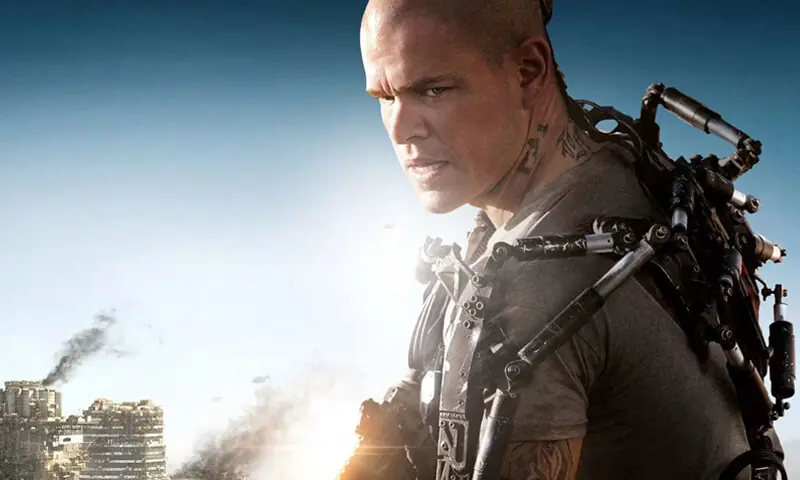
Elysium (Director: Neill Blomkamp, 2013)
Set in 2154, Elysium imagines a future in which the majority of humanity lives in poverty on Earth, while the wealthy reside aboard a luxurious orbital space station. Up there, advanced Med-Bays, inspired by gene-editing technologies such as Crispr, can cure disease, repair injuries, and effectively eliminate bodily limitations.
Earth-bound ex-convict Max Da Costa (Matt Damon) is fitted with an exoskeleton that dramatically enhances the strength and endurance of his irradiated, failing body. The suit was partly inspired by the Human Universal Load Carrier, a real-world exoskeleton designed for military use (but never actually used).
Ultimately, the film asks who gets access to technologies that can heal, repair and thus enhance the body. In doing so, it broadens augmentation beyond strength and endurance to questions of disability, bodily reconstruction, self-optimisation — and unequal access to these technologies.
DESIGNED EVOLUTION
Gattaca (Director: Andrew Niccol, 1997)
One of science fiction’s most influential explorations of genetic engineering, Gattaca imagines a eugenicist future with a near-universal reproductive system of embryo selection and IVF to optimise human bodies before birth.
In this genetically stratified society, DNA determines everything from career prospects to social status. Vincent Freeman (Ethan Hawke) is an “in-valid” conceived naturally (a “faith birth”) and thus barred from opportunities and status.
Rather than focus on spectacular superhuman abilities, Gattaca explores the quieter consequences of designed evolution. By treating desirable traits as products that can be selected and improved, the film asks what happens when biology becomes a measure of human worth. Nearly 30 years after its release, its vision of a society shaped by genetic optimisation remains strikingly relevant amid current concerns over the profiling of embryos’ DNA sequences, for example.
NETWORKED BODIES
Sleep Dealer (Director: Alex Rivera, 2008)
Set in a near-future Mexico, Sleep Dealer follows Memo (Luis Fernando Peña), a young hacker who flees to Tijuana after a military drone attack destroys his home. There, he becomes a cybracero (cyber-bracero/manual worker), connecting his body to a digital network through implanted nodes that allow him to perform physical labour remotely for the US.
Developed from Rivera’s satirical 1997 short Why Cybracero?, which parodies 1950s US recruitment films for migrant workers, Sleep Dealer critiques governments and corporations that profit from migrant labour while treating workers’ rights and bodies as disposable.
In this dystopian future, they gain the labour without bearing the burden of their legal and survival needs.
DIGITAL SELVES
Advantageous (Director: Jennifer Phang, 2015)
In this less well-known example, augmentation goes beyond the physical body to explore the human mind as something that can be separated, preserved and transferred into new forms.
In Advantageous, Gwen (Jacqueline Kim) is a single mother facing age discrimination and financial hardship, who believes the only way to secure her daughter’s future is via social status. So, she agrees to an experimental procedure that transfers her consciousness into a younger, more socially acceptable body.
Unlike the majority of digital transfer narratives, Gwen does not seek immortality or transcendence from her fleshy human life. She sacrifices her body/self to preserve her child’s future. Advantageous thus asks whether identity can survive technological transformation, and whether a transferred consciousness remains the same person once separated from its original biological body.
IMMORTAL BODIES
Altered Carbon (Creator: Laeta Kalogridis, 2018-20)
In the world of Altered Carbon, human consciousness can be stored and transferred between bodies, referred to as “sleeves”. A device implanted in the back of the neck regularly downloads the user’s consciousness data. In the event of death or injury, this can be placed into a new body — meaning the super-wealthy have effectively achieved immortality, by being backed up on a cloud and having a clutch of ready-to-go, biobag-grown clones.
Those with fewer resources, however, are often forced into inappropriate or unwanted bodies. In the first episode, a dying child is re-sleeved into the body of an adult. By turning longevity into a purchasable technology, this cyberpunk TV series explores the social inequalities that emerge when ageing and death no longer affect everyone equally.
The writer is Senior Lecturer in Film and Media Studies at Manchester Metropolitan University in the UK
Republished from The Conversation
Published in Dawn, ICON, October 18th, 2026