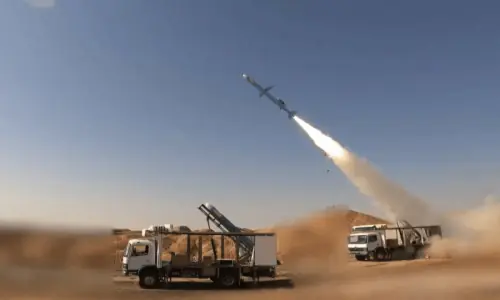
AS Saudi Arabia and Yemen’s Houthi movement continue to trade fire, and the US-Iran war is locked in a stalemate, regional states continue to stress the need for a diplomatic solution to the conflicts in both theatres. Numerous attempts have been made in the past to find a negotiated off-ramp in both conflicts, but they have met with little success.
Regional states know that the alternative to talks — a fully fledged war on both fronts — will bring immeasurable destruction to the Gulf, the Red Sea and the surrounding areas. The need for diplomacy was stressed during Omani Foreign Minister Badr al-Busaidi’s visit to Pakistan on Wednesday. Though the visit was of a bilateral nature, the regional situation was high on the agenda, with Oman’s top diplomat reiterating that “diplomacy is the only way forward”.
Both Pakistan and Oman have played integral roles in trying to find a negotiated settlement to the US-Iran dispute, while the sultanate is also a key link between the Saudis and the Houthis. Both Pakistan and Oman know that any further escalation either in the Gulf or in Yemen will destabilise the whole region.
With regard to the Yemeni conflict, while Pakistan has pledged to stand “shoulder to shoulder” with Saudi Arabia, the prospect of a long war of attrition involving the kingdom and its allies, and the pro-Iran Houthis, is in no one’s interest. The goal, therefore, should be a renewed ceasefire, which promises Saudi security and an end to the Yemeni civil war. Pakistan, Oman and other regional states should concentrate on achieving this goal.
Where Iran is concerned, it is likely that the US will make its next move after the midterm elections in early November. However, media reports that America plans on dropping the ‘mother of all bombs’ on Iranian energy and nuclear sites should be a matter of concern for all. America’s aggression has failed to make Iran capitulate, and it is hard to see what more violence will achieve, other than perpetuating chaos in the region.
What is needed is a holistic ceasefire that addresses all fronts — Iran, Yemen, Lebanon — along with a long-term peace between the US and Iran. The US must also refrain from initiating more wars in the Middle East, along with reining in its bloodthirsty ally Israel.
Published in Dawn, October 16th, 2026