Pakistan, Oman urge diplomacy to bring peace to Mideast
ISLAMABAD: Pakistan and Oman on Wednesday stressed the need for dialogue and diplomacy to end the conflict between the United States and Iran and agreed to continue working together for regional peace and stability amid escalating tensions in the Gulf and attacks by Yemen’s Houthis on Saudi Arabia.
The understanding was reaffirmed during the visit of Omani Foreign Minister Sayyid Badr bin Hamad bin Hamood Al Busaidi to Islamabad for the eighth session of the Pakistan-Oman Joint Ministerial Commission (JMC), which reviewed bilateral cooperation alongside regional developments.
Although the visit was primarily focused on bilateral relations, the deteriorating regional situation remained a key concern for the Omani minister. Soon after arriving in Islamabad on Tuesday night, Mr Al Busaidi spoke to Iranian Foreign Minister Abbas Araghchi to discuss the latest regional developments, including the situation in Yemen, and explore ways to promote peace and stability.
Speaking at a joint media interaction with Deputy Prime Minister and Foreign Minister Ishaq Dar after the JMC meeting, Mr Al Busaidi said the two sides had discussed regional challenges and shared the view that sustained diplomatic engagement was essential to prevent further escalation.
Mr Dar said Pakistan and Oman had a common understanding on the need to resolve disputes through peaceful means.
“We have commonality of view that dialogue and diplomacy is the only way forward. Conflict is no solution to any issue in the world, and we have seen from past history that conflicts take you to no positive conclusion,” he said, adding that the two countries had agreed to continue working for regional stability.
The two ministers also underscored the importance of ensuring the safety and freedom of navigation through the Strait of Hormuz and Bab al-Mandab, key maritime routes for global energy and food supplies.
While regional tensions dominated the political discussions, the JMC also took up its regular agenda on expanding economic and institutional cooperation between Pakistan and Oman.
Mr Dar said a key outcome of the session was the establishment and operationalisation of joint working groups on trade and investment, agriculture, oil and gas, and labour and human resource development. These mechanisms would ensure regular engagement and follow-up on decisions taken by the commission, he said.
The two sides also discussed cooperation in ports and logistics, energy, food security, information technology, tourism, education and workforce mobility, with both ministers calling for greater engagement between their business communities.
The ministers also agreed to continue institutional engagement, with the ninth session of the Joint Ministerial Commission to be held in Oman.
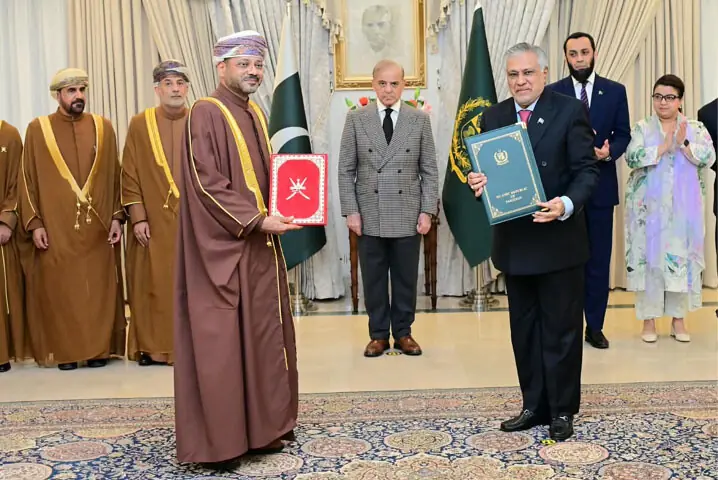
Later, PM Shehbaz Sharif received the Omani foreign minister and witnessed the exchange of six agreements and memorandums of understanding aimed at expanding bilateral cooperation.
The agreements included the protocol recording the minutes of the eighth JMC session, a mutual visa exemption agreement for holders of diplomatic, special, official and service passports, and an MoU on records and archives.
Other agreements covered information and broadcasting, information technology and telecommunications, and news exchange and media cooperation.
Published in Dawn, October 15th, 2026