At UNSC, Pakistan condemns Houthi attacks on Saudi Arabia, reaffirms support for kingdom's security
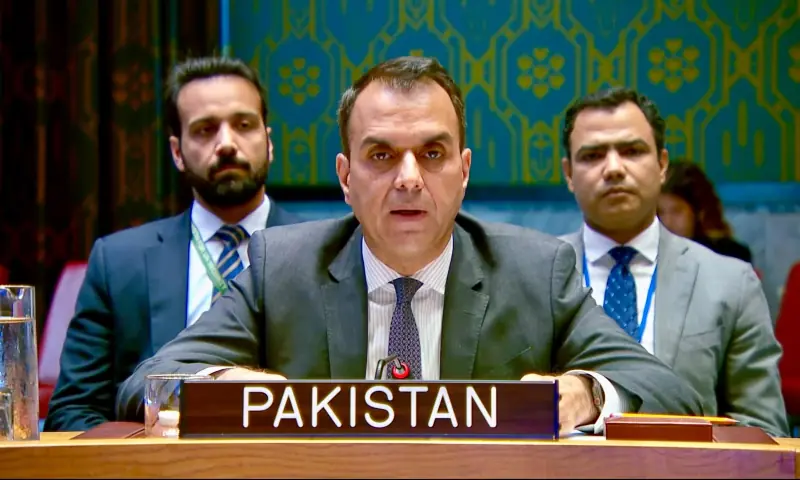
WASHINGTON: Pakistan on Thursday strongly condemned Houthi attacks on Saudi Arabia’s civilian and economic infrastructure, reaffirming its support for the kingdom’s security and right to self-defence amid escalating regional tensions.
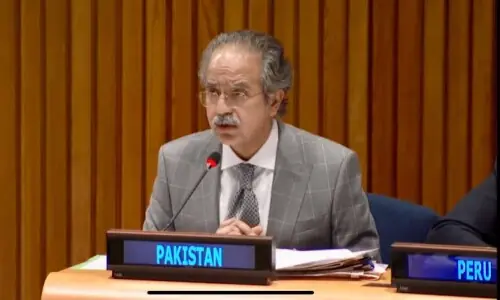
Speaking at a United Nations Security Council (UNSC) debate on the Middle East, Pakistan’s acting Permanent Representative, Ambassador Usman Jadoon, said, “These attacks must cease immediately.”
He reiterated Islamabad’s support for efforts to secure a peaceful settlement in Yemen.
Pakistan also backed the UN special envoy’s efforts to resume dialogue aimed at achieving a comprehensive and lasting peace in Yemen.
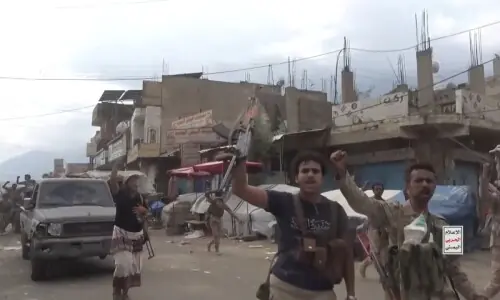
Saudi Arabia has, in recent days, come under sustained attack, including a strike on Riyadh’s international airport that was the deadliest in years, as the war with the Houthis dramatically escalates.
Yemen’s civil war reignited in July after a UN-brokered truce collapsed, months into a wider Middle East war that has rocked the region and roiled energy supplies and markets.
The conflict in the country has caused what the UN calls one of the world’s worst humanitarian crises, leaving most of the nation’s population dependent on aid.
The Saudi-led coalition has fought the Houthis since 2015 after they seized Yemen’s capital Sanaa and forced out the internationally recognised government from the city, until a UN-brokered ceasefire in 2022.
Concern expressed over Gaza
In the same session, Pakistan joined the call for halting settler violence in the West Bank and abandoning attempts to annex occupied Palestinian territory.
“In the occupied West Bank, including East Jerusalem, settlement expansion, particularly the E1 project, threatens to sever Palestinian territorial contiguity. Settler violence, demolitions, land seizures and forced displacement are entrenching annexation and dismantling the foundations of peace,” Jadoon said.
“All settlement activities must cease […]; settler violence must be halted; and accountability ensured.”
The E1 plan was greenlit by Israel last year and would further separate east Jerusalem, occupied and annexed by Israel and predominantly inhabited by Palestinians, from the West Bank.
Jadoon added that the international support for a two-state solution to the Palestinian issue must be accompanied by concrete measures to preserve Palestine’s territorial integrity and viability.
“The two-state solution remains the internationally agreed framework and the indispensable foundation for just and lasting peace,” he said, adding that Resolution 2803, the Comprehensive Plan to End the Gaza Conflict, and the New York Declaration provided mutually reinforcing frameworks for advancing that objective.
“Pakistan supports their full and good-faith implementation,” he added.
He also condemned Israeli incursions into Al-Aqsa Mosque and demanded respect for the historical and legal status quo of the holy sites.
Regarding Gaza, Pakistan expressed concern over continued ceasefire violations, Palestinian deaths and restrictions on humanitarian access.
Jadoon warned that the approaching winter threatened to worsen the suffering of families living amid destruction without adequate shelter or essential services.
He called for the Gaza ceasefire to be fully upheld, humanitarian assistance to be delivered unhindered and at scale, and recovery and reconstruction to proceed without delay.
Pakistan also stressed the need to support the work of the UN Relief and Works Agency for Palestine Refugees, and demanded the release of withheld Palestinian revenues to enable the Palestinian Authority to fulfil its responsibilities.
Jadoon rejected forced displacement and any attempt to fragment Gaza and the occupied West Bank, including East Jerusalem, which he said constituted a single territorial unit.
He called for a “credible, time-bound and irreversible” political process to end the Israeli occupation and establish an independent, sovereign, contiguous and viable Palestinian state on pre-1967 borders, with Al-Quds Al-Sharif as its capital.
Jadoon concluded that lasting peace in the Middle East would remain out of reach as long as the occupation continued and the Palestinian people’s right to self-determination remained unfulfilled.
“Pakistan remains committed to advancing dialogue and diplomacy in the region to help de-escalate tensions, resolve differences and promote lasting peace and stability,” he said.
The Palestinian representative, Deputy Permanent Observer Majed Bamya, said Israel continued to kill Palestinians despite the ceasefire and questioned what he described as unequal international responses to Israeli and Palestinian casualties.
“If violence is an impasse, as we are often told, and I believe it is, how can Israeli militarism be justified while Palestinian pacifism is demanded?” he asked.
Bamya said Israel had squandered the international sympathy that followed the Hamas attacks of October 7, 2023, through the killing of Palestinians, including children, and the destruction of entire multigenerational families.
He said more than 1,000 Palestinians had been killed over three years in the occupied West Bank, including East Jerusalem, while Israeli settlers and soldiers continued to perpetrate violence.
He called for Gaza and the West Bank to be reunited under the Palestinian Authority, with one government, one legal system and one security authority.
“We are either sovereign states, equal in rights and duties, sharing security and prosperity, or warring parties forever,” he said, adding that “occupation must end”.
France’s ambassador, Jerome Bonnafont, also called for an end to Israeli settlement expansion, warning that the E1 project, settler violence and financial pressure on the Palestinian Authority were fuelling instability.
“The unchecked expansion of settlements—including the E1 project—the clear trajectory toward annexation, the systematic and unpunished acts of terror committed by settlers, and the financial strangulation of the Palestinian Authority all fuel instability, including for Israel itself,” he said.
Britain echoed the criticism of Israeli settlement policy. Ambassador Sarah MacIntosh demanded an immediate halt to the E1 project, withdrawal of the relevant tender and an end to settlement expansion.
“The Government of Israel must ensure compliance with its obligations under international humanitarian law and remove the current restrictions on this critical aid,” she said, referring to humanitarian assistance for Gaza.
The United States defended President Donald Trump’s comprehensive Gaza peace plan, endorsed by Security Council Resolution 2803 (2025), saying its success depended on Hamas disarming and relinquishing its weapons.
The UN’s acting Special Coordinator for the Middle East Peace Process, Ramiz Alakbarov, warned that the ceasefire remained extremely fragile, with Israeli military operations continuing to cause Palestinian casualties.
Citing Gaza’s Ministry of Health, he reported approximately 1,500 Palestinian fatalities since the ceasefire, including more than 320 children and 140 women.
“During my visit to Gaza on Sunday, I witnessed that, for Palestinians living along the Yellow Line, the ceasefire exists in name only,” he said.
Alakbarov warned that winter would deepen the humanitarian crisis, with an estimated 950,000 people living in areas at medium or high risk of flooding and more than 4,000 buildings being used as shelters at risk of collapse.
He called for the full implementation of the Gaza peace plan, including the disarmament of Hamas and other armed groups, withdrawal of Israeli forces, deployment of the international stabilisation force and transfer of transitional governance responsibilities to the National Committee for the Administration of Gaza.
He said the ceasefire must become the foundation for genuine recovery and a lasting political settlement, paving the way for two states living side by side.