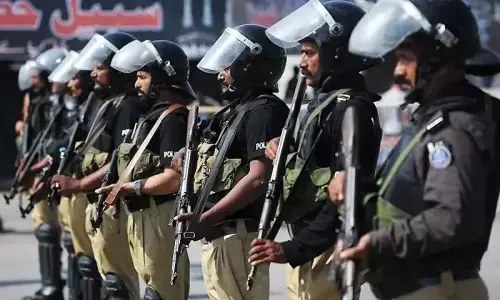
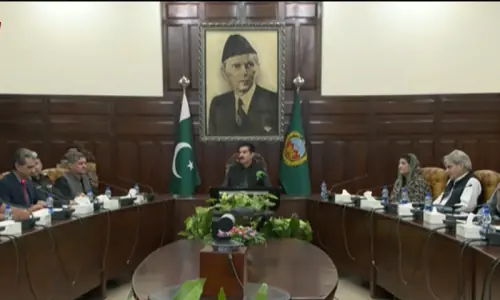
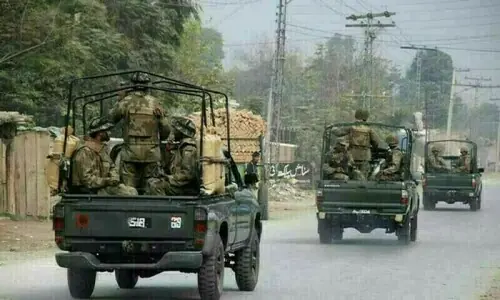
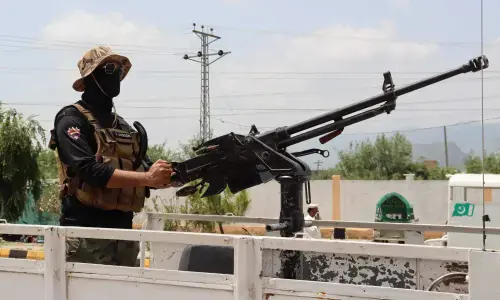
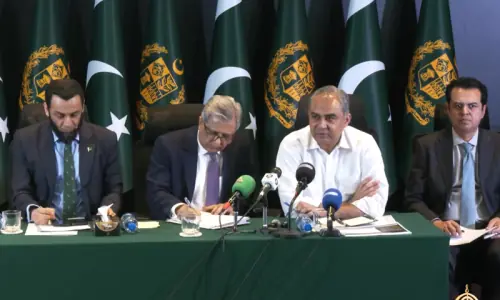
The federal government imposed an emergency and governor’s rule in Khyber Pakhtunkhwa amid growing tensions with the PTI-led provincial government, including disagreements over counterterrorism policy amid a deteriorating security situation in the province.
The decision was taken under Articles 232 and 234 of the Constitution of Pakistan. Here is what it means.
Governor’s rule
Article 234 of the Constitution of Pakistan stipulates that, if the president believes that a provincial government cannot function in accordance with the Constitution, the federal government can assume control of the province.
This can be done either directly or by assigning the relevant functions to the provincial governor — hence the term governor’s rule.
Under this arrangement, the powers of the provincial assembly can be exercised by Parliament. However, neither the president nor the governor can assume the powers of the high court or suspend its operations.
Moreover, governor’s rule can be imposed for an initial period of two months, with a joint sitting of Parliament able to approve an extension of up to two months at a time.
In total, governor’s rule can remain in place for a maximum of six months.
While a province is under governor’s rule, its government or the chief minister cannot exercise their powers, but “I don’t see how it brings the government to an end”, said lawyer Mirza Moiz Baig.
He added, “The government would come back into existence upon the end of the emergency”.
“Once the proclamation expires, the Chief Minister and his Cabinet are restored,” lawyer Rida Hosain told Dawn.
State of emergency
Meanwhile, under Article 232, which pertains to the proclamation of an emergency, the provincial assembly continues to function as usual. However, if a provincial law conflicts with a federal law enacted by Parliament, the latter takes precedence.
Lawyer Basil Nabi Malik, speaking to Dawn, explained that the chief minister would remain in office during a state of emergency. However, the federal government could assume certain functions of the provincial government.
An emergency also allows the federal government to make provisions it considers necessary and suspend certain constitutional provisions relating to provincial bodies. However, as with governor’s rule, the federal government cannot assume the powers of a high court.
It also empowers Parliament to confer powers and impose duties on federal government officers in the province.
It further stipulates that laws passed by Parliament solely on account of the emergency will cease to have effect six months after the emergency ends.
The proclamation of emergency lapses after two months unless it is approved by a resolution of a joint sitting of Parliament.