Now, to be fair, this might not have anything to do with the movie — but then again, maybe it does — but a strange thing happened during the premiere of Sheroes: Stories of Nisa, a women-empowering anthology of no specific genre, funded by the Government of Sindh.
A few minutes into the third short film, three rows of celebrities — the cast, their well-wishing actors, directors and channel executives — simply got up and left, with 30-odd minutes still remaining before the end credits rolled! Only government representatives, their families, a few journalists and general invitees remained seated.
A prior engagement, one presumes? Still, couldn’t the cast have stayed, especially for their own film?
The en masse exit signals the temperament of state-funded projects: an utter lack of ownership. Staying till the end would at least have given one the reason to say: Hey, the movie is not a total loss!
Sheroes sets out to tell three unconventional stories about women’s empowerment, culture and anti-terrorism, but weak writing and lacklustre direction leave the Government of Sindh-backed anthology struggling to land its punches
Sheroes is four steps up from Mera Lyari, the Sindh government’s first release. On a scale of one to 10, it lands a four, maybe even a five on a good day.
SOUNDS LIKE A GOOD IDEA — OR THREE
Sheroes’ pitch was music to the ears: deliver three unconventional stories around mandated themes of women’s empowerment, cultural showcase and anti-terrorism. That’s hitting three birds with one stone… if the aim weren’t shoddy. The execution lands strictly between meh and moronic. I’d blame the writers and directors.
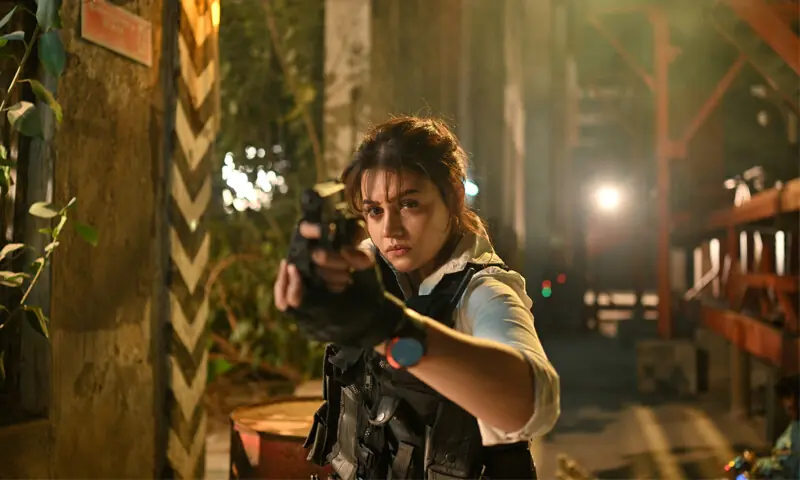
The first segment, Gear Up — written by Hashim Nadeem, directed by Saqib Khan (Ghabrana Nahin Hai) and shot by Nabeel Hassan Razvi — stars Zara Noor Abbas as a bomb-disposal expert battling male chauvinism and a motiveless terrorist played by her real-life husband, Asad Siddiqui.
The second, Artist, has Kinza Hashmi as an upcoming artist who decides to pull one over the system with the help of the local trans community led by Nayyer Ejaz (please give him a break from these roles already!). It is written by Amna Mufti, directed by Saqib Khan and shot by Nabeel Hassan Razvi.
The third is Punch — the most complete story of the three — written by Mohsin Ali, directed by Badar Mehmood (of the TV drama Kabhi Main Kabhi Tum fame) and shot by Suleman Razzaq and Shoaib Suleman Razzaq. In it, Gohar Rasheed’s character fights against family and tradition (more like emotionally argues, convinces and puts his foot down) to bring his once-boxing champion wife, played by Ushna Shah, back into the ring.
These are good ideas whose shortfalls cannot be analysed without spoilers, because the issues start with the story and the approach to the narrative.
WARNING: PLOT AND SPOILERS AHEAD
In Gear Up, Saira Moin (Zara Noor Abbas) is the very definition of empowered — at least superficially. She wears aviator sunglasses over a sleek jacket and a white shirt, and rides her heavy bike to work.
Snappy cuts tell us she got the job in the bomb-disposal department after her father died defusing an explosive device. As the only woman in the department, she seeks validation from her boss, played by Rashid Farooqui.
Then comes the opportunity: a man in a hoodie, played by Asad Siddiqui, calls with a lame riddle pointing to planted bombs. She springs into action without back-up and finds her boss’ son, played by Omi Butt, strapped with a bomb, with two more explosives hidden hardly 15 feet apart.
The bomber reveals his real identity without a legit backstory or motive. Standing just out of reach, he taunts her throughout the short film. Having had enough of his yammering, she shoots the man in the head and defuses the bombs, earning validation from her boss with a pat on the back.
One cannot help but ask the most basic of questions: what was the villain’s motive? Why plant three bombs steps away from each other and not in different areas of the city? Why kill the villain at all, with the police nearly there, and especially with no repercussions or dramatic twists to follow?
Replace the woman with a man, and the same gesture of a superior’s validation applies, irrespective of gender.
So, where’s women’s empowerment in the story? Isn’t this just a female-led action thriller, without the highs of either genre? Moreover, it is one where the dramatic music and heavy-handed colour-grading hammer and desensitise your senses.
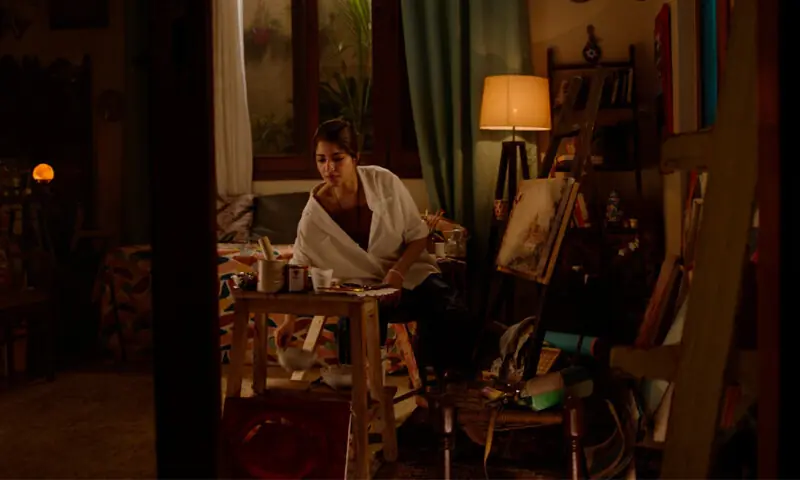
Artist is worse off. When the debut exhibition of artist Aiman Gillani (Kinza Hashmi) fails and the world puts her down, she concocts an art swindle with Guru ji, the head of the transgender community (Nayyer Ejaz).
She falsely ages one of her artworks, passes it off on social media as the lost work of a renowned artist, and sells it for two crore rupees. Not only that, she puts a condition that an esteemed art critic, who negatively reviewed the artworks in her debut painting exhibition, praises them and that the paintings be put up for show once again.
Again, what has women’s empowerment got to do with it? More importantly, rather than setting the system right, or at least fighting it, she becomes just as corrupt, exploiting her art by lying, cheating and pulling off an ignoble deal.
Both films mistake the words ‘women-led’ for ‘women empowered’.
The third film slips in parts — especially when the old, grumpy coach (Mohammed Ehtashamuddin) visits Ifrah Ahmed’s (Ushna Shah) house — but the writing and Ifrah’s motivations make far more sense.
Instead of forcing Ifrah to lead, retaliate and revolt, the film lets her talk about issues such as willingly taking — and being bound by — the responsibility of caring for home and family, and why unconditional support from loved ones, especially her husband Zahid (Gohar Rasheed), can lead to true empowerment.
WHAT WORKS, WHAT DOESN’T
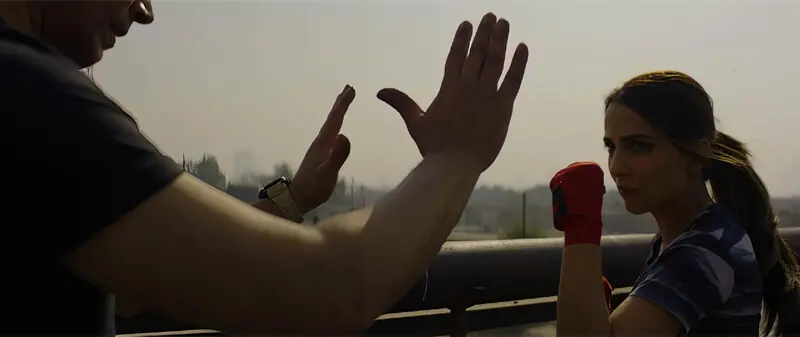
By way of performances. Zara Noor Abbas is fine, as are Nayyer Ejaz, Noor-ul-Hasan, Hammad Siddiq, Farrukh Darbar (as a transgender character), Ahmed Safdar, Mohammed Ehtashamuddin, Ushna Shah and Gohar Rasheed. The latter, in particular, singlehandedly does the heavy lifting of an entire segment. The cinematography is a minor plus (with the exception of Punch), though the direction is mostly standard and forgettable throughout.
The editing (credited to Fawad Bajwa, Noman Anwar and Rizwan AQ) hastens the pace but cannot mask the main problem with Sheroes (and perhaps most Pakistani films): an utter lack of clear-headedness and foresight when penning the stories.
If the script is not right, neither government initiatives, heroes, nor sheroes, will get a chance to gear up, artistically shine or land the right punch (pun intended).
Produced by Imran Hussain under the banner of Tamasha Films and Sindh Films (the government’s label), and distributed by Orient Distribution Club, Sheroes may still be playing in cinemas — check local timings. The film is rated U, suitable for every age group, irrespective of gender
The writer is Icon’s primary film reviewer
Published in Dawn, ICON, October 11th, 2026