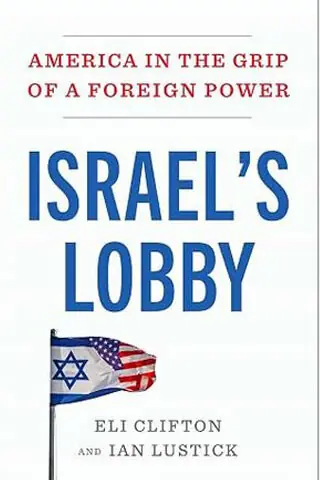
Israel’s Lobby: America in the Grip of a Foreign Power
By Eli Clifton and Ian Lustick
Simon & Schuster
ISBN: 978-1668210840
304pp.
The Hanover Institute for Public Policy published 124 reports totalling more than 560,000 words between August 6 and August 14, 2026. The main purpose of the Hanover Institute is to give the Israeli perspective to online queries on issues such as the genocide in Gaza, settler violence in the occupied territories and the rising anti-Israel sentiment in the United States.
The Hanover Institute, according to The Guardian of August 26, 2026, was registered in the USA under the Foreign Agents Registration Act (Fara), a 1938 law that requires everyone working for a foreign government to formally disclose it. This report-spewing behemoth, however, has no physical address and carries no named staff and no bylines.
It is the most recent example of questionable tactics used by Israel and its lobby to influence American policy and public opinion about the Middle East. Eli Clifton and Ian Lustick’s book, Israel’s Lobby: America in the Grip of a Foreign Power, painstakingly documents how a small state has managed to exercise oversized impact on a great power for the last 70 years.
Any scholar in America who publishes a critical appraisal of Israel-US relations knows there will be concerted efforts to question the credentials of the study and those who penned it. Scholars Noam Chomsky and Norman Finkelstein were termed self-hating Jews for criticising Israel. Clifton and Lustick knew that the publication of their book would not lead to invitations to popular talk shows. The big success of Israel’s lobby is the “criminalisation of criticism of Israel’s policies” because criticism of Israel is treated as an attack on all Jews.
An important and timely new book details how the Zionist state and its allied American pressure groups have shaped US policy, aid and public opinion over seven decades
The book chronicles in detail how, with the help of Israel’s lobby, the small country about 10,000 kilometres away from Washington DC, has managed to extract unconditional aid “at a scale and duration beyond anything a great power has ever done for a foreign country.”
Since the 1970s, Israel has been the largest recipient of American aid and it regularly receives one-quarter of all US military aid delivered worldwide. A conspiracy theory-driven explanation, a popular staple in Pakistan, is that it is Jews who make America’s Middle East policy. Rather than focusing on the straw-man of scheming Jews, Clifton and Lustick want us to understand Israel’s lobby, which has close relations with Christian evangelicals. The term ‘Israel’s lobby’ refers to “a panoply of organisations, groups and individuals (including Jews, Christians and others) who advocate for American policies that favour the interests of Israel.”
Being the largest recipient of US aid does not make Israel a political pygmy in America. Benjamin Netanyahu has addressed the US Congress four times, surpassing Winston Churchill, the only other foreign leader to have spoken on three occasions. The lobby’s clout is unmistakable when it comes to US support for Israel in the UN, where standing instructions to the American delegation are to blunt any criticism of Israeli actions by exercising veto power.
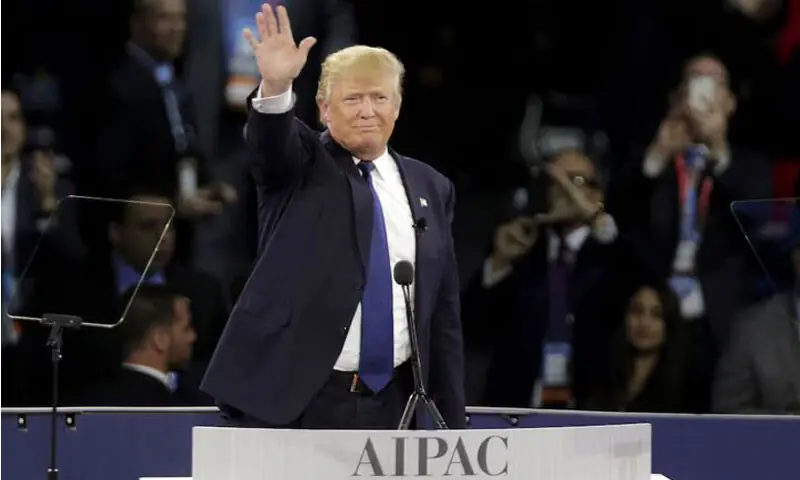
To help us understand the labyrinthine nature of the lobby’s multipronged outreach, the authors zoom in on the American Israel Public Affairs Committee (AIPAC), the envy of all foreign lobbies in the US. It was founded as the American Zionist Committee in the 1950s to “protect Israel from criticism.” Renamed AIPAC in 1959, as of 2025 it has five million members and is closely aligned with the conservative Likud Party of Israel.
US lawmakers know the rewards and punishments that AIPAC is capable of meting out. AIPAC roughly contributes 10 to 15 percent of a typical congressional campaign budget and, thanks to keeping a record of, and a close eye on, legislators’ actions and words, it arranges funding accordingly. Echo the lobby’s voice at the Capitol and you will be rewarded. Any digression from it runs the risk of being termed as antisemitism.
Clifton and Lustick argue that the success of the Israel lobby in using American domestic politics and public opinion has come at the cost of “repeated sacrifice of American national interests” and a betrayal of traditional American values. For evidence, they turn to the history of Israel-US relations, starting with President Harry Truman (1945-1953). The majority of his cabinet was against the premature recognition of Israel in 1948 but Truman ultimately chose otherwise because of the upcoming elections.
About a quarter century later, President Gerald Ford (1974-1977) and his secretary of state and national security adviser Henry Kissinger wanted a reassessment of the US’ Middle East policies and, for that purpose, they formed the committee of ‘Wise Men.’ It comprised former government officials who had served as pillars of the postwar US foreign policy establishment. The unanimous recommendation of the committee was to pressure Israel to withdraw from territories it had occupied in 1967, in order to achieve a comprehensive peace in cooperation with the Soviet Union.
Israel’s lobby went into overdrive to thwart the initiative and it started with denouncing Kissinger, himself Jewish. The lobby had a letter signed by 76 senators that warned the president to desist from adopting policies that might harm Israel.
The biggest challenge the lobby has encountered of late is declining support for Israel’s repressive policies among ordinary Americans. The lobby’s preferred weapons have been aptly captured by a chapter title of the book ‘The Antisemitism Witch Hunt.’ Instead of engaging with or rebutting criticism of Israel, dissenting voices are now branded antisemitic and Palestinians are portrayed as crazy militants. The new modus operandi is to attack the messenger — not the message.
The book is a timely publication that will help the reader understand the complex nexus between the American domestic and foreign policy realms. It offers insights into the functioning of the American political system, where big money and a well-designed lobbying combo can have far-reaching impacts on a volatile region like the Middle East. There is a lot of literature on asymmetric warfare but little on asymmetric friendship. The Israel-America friendship shows how a small and less powerful friend can bend the will of the more powerful friend.
My one gripe with an otherwise brilliant book is the authors almost portraying American leadership as innocent guys who foolishly walk into traps set up by Israel and its lobby. In fact, there is merit in the argument that Israel has informally served as the most reliable US base in the Middle East. Also, the US has used Israel as one factor in convincing oil-rich Arab states to be big buyers of US arms. Additionally, prolonged military engagements, such as the ongoing war in Gaza, provide an opportunity to field-test American weapons.
Above all, both Israel and the United States are settler colonial states and shared characteristics do play a role in explaining the US turning a blind eye to Israel’s treatment of the Palestinian population.
The reviewer teaches at IBA, Karachi.
He can be reached at hnizamani@hotmail.com
Published in Dawn, Books & Authors, October 11th, 2026