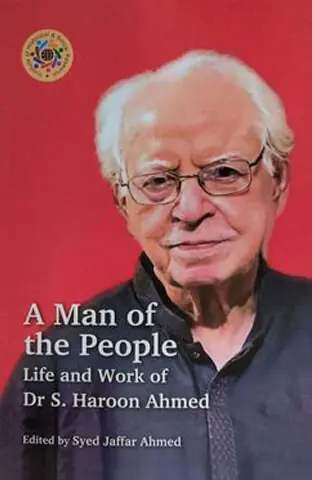
A Man of the People: Life and Work of
Dr S. Haroon Ahmed
Edited by Syed Jaffar Ahmed
Institute of Historical and Social Research
172pp.
Some books arrive as intellectual encounters; others evoke a world one has known personally. A Man of the People: Life and Work of Dr S. Haroon Ahmed did both for me.
Having spent much of my own life around education, social development, human rights and progressive intellectual circles in Pakistan, I found myself reading this collection not simply as the record of a distinguished psychiatrist, but as the portrait of a generation that believed professional achievement carried a wider social responsibility. Haroon Ahmed belonged unmistakably to that generation. Medicine was his profession, but society was his larger patient.
Dr Syed Haroon Ahmed, who died in Karachi on April 3, 2025, at the age of 94, inhabited several worlds at once: psychiatrist, researcher, institution-builder, democrat, peace activist and public intellectual. A Man of the People, edited by Syed Jaffar Ahmed, demonstrates that these were not separate compartments of his life. They flowed into one another. Psychiatry, politics and humanism became different expressions of the same concern: how human beings might live with dignity, psychological security and freedom.
Published by Karachi’s Institute of Historical and Social Research, the book is part anthology, part professional record and part memorial. The editor candidly admits that it is not a complete collection of Haroon Ahmed’s writings. His work, produced over decades, remains scattered and a more comprehensive compilation will eventually be necessary. This apparent limitation is also revealing. Ahmed’s interests were simply too wide to fit comfortably into one discipline or one volume.
A book on the late Dr Haroon Ahmed attempts to connect his wide-ranging work as a psychiatrist, researcher, institution-builder, democrat, peace activist and public intellectual
Born in Jaunpur in 1931, he migrated to Pakistan after Partition, graduated from Dow Medical College in 1953 and later specialised in psychiatry at the Maudsley Hospital in Britain. But medicine was only one part of his education. During his student years in Karachi, he became involved in progressive politics and the Democratic Students Federation, campaigning for affordable and accessibleb2
education. The book places these activities against the backdrop of Pakistan’s early struggles over democracy, social justice and authoritarianism.
That formative experience appears to have shaped his psychiatry. Ahmed did not see mental illness simply as a malfunction inside an isolated individual. Families, poverty, migration, stigma, violence, sexuality, political insecurity and cultural expectations entered the consulting room along with the patient.
Indeed, the book reads almost like an alternative social history of Pakistan. There are essays on anxiety and schizophrenia but also on the ‘Dubai Syndrome’, associated with migration to Gulf states; depression and culture; the role of relatives in psychiatric care; the coronavirus; political violence; child-rearing among different ethnic communities; sexuality; and culturally familiar complaints labelled Dhat Syndrome, “gas” and alexithymia (the inability to name and identify emotions). Psychiatry becomes a window through which Pakistani society examines itself.
The chapter titled ‘Dubai Syndrome in Karachi’ is particularly striking. Based on conversations with 20 families in which an earning member had migrated to the Gulf, it examines the emotional hardship experienced by wives and children left behind. The sample would appear small by contemporary research standards, but the questions remain remarkably current. Migration is usually discussed in Pakistan in terms of remittances, foreign exchange and employment. Ahmed was asking a different question: what happens psychologically to the family that remains behind?
It was at this point in the book that I felt a particularly strong connection with Ahmed’s method. During decades of working in education and development, I have repeatedly seen how statistics can conceal the human beings behind them. A migrant worker may appear in an economic table as a source of remittances; his absence may appear nowhere. A child may be counted as enrolled in school without anyone asking what anxiety, family separation or social pressure accompanies that child into the classroom. Ahmed’s psychiatry repeatedly insists on looking behind the numbers. That, perhaps, is why some of these relatively old studies still speak to us.
The same sensitivity appears in the study of child-rearing practices among Pakhtun, Punjabi, Baloch, Sindhi and Muhajir communities. Instead of imagining Pakistan as culturally homogeneous, the researchers attempted to identify both similarities and variations across five groups. Ahmed’s brief study of alexithymia is equally revealing. Rather than importing a Western psychological concept unquestioningly, Ahmed and his colleagues tested its applicability in Karachi and cautioned against accepting theories developed elsewhere without considering local social and cultural conditions. It is a useful principle far beyond psychiatry: intellectual imports, like material ones, deserve inspection at the border.
Not everything in the volume has aged equally well. ‘Anxiety State — Diagnosis and Treatment’ belongs to an earlier psychiatric vocabulary. Some samples are small. Discussions of sexuality and ‘potency’ reflect the terminology and assumptions of their time. The book should therefore not be approached as a contemporary clinical manual. It is more valuable as an intellectual history of Pakistani psychiatry: evidence of how doctors attempted to understand mental distress within a rapidly changing postcolonial society.
Ahmed’s institutional achievements were substantial. He founded the Pakistan Association for Mental Health in 1965, helped establish the Pakistan Psychiatric Society in 1972 and later the Institute of Behavioural Sciences in Karachi. He also worked for legal protection for people suffering from mental illness, an effort the volume connects to the eventual Sindh Mental Health Act of 2013.
Institution-building is among the least glamorous forms of public service. Buildings, associations and professional bodies rarely possess the romance of speeches or demonstrations. Yet, societies are ultimately sustained by people willing to endure committees, constitutions, meetings and endless administrative negotiations. Ahmed seems to have possessed that patience.
The final section changes the register. Clinical papers give way to remembrance. Journalist Ghazi Salahuddin recalls an exceptional figure whose concerns ranged from psychiatric care to progressive politics and peace. Habib University’s President Syed Wasif Ali Rizvi remembers Ahmed within the democratic and progressive activism of the 1980s. Journalist and documentary filmmaker Beena Sarwar places him within South Asian peace initiatives and public-health advocacy, giving the reader a sense of a man whose moral geography extended beyond national borders.
The affectionate tone is understandable, though it also produces the volume’s principal weakness. Tribute occasionally substitutes for critical distance. A stronger editorial apparatus could have told us when and where each piece first appeared, placed the clinical papers within changing psychiatric debates and distinguished ideas that remain scientifically persuasive from those now primarily of historical interest.
A fuller intellectual biography would also have helped connect Ahmed’s medical thought more explicitly with his democratic commitments.
The reviewer is a columnist and educator.
He can be reached at mnazir1964@yahoo.co.uk
X: @NaazirMahmood
Published in Dawn, Books & Authors, October 11th, 2026