SOCIETY: THE KITCHEN OF ISLAMKOT
As the sun sets over the Tharparkar desert, casting a warm golden hue across the landscape, the courtyard of a little-known ashram [hermitage] in Islamkot transforms into a lively haven. Flocks of birds arrive to roost, filling the air with their chirps and songs, as locals bring grain offerings.
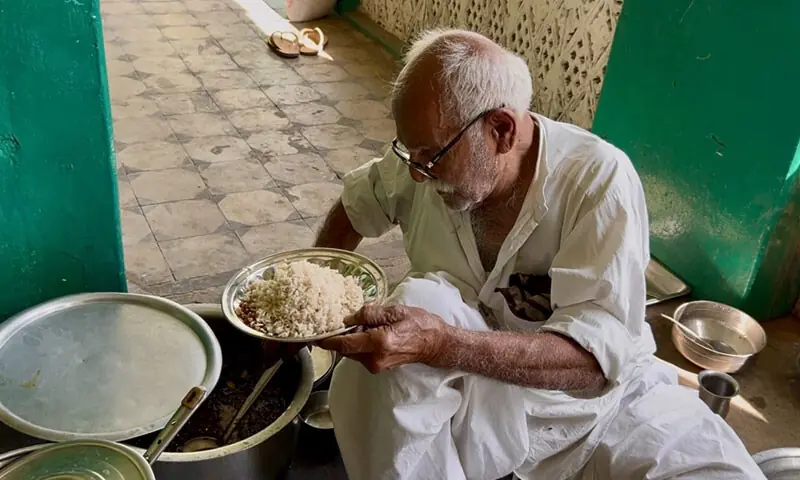
“This ashram is run on pure faith and love,” says Lachman Das, now in his eighties. He has spent the last two decades as the caretaker of the Sant Nenuram Ashram. The ashram feeds more than a thousand people a day, as well as tens of thousands of animals and birds, almost entirely through community support and without government funding.
“When Sant Nenuram was alive, he would walk through the town’s streets, visiting different shops to collect donations and flour to serve the needy,” Das tells Eos. “To keep his sacred memory and mission alive, we continue this work today.”
For Das, the hermitage embodies Tharparkar’s long tradition of coexistence and seva [service]. This tradition of seva — or sheva as it is pronounced in Thar — dates back generations and is deeply intertwined with the mystical, pluralistic culture of Sindh. The tradition continues to thrive in Islamkot, a historic desert town shaded by ancient neem trees.
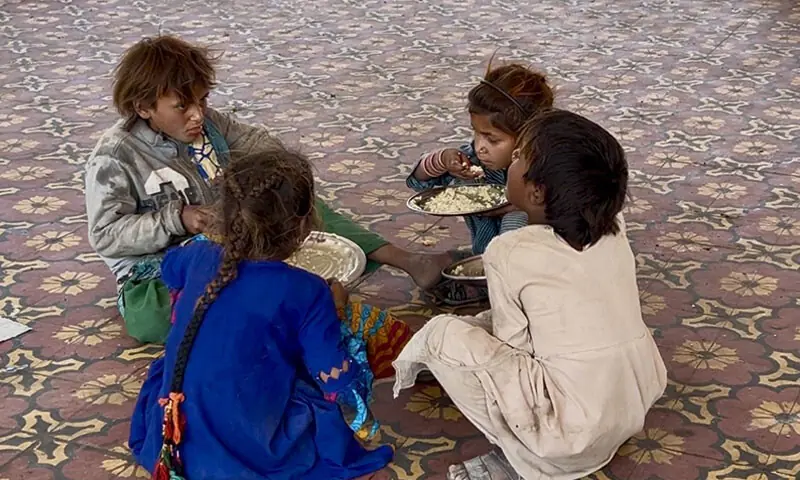
For decades, the Sant Nenuram Ashram in Thar has offered free meals to anyone who arrives at its doors, continuing a tradition of community service that extends from people to animals and birds
A BAREFOOT PILGRIM RETURNS
Born in 1898, Sant Nenuram developed a strong commitment to humanitarian work and a deep love for nature from an early age. Though he received little formal education, he was deeply influenced by the inclusive poetry of Sindh’s Sufi traditions, including the works of Shah Abdul Latif Bhittai, Sachal Sarmast and Sami. He was also well versed in the writings of regional mystics such as Bhagat Kabir and Baba Bulleh Shah.
According to accounts of his life, he once joined a group of pilgrims on a barefoot journey that took him to the village of Kekri in Rajasthan. There, he stayed at the ashram of a famous spiritual figure, Guru Kaniram, and absorbed the principles of devotion.
In 1935, he returned to Islamkot and established his base at the site of another ashram, Puran Bharti Madhi. Initially, it served as a resting place for seasonal migrants travelling towards the irrigated barrage areas, where they could feed and water their livestock free of charge.
Witnessing the extreme poverty around him — most locals could barely afford one meal a day — Sant Nenuram started a langar [free communal meal] that has operated continuously since then.
“The Sant’s legacy transcends religious and social boundaries,” says Das. “Everyone is welcome and no one is ever asked about their faith or caste.”
This ethos extends beyond humans to the desert’s wildlife. Inside the premises, clay pots placed across the courtyard are kept constantly filled with fresh water, and the areas designated for feeding birds are kept covered with grain. The ashram also maintains its own livestock, ensuring a steady supply of milk for visitors and pilgrims.
Dileep Kumar, a devoted follower of the saint, spends his evenings here. “Here, the hunger of every creature matters,” he tells Eos. “Humans, animals and birds all find sustenance in this courtyard.”
A KITCHEN WITHOUT A LEDGER
Keeping such a large operation running in the middle of the desert is no simple task.
The ashram relies on an unusual system of anonymous donations, managed entirely by the local community. Whether the contribution comes from a local resident or an outsider, no donor’s name or address is recorded in any ledger. Instead, every offering is acknowledged on its receipt with the phrase: “Nenuram ne diya, Nenu ne liya” [Given by Nenuram, received by Nenuram].
Beyond serving as a place of sustenance, the ashram is also a repository of regional culture and history. It preserves personal items used by Sant Nenuram so that younger generations can learn about his austere life. The original well, dug when the ashram was established, is another important part of the site.
According to local lore, the wells in Islamkot yielded bitter, brackish water before the ashram was built. When Sant Nenuram had this well dug to provide drinking water for people and animals, local accounts hold, its water became sweet.
The site also holds spiritual significance for devotees from different religious communities across Sindh. Before setting off for various regional festivals and fairs, devotees of all backgrounds visit the ashram to light a sacred fire behind the samadhi [tomb] of Sant Nenuram. Only after performing the ritual and receiving the saint’s blessing do the pilgrims proceed on their journeys.
A LIFELINE IN THE DESERT
For low-income families in Thar, the ashram is not just a spiritual sanctuary; it is a vital economic lifeline. As rising prices make basic necessities increasingly difficult to afford, the free kitchen keeps hunger at bay.
Santosh, a 35-year-old labourer, visits the ashram every afternoon for lunch. “This is a monumental service,” he tells Eos. “By eating here, we save money that would otherwise be spent on food. A large number of people from nearby neighbourhoods rely on this kitchen to survive.”
Similarly, the ashram plays a quiet but pivotal role in supporting the dreams of the region’s youth. Meghraj, a student hailing from a family of farmhands, has to travel 15 kilometres daily from his remote village to study in Islamkot.
Meghraj says the ashram’s free kitchen is what makes it possible for him to continue his education. “A single meal at a local hotel costs at least 300 rupees today,” he tells Eos. “If I had to pay for my food daily, my family wouldn’t have been able to afford my education.”
Every year, the birth and death anniversaries of Sant Nenuram draw thousands of devotees from distant areas across Pakistan to participate in a mela [festival].
For as long as the kitchen continues to serve anyone who arrives at its doors, Sant Nenuram’s tradition of seva will live on — one meal and one offering at a time.
The writer is a freelance journalist from Tharparkar, Sindh. He can be contacted at gr.junejo123@gmail.com
Published in Dawn, EOS, October 11th, 2026