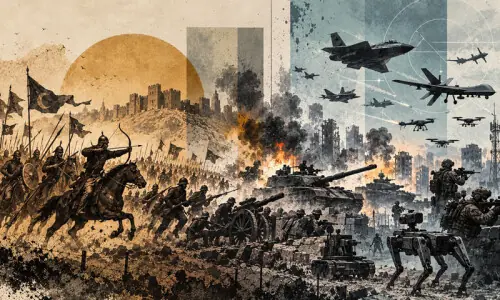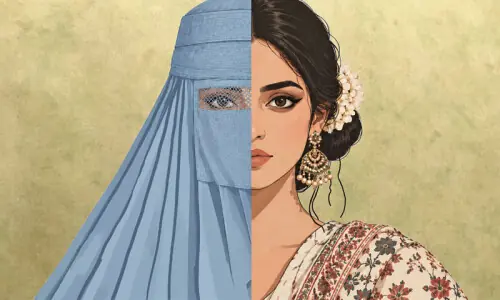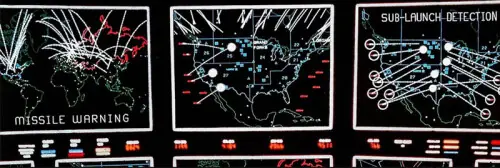
When a society experiences rapid political, technological or social change, historians need time to develop a language to describe the change. The arts can immediately respond with poetry, music and visual images.
Music is the most easily shared of the arts across a society. It becomes a historical record of its times, from classical compositions to modern genres such as punk, blues and rap. Arnold Schoenberg’s atonal music compositions reflect the intense anxiety and uncertainty of pre-WWI Europe. Songs such as “Sometimes I Feel Like a Motherless Child” perfectly embody the collective trauma experienced by enslaved African Americans. The singer songwriter Prince expressed existential dread with his edgy music, ending one of his songs with a child asking, “Mommy, why does everybody have a bomb?” Lyari’s female rapper Eva B sings: “Gir ke hi uthna seekha main ne [Only after falling did I learn to rise].”
The last Mughal emperor, Bahadur Shah Zafar, facing the loss of his kingdom, wrote, “Lagta nahin hai dil mera ujrray dayaar mein [My heart feels lost in this blighted land].” In the violent chaos of Partition, Faiz Ahmed Faiz wrote in August 1947, “Woh intezaar tha jiska, yeh woh sahar tau nahin [This is not the dawn that we were waiting for].” Indian classical music has a raag [melodic framework] for every emotion and every time of the day. Raag Marwa is considered the ultimate expression of deep unease, restlessness and anxiety, performed during jhatpata or twilight, where day meets night.
In his book Goliath’s Curse: The History and Future of Societal Collapse, the researcher Luke Kemp uses ‘Goliath’ as a term for large civilisations built on dominance, coercion and the extraction of labour and resources. The ‘curse’ is that these giant structures seem invincible with their military might, amassing immense wealth and causing extreme economic and social inequality. Where there is a Goliath, the story must include a David. Kemp suggests that citizens can collectively act as the ‘Davids’ that resist dominant systems. However, the ‘Goliaths’ usually destroy themselves by their own hubristic actions.
Long before historians arrive at their conclusions, poets, musicians and artists are already recording the anxieties, losses and hopes of their times, thus giving these moments their most immediate and enduring expressions
Studying 440 societies across history, Kemp found that, where there are no Goliaths, communities are able to reset themselves. What history calls the collapse of empires becomes freedom for the oppressed, vividly captured across art, literature and music, which becomes free to express the lived reality of the average person.
Jean-Francois Millet could paint peasant women picking stray stalks of wheat after the harvest. Vincent Van Gogh could paint sunflowers in a humble vase. Kalighat painters could mock the Indian upper classes, whose power was usurped by the colonisers. Contemporary Pakistani miniatures elevate everyday life using the language of high art.
The English Romantic movement responded to the dehumanising effects of the Industrial Revolution through William Blake’s poem Dark Satanic Mills, by celebrating nature, the vanishing pastoral world and by reviving crafts to honour the human soul that could not be mechanised.
Art is never just a passive by-product of chaos. It fills the cracks by being relevant, resilient, processing emotions and unafraid of breaking traditions to find a new way forward. The art of the unsettled can be expressed not only in galleries but also through rap, graffiti and T-shirt designs. When an empire ends, creativity remains alive. Where once it served the palace, it now steps onto the streets and speaks for the people. It prioritises telling the truth of a chaotic moment over an academic standard of perfection.
Art is the most vibrant connecting link across historical and often lost pre-historical civilisations. Art is a bridge across eons that brings to life a people’s beliefs, skills and lifestyles: the playing dice of the Indus civilisation still used today, 68,000-year-old cave paintings in Indonesia, the Nazca Lines in Peru, Egyptian narrative wall paintings, ziggurats across the world and the buried terracotta army in China. Displaced First Nations in North America and Australia fight for respect through their art as a reminder of the theft of their lands.
Art presents what was broken, what never broke, what mattered to people, what should matter and all that survives the storms. It offers no solutions but makes us remember.
Durriya Kazi is a Karachi-based artist.
She may be reached at durriyakazi1918@gmail.com
Published in Dawn, EOS, October 11th, 2026