• Students, office-goers, domestic workers severely affected by rising travel costs
• Transport operators say they are on the brink of collapse due to escalating fuel prices
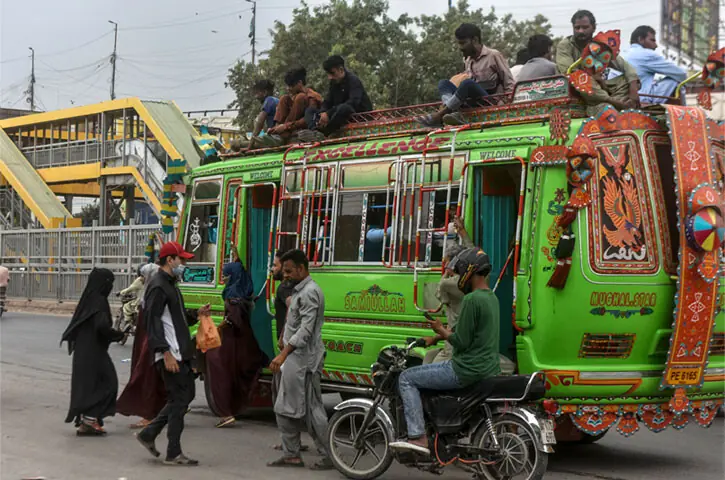
KARACHI: The first taste Iqra got of the bitter socioeconomic realities of the city was after being admitted to a government college, and it came in the form of unauthorised and unilateral hikes in bus fares carried out gradually over the past couple of months during the ongoing US-Iran conflict.
She passed her matriculation with an A1 Grade in July and secured admission to a government college in a Pakistan Navy facility on Dalmia Road.
Speaking to Dawn, Iqra said she travelled by the No. 55 bus to her college, and the fare was Rs40 for a one-way trip.
“Now it takes Rs70 for the same journey. It is a substantial increase in my transportation expenses,” she said.
“I also go to a coaching centre for extra classes in Gulshan-i-Iqbal in the evening which costs me Rs70-80 for a one-way trip. It goes around Rs150 in daily expenses, which was earlier Rs100 for a two-way trip.”
Petrol is around Rs390 per litre, and diesel is selling at Rs400 per litre. Almost all buses run on diesel in Karachi.
Mai Khairan, an elderly woman, complained about the rising cost of travel while gesturing quickly with her hands.
She said she works in homes and had to travel from her residence at Qatar Mor in Orangi Town to different areas of North Nazimabad and Nazimabad. “The travel cost of bus and Qingqi rickshaw has risen from Rs60 to Rs90.”
Grey-haired Salma works as a domestic helper in a DHA bungalow near Misri Shah Mazar.
Speaking to Dawn, she said that before the steep rise in travel charges, her daily travel expenditure was Rs150, but now it costs her Rs250.
“I am a widow, and my young son has died in an accident. My salary is Rs20,000, which I earn from the bungalow. You know, it is very hard these days. I have to do a second job to meet my expenses. That’s where I am going now, at this time in the evening. The rise in bus fares has broken my backbone.”
A couple of female students said they travel daily from Baldia Town to KDA Chowrangi in North Nazimabad to attend their university.
They also complained about the rise in bus fares, saying they each used to spend Rs60 on travel, which has now increased to Rs80. “When the petrol prices go down, they don’t cut the fare,” one of them grumbled.
Arif, who comes from Bhains Colony to Saddar through a number 16 bus, says he pays Rs150 for the fare. Earlier it was Rs100-120. “Almost a hundred rupees have been added to my daily travel cost.”
A 4-L bus passenger says some bus conductors are demanding Rs50 for Saddar from Gurumandir. “The fare was Rs40 just a few days ago. This rise is unjust.”
Another elderly man, Hamid, says that he used to come to Shaheen Complex from Baldia Town in Rs90 by a bus. “However, the fare has been raised to Rs120-130,” he said.
Almost all commuters have said that transportation expenses have risen from Rs10 up to Rs40 or even more depending on travelling distance.
The Sindh Regional Transport Authority issued an official notification on April 4, 2026, fixing bus and minibus fares at Rs40-Rs50 for up to 10 kilometres, Rs70-80 for up to 30km, and Rs110-120 for routes exceeding 31km. This rate list is still in effect, according to its website.
However, this survey shows that transport operators clearly violate this notification as they charge fares at their discretion and raised them significantly, citing the massive increase in diesel prices.
The government has not issued an official notification sanctioning the recent hike in bus fares.
Green, Red Bus fares
The commuters, however, appreciated the fact that Bus Rapid Transit (BRT) Green and Orange Lines charges and the Peoples Red Bus Service fares have not been increased.
A large number of commuters prefer these services over rickety buses due to their comfortable rides, air conditioning and low travel costs. However, they said that in recent days, a shortage of Red Buses has been witnessed.
Drivers and transporters’ woes
Shakeel, who drives a minibus between Sohrab Goth and Cantonment Railway Station, narrated his side of the ordeal.
Responding to queries, he said whatever they earn throughout the day “vanishes” at a petrol pump. He said the rise in diesel prices has severely affected them.
While driving his minibus, Shakeel said most drivers operate on the basis of daily wages or the rental system.
Before this extraordinary rise in petrol prices, he used to give his Seth Rs5,000 to Rs7,000 a day after keeping Rs2,500-3,500 for himself and Rs2,000 to Rs2,500 for his conductor.
“However, now I hardly give my conductor Rs1,000-1,200 a day, after keeping Rs2,000 for myself.”
Another bus driver of Mashallah Coach shared similar sentiments.
“This daily rise in diesel prices has destroyed us. We are left with nothing at the end of the day.”
He urged the government to do something and control this trail of destruction wreaked upon the transport sector due to skyrocketing fuel costs.
Speaking to Dawn, Karachi Transport Ittehad (KTI) President Haji Tawab Khan denied any official hike in transport fare from the KTI platform.
“No official fare hike has been made so far, but soaring diesel prices have devastated the transport industry,” he said.
He, however, admitted that some transporters might be charging an extra amount individually, but the KTI had not raised the fares so far.
Mr Tawab explained that a massive gap of around Rs150 had emerged due to escalating diesel prices, pushing the transport sector into a deep crisis. He said nearly 60 per cent of buses had gone off the roads due to high fuel costs.
“Several transporters are removing bus bodies to convert them into trucks or moving their fleets to other cities.”
He said that an official meeting of transporters would soon be convened to announce a fare hike from their office.
Published in Dawn, October 7th, 2026