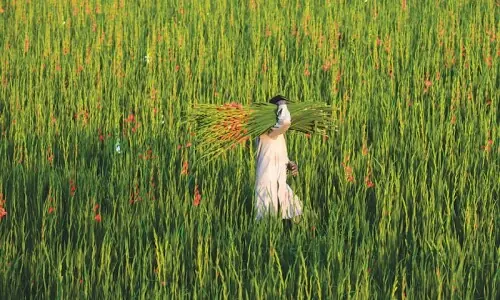
THE Kissan Board Pakistan has demanded that agriculture receive at least 10pc of the federal and provincial budgets to lower input costs and address recurring deficits.
The farmers’ body also wants support prices of Rs5,000 per 40kg for wheat and Rs700 for sugarcane, citing declining profitability. It has criticised urea shortages, high electricity bills, weak fruit sector returns, and the Pak-Afghan border closure, warning of protests if their demands are not met. Their case for enhanced budgetary allocations deserves consideration. The sector contributes about 22pc of GDP and supports nearly 60pc of the population, but receives only 2-3pc of allocations. However, money alone will not fix matters. Nor should a larger allocation become another excuse for inefficient price subsidies. Pakistan has spent decades trying to support farmers through administered prices, input subsidies and other interventions. This has distorted markets, encouraged inefficient production and benefited better-connected producers more than small farmers.
Public investment should, instead, address structural weaknesses that depress farm productivity. Water management, irrigation efficiency, farm-to-market roads, storage, research, extension services and better seed technology need sustained investment. Mechanisation must become a central priority. Shared machinery services, and affordable financing can help spread mechanisation without imposing a massive capital burden on farmers. The aim should be to lower production costs, while raising yields and quality. That requires modernisation, not perpetual protection from market forces. Farmers cannot become globally competitive if they face unpredictable trade policies, distorted input markets, poor access to finance, unreliable power and water supply, and arbitrary official intervention in crop markets. Policy must encourage farmers to respond to prices and market demand rather than to official announcements.
Pakistan also needs to look beyond the farm gate. A stronger downstream processing industry can reduce post-harvest losses, add value to farm output and create export opportunities. Better cold storage, grading, packaging, processing, and logistics are essential, and can help stabilise markets when production falls by allowing stocks to be preserved. This matters because agriculture is treated as a production problem when it is really a value-chain issue. Producing more wheat, fruit, vegetables, sugarcane or rice means little if large quantities are wasted, farmers receive poor returns, and consumers face shortages or sudden price spikes. Farmers, therefore, are right to demand greater public investment. But the test should not be the size of the allocation. It should be where the money goes and what it achieves. Agriculture needs investment, but not another round of costly interventions. It needs infrastructure, technology, mechanisation, processing, markets, and policies that make farming competitive rather than dependent on the state’s largesse.
Published in Dawn, October 6th, 2026