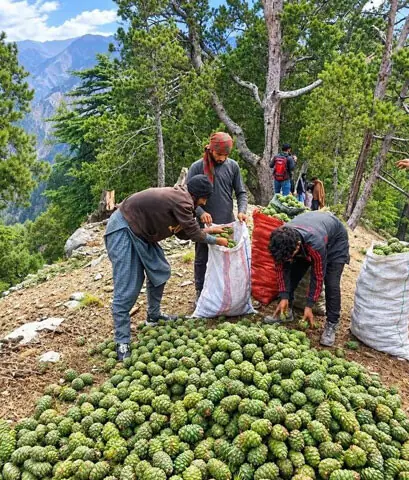
CHITRAL: Hundreds of unemployed local youth have thronged the dense, rugged forests in Chitral’s scenic valleys to harvest pine nuts (chilgoza) as the local forest department has formally opened the harvest season.
Thousands of young men from Bumburate, Birir and Rumbur as well as the remote woodland stretches of Sheshi Koh, Orghoch and Drosh have capitalised on the opportunity to earn money.
This year, the forest department implemented strict conservation measures to safeguard both the market value of the commodity and the ecological health of the trees. Authorities had imposed a ban on harvesting chilgoza cones before their natural ripening period.
The government officially opened the harvest season in the third week of September, allowing locals to harvest pine nuts before re-imposing the ban until the following year.
Activity termed crucial financial lifeline for hundreds of unemployed youngsters
Forestry experts said that timely intervention prevented the premature plucking of green cones to ensure that the harvested nuts reached their maximum size, weight and oil content.
The policy has paid off, resulting in a superior quality crop that is fetching premium prices in the regional markets. As soon as the restrictions were lifted, village folk advanced deep into their respective communal and state-managed forests to maximise their yields.
The economic pull of the pine nut harvest is so strong that it temporarily alters the demographic landscape of local villages.
Haji Manzur, a resident of Gambak village nestled within the Bumburate valley, shared that the seasonal rush has left residential areas nearly devoid of adult men.
“About 80pc of the men from our village have left for the nearby pine nut forests, leaving behind only women, the elderly and young children,” Manzur said.
Describing the rigorous routine of the collectors, he explained that the operation demands absolute dedication. “Many of them leave the village well before dawn and only return after dusk. However, the vast majority chose to camp out and stay for the entire two weeks inside the dense forest to save travel time and secure the best spots.”
Manzur emphasised that harvesting chilgoza is not a casual endeavour. It is widely considered one of the most tedious, hazardous and complicated manual jobs in the region.
“Because of the sheer height of the trees and the danger of falling, it is absolutely necessary to work in cohorts rather than individually,” he added.
For the region’s underemployed youth, the two-week harvest acts as a crucial financial lifeline in an area with sparse industrial employment.
Afzal Khan, a young resident of Orghoch village, shared his personal success story. “I wait eagerly throughout the entire year for this specific season,” Khan said. “The money I earn over these few weeks is a hefty amount that finances my personal and family needs for months to come.”
According to Khan, nature was particularly generous this season. The pine nut trees bore a significantly higher volume of cones compared to the previous year. Furthermore, the government’s strict enforcement against early plucking meant that the nuts were fully matured and high in quality.
“We formed a group of five youths and spent 12 grueling days camping in the high-altitude forest of Orghoch Dok,” Khan narrated. “Our hard work paid off. We returned to the lowlands with about 90 gunny bags filled to the brim with pine nut cones.”
The financial returns have been unprecedented. Khan revealed that this year, a single gunny bag of raw cones values anywhere from Rs16,000 to Rs20,000, depending on the size and quality of the cones. The revenue generated is subsequently divided among the group members.
Extracting the delicate, expensive pine nut grains from their tough, resinous cones is a labour-intensive process. Traders and wholesalers, who buy the raw cones directly from the youth collectors in the villages, set up large-scale processing camps. This phase engages a vast secondary army of raw and unskilled labourers.
Labourers are hired by the thousands to manually break open the cones, separate the seeds, clean them, and prepare them for final packaging. This secondary processing ensures that the financial benefits of the forest are distributed equitably across various segments of Chitral’s society.
While commercial harvest has brought joy to many valleys, a strictly hands-off approach is maintained in the region’s protected ecological zones. In the sprawling Chitral Gol National Park, which encompasses over 7,000 hectares of pristine wildlife habitat, commercial harvest is not allowed.
“The pine nut is not just a commercial commodity; it is a foundational pillar of our local ecosystem,” the official explained. “A large number of indigenous bird species including the endangered nuthatches and wild pheasants, as well as small mammals, heavily depend on these high-energy pine nuts for food, especially as the harsh winter approaches,” said an official of the national park.
The official warned that allowing harvest within the park’s boundaries would severely disrupt the delicate food chain. “If we open up the park to commercial collection, it will lead to widespread starvation among the wildlife population, dealing a devastating blow to the biodiversity we have spent decades protecting,” he said.
Published in Dawn, October 6th, 2026